AQA · A-Level · History
Course version: 7042 · Version from Sept 2017
Germany’s challenges to the Treaty of Versailles: the aims and actions of…
Full specification wording
2K International Relations and Global Conflict, c1890–1941 (A-level only) – The coming of war, 1935–1941: Germany’s challenges to the Treaty of Versailles: the aims and actions of Hitler
Hitler’s foreign policy was driven by his aim to dismantle the Treaty of Versailles, which he viewed as a national humiliation.
Checked against the AQA 7042 specification (opens in a new tab) on .
- Point 1 of 4
Study notes
From the checked teaching notes for this specification point.
The idea
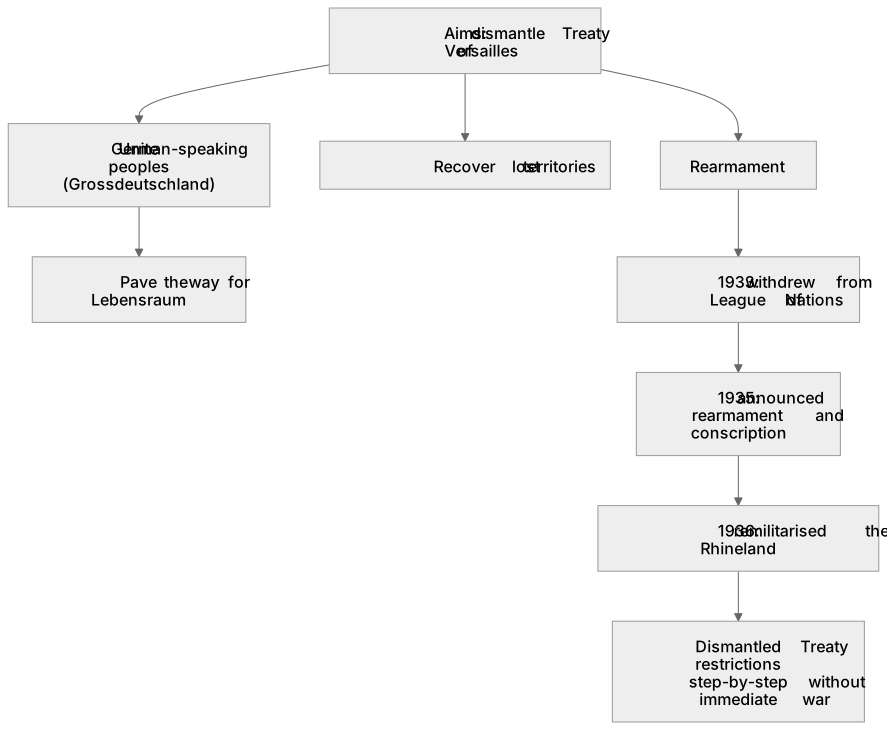
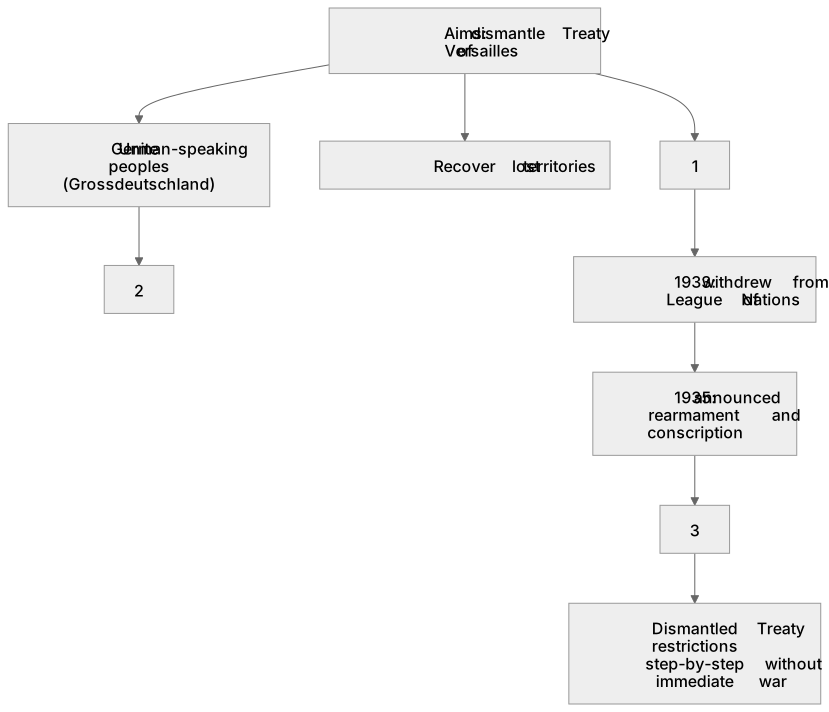
Hitler’s foreign policy was driven by his aim to dismantle the Treaty of Versailles, which he viewed as a national humiliation. His primary objectives included rearmament, recovering lost territories, and uniting all German-speaking peoples (Grossdeutschland) to pave the way for Lebensraum. To achieve these aims, Hitler took decisive actions challenging the Treaty. He withdrew from the League of Nations in 1933, announced rearmament and conscription in 1935, and remilitarised the Rhineland in 1936. These calculated actions exploited British and French reluctance to enforce the Treaty, successfully dismantling its military and territorial restrictions step-by-step without triggering immediate war.
What earns the marks
- Identify Hitler's core aims: overturning Versailles, uniting ethnic Germans, and securing Lebensraum in the East.
- Explain the significance of the 1935 announcement of rearmament and conscription as a direct violation of Versailles military clauses.
- Analyse the 1936 remilitarisation of the Rhineland as a critical test of Anglo-French resolve to uphold the Treaty.
- Evaluate how Hitler used bilateral agreements, such as the 1935 Anglo-German Naval Agreement, to undermine the multilateral Versailles settlement.
Common mistakes and how to put them right
Claiming Hitler's only foreign policy aim was to start a world war.
Put it right: Recognise that his initial aims focused on revising Versailles and expanding German territory, often hoping to achieve this without a general European war.
Confusing the remilitarisation of the Rhineland with the annexation of the Sudetenland.
Put it right: Ensure the Rhineland (1936) is identified as a challenge to Versailles demilitarisation, whereas the Sudetenland (1938) relates to territorial expansion.
Stating that the Allies took military action against Hitler's early breaches of Versailles.
Put it right: Note that the Allies relied on diplomatic protests and appeasement rather than military enforcement during this period.
Exam tips
- Link specific actions, such as the reintroduction of conscription, directly to the specific clauses of the Treaty of Versailles they violated.
- Assess the extent to which Hitler's actions were pre-planned steps towards war versus opportunistic gambles exploiting Allied weakness.
- Use the Anglo-German Naval Agreement as evidence of how Hitler successfully divided the Stresa Front and weakened the Versailles consensus.
Try the lesson
The start of the 2K International Relations and Global Conflict, c1890–1941 (A-level only) – The coming of war, 1935–1941: Germany’s challenges to the Treaty of Versailles: the aims and actions of Hitler lesson, made from checked teaching notes for this specification point.
Have a go first
Which of the following actions taken by Hitler in 1935 directly violated the military restrictions imposed on Germany by the Treaty of Versailles?
Listen
Hitler’s foreign policy was driven by his aim to dismantle the Treaty of Versailles, which he viewed as a national humiliation. His primary objectives included rearmament, recovering lost territories, and uniting all German-speaking peoples (Grossdeutschland) to pave the way for Lebensraum. To achieve these aims, Hitler took decisive actions challenging the Treaty. He withdrew from the League of Nations in 1933, announced rearmament and conscription in 1935, and remilitarised the Rhineland in 1936. These calculated actions exploited British and French reluctance to enforce the Treaty, successfully dismantling its military and territorial restrictions step-by-step without triggering immediate war. A strong answer earns marks for these points. Identify Hitler's core aims: overturning Versailles, uniting ethnic Germans, and securing Lebensraum in the East. Explain the significance of the 1935 announcement of rearmament and conscription as a direct violation of Versailles military clauses. Analyse the 1936 remilitarisation of the Rhineland as a critical test of Anglo-French resolve to uphold the Treaty. Evaluate how Hitler used bilateral agreements, such as the 1935 Anglo-German Naval Agreement, to undermine the multilateral Versailles settlement. A common slip: Claiming Hitler's only foreign policy aim was to start a world war. Instead, Recognise that his initial aims focused on revising Versailles and expanding German territory, often hoping to achieve this without a general European war. Exam tip: Link specific actions, such as the reintroduction of conscription, directly to the specific clauses of the Treaty of Versailles they violated.
See it
Put the events in order
Put these events in the order they happened, earliest first.
- 1. Hitler withdrew from the League of Nations
- 2. Hitler remilitarised the Rhineland
- 3. Hitler announced rearmament and conscription
Label the diagram
Some boxes have lost their names. Pick the right name for each number.
1Box 1
2Box 2
3Box 3
There is more to this lesson
The full lesson goes on to check your understanding and help you earn the marks. Create a free account to carry on, with your progress saved.
A week of Premium from your first lesson · Then the free plan continues · No card, no charge
Test your understanding of 2K International Relations and Global Conflict, c1890–1941 (A-level only) – The coming of war, 1935–1941: Germany’s challenges to the Treaty of Versailles: the aims and actions of Hitler
Active recall beats re-reading. Take an instant quiz now to test what you’ve learned and lock it into long-term memory.
A week of Premium from your first lesson · Then the free plan continues · No card, no charge