AQA · A-Level · History
Course version: 7042 · Version from Sept 2017
The international response to German, Italian and Japanese aggression: the…
Full specification wording
2K International Relations and Global Conflict, c1890–1941 (A-level only) – The coming of war, 1935–1941: The international response to German, Italian and Japanese aggression: the Rhineland Crisis; the Anschluss; the Spanish Civil War; Italy and Albania; war in China; alliances amongst the aggressors
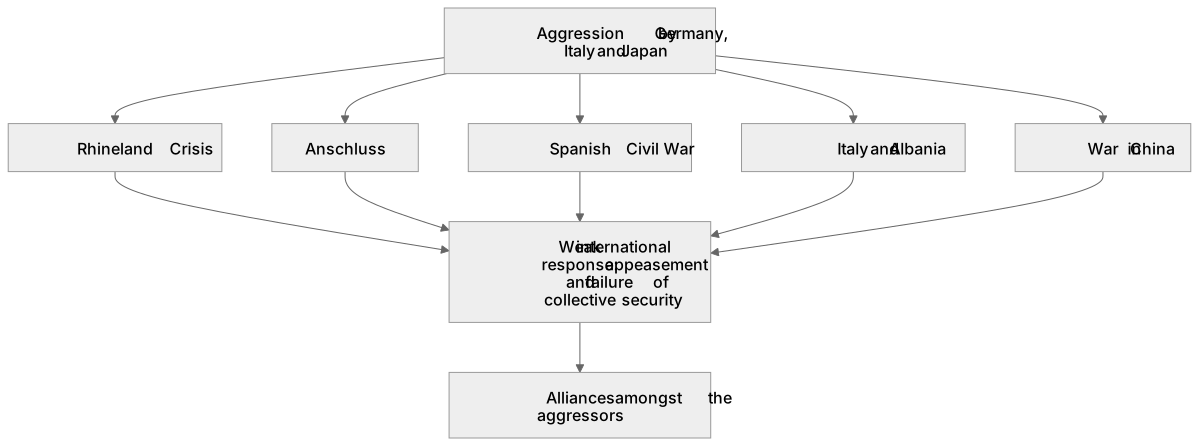
The international response to Axis aggression was characterised by appeasement and the failure of collective security.
Checked against the AQA 7042 specification (opens in a new tab) on .
- Point 2 of 4
- 4 key terms
Study notes
From the checked teaching notes for this specification point.
The idea
The international response to Axis aggression was characterised by appeasement and the failure of collective security. During the Rhineland Crisis (1936) and the Anschluss (1938), Britain and France offered only diplomatic protests, emboldening German expansion. In the Spanish Civil War, Western democracies pursued non-intervention, while Germany and Italy actively supported Franco. The League of Nations similarly failed to counter the Japanese war in China or Italy's 1939 invasion of Albania. This weak international response facilitated alliances amongst the aggressors, notably the Anti-Comintern Pact and the Pact of Steel, consolidating a formidable Axis bloc against the divided democracies.
What earns the marks
- Assess the reasons for British and French inaction during the Rhineland Crisis and the Anschluss, focusing on appeasement and military unpreparedness.
- Evaluate the impact of the Non-Intervention Committee during the Spanish Civil War on the balance of power in Europe.
- Analyse the failure of the League of Nations to provide a robust international response to the Japanese war in China and the Italian invasion of Albania.
- Explain how the lack of unified opposition encouraged the formation of alliances amongst the aggressors, such as the Rome-Berlin Axis and the Pact of Steel.
Common mistakes and how to put them right
Assuming the international community took no action at all in response to aggression.
Put it right: Specify that responses existed, such as diplomatic protests or the Non-Intervention Committee, but they lacked military or economic enforcement.
Treating the aggressor nations as a fully unified alliance from the early 1930s.
Put it right: Trace the gradual development of alliances amongst the aggressors, noting that the Pact of Steel was not signed until 1939.
Confusing Italy's invasion of Abyssinia with the invasion of Albania.
Put it right: Ensure Albania is placed in its correct 1939 context as a precursor to wider European conflict, distinct from the earlier Abyssinian crisis.
Exam tips
- Compare the international responses to different crises to evaluate whether appeasement was a consistent policy or a reaction to specific circumstances.
- Discuss how the Spanish Civil War served as a testing ground for German and Italian military tactics, highlighting the failure of the non-intervention policy.
- Link the formation of alliances amongst the aggressors directly to the perceived weakness of the League of Nations and Western democracies.
Try the lesson
The start of the 2K International Relations and Global Conflict, c1890–1941 (A-level only) – The coming of war, 1935–1941: The international response to German, Italian and Japanese aggression: the Rhineland Crisis; the Anschluss; the Spanish Civil War; Italy and Albania; war in China; alliances amongst the aggressors lesson, made from checked teaching notes for this specification point.
Have a go first
How did Britain and France primarily respond to the outbreak of the Spanish Civil War in 1936?
Listen
The international response to Axis aggression was characterised by appeasement and the failure of collective security. During the Rhineland Crisis (1936) and the Anschluss (1938), Britain and France offered only diplomatic protests, emboldening German expansion. In the Spanish Civil War, Western democracies pursued non-intervention, while Germany and Italy actively supported Franco. The League of Nations similarly failed to counter the Japanese war in China or Italy's 1939 invasion of Albania. This weak international response facilitated alliances amongst the aggressors, notably the Anti-Comintern Pact and the Pact of Steel, consolidating a formidable Axis bloc against the divided democracies. A strong answer earns marks for these points. Assess the reasons for British and French inaction during the Rhineland Crisis and the Anschluss, focusing on appeasement and military unpreparedness. Evaluate the impact of the Non-Intervention Committee during the Spanish Civil War on the balance of power in Europe. Analyse the failure of the League of Nations to provide a robust international response to the Japanese war in China and the Italian invasion of Albania. Explain how the lack of unified opposition encouraged the formation of alliances amongst the aggressors, such as the Rome-Berlin Axis and the Pact of Steel. A common slip: Assuming the international community took no action at all in response to aggression. Instead, Specify that responses existed, such as diplomatic protests or the Non-Intervention Committee, but they lacked military or economic enforcement. Exam tip: Compare the international responses to different crises to evaluate whether appeasement was a consistent policy or a reaction to specific circumstances.
See it
Put the events in order
Put these events in the order they happened, earliest first.
- 1. Rhineland Crisis met with diplomatic protests from Britain and France
- 2. Italy invades Albania
- 3. Anschluss met with diplomatic protests from Britain and France
Key words
Say what each word means before you turn the card.
Appeasement
Try answering aloud or in your head before turning the card.
Collective Security
Try answering aloud or in your head before turning the card.
Aggression
Try answering aloud or in your head before turning the card.
Alliances
Try answering aloud or in your head before turning the card.
See every definition
- Appeasement
- A response to aggression in which Britain and France offered only diplomatic protests, as during the Rhineland Crisis and the Anschluss.
- Collective Security
- An international response whose failure characterised the reaction to Axis aggression, as the League of Nations failed to counter the Japanese war in China or Italy's invasion of Albania.
- Aggression
- The actions of Germany, Italy and Japan to which the international response was characterised by appeasement and the failure of collective security.
- Alliances
- Arrangements amongst the aggressors, notably the Anti-Comintern Pact and the Pact of Steel, facilitated by the weak international response.
Label the diagram
Some boxes have lost their names. Pick the right name for each number.
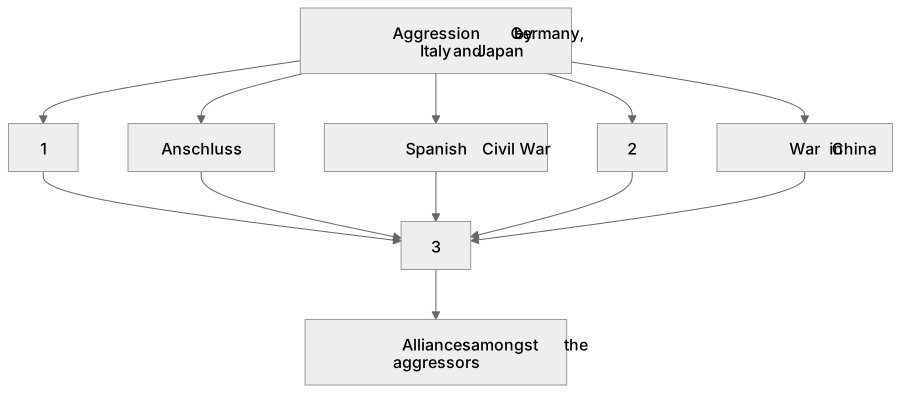
1Box 1
2Box 2
3Box 3
There is more to this lesson
The full lesson goes on to check your understanding and help you earn the marks. Create a free account to carry on, with your progress saved.
A week of Premium from your first lesson · Then the free plan continues · No card, no charge
Test your understanding of 2K International Relations and Global Conflict, c1890–1941 (A-level only) – The coming of war, 1935–1941: The international response to German, Italian and Japanese aggression: the Rhineland Crisis; the Anschluss; the Spanish Civil War; Italy and Albania; war in China; alliances amongst the aggressors
Active recall beats re-reading. Take an instant quiz now to test what you’ve learned and lock it into long-term memory.
A week of Premium from your first lesson · Then the free plan continues · No card, no charge