AQA · A-Level · History
Course version: 7042 · Version from Sept 2017
Evolving alliances: the Moroccan crises; Anglo-French Entente; the…
Full specification wording
2K International Relations and Global Conflict, c1890–1941 (A-level only) – The Great Powers and Crises, 1900–1911: Evolving alliances: the Moroccan crises; Anglo-French Entente; the formation of the Triple Entente
The evolution of European alliances fundamentally shifted the balance of power.
Checked against the AQA 7042 specification (opens in a new tab) on .
- Point 2 of 4
Study notes
From the checked teaching notes for this specification point.
The idea
The evolution of European alliances fundamentally shifted the balance of power. The 1904 Anglo-French Entente resolved colonial disputes, ending Britain's 'splendid isolation'. Germany attempted to test and break this new friendship during the First Moroccan Crisis (1905), but the Algeciras Conference only strengthened Anglo-French ties. The 1907 Anglo-Russian Convention subsequently resolved Asian colonial rivalries, completing the formation of the Triple Entente. Germany's aggressive gunboat diplomacy during the Second Moroccan Crisis (1911) at Agadir further solidified this bloc. Instead of dividing its rivals, Germany's actions convinced Britain, France, and Russia that they needed closer military and diplomatic cooperation.
What earns the marks
- Explain the origins of the Anglo-French Entente as a colonial settlement rather than a formal military alliance.
- Analyse how Germany's actions in the First Moroccan Crisis backfired, leading to closer military conversations between Britain and France.
- Evaluate the significance of the 1907 Anglo-Russian agreement in forming the Triple Entente and completing the diplomatic encirclement of Germany.
- Assess the impact of the 1911 Agadir Crisis on solidifying the Triple Entente and increasing British commitment to French security.
Common mistakes and how to put them right
Describing the Anglo-French Entente as a formal military alliance.
Put it right: It was initially a colonial agreement that only later developed military dimensions due to German pressure.
Confusing the outcomes of the two Moroccan Crises.
Put it right: The first led to the Algeciras Conference, while the second (Agadir) resulted in a territorial compromise in Africa but deeper Anglo-French naval cooperation.
Assuming the Triple Entente was a single treaty.
Put it right: It was a web of three separate agreements (Franco-Russian, Anglo-French, Anglo-Russian) that aligned the three powers.
Exam tips
- Emphasise how German attempts to break the Anglo-French Entente during the Moroccan crises actually achieved the opposite result.
- Trace the shift in British foreign policy from 'splendid isolation' to active alignment with France and Russia.
- Use the term 'encirclement' to explain German fears regarding the formation of the Triple Entente.
Try the lesson
The start of the 2K International Relations and Global Conflict, c1890–1941 (A-level only) – The Great Powers and Crises, 1900–1911: Evolving alliances: the Moroccan crises; Anglo-French Entente; the formation of the Triple Entente lesson, made from checked teaching notes for this specification point.
Have a go first
What was the primary purpose of the Anglo-French Entente (Entente Cordiale) when it was signed in 1904?
Listen
The evolution of European alliances fundamentally shifted the balance of power. The 1904 Anglo-French Entente resolved colonial disputes, ending Britain's 'splendid isolation'. Germany attempted to test and break this new friendship during the First Moroccan Crisis (1905), but the Algeciras Conference only strengthened Anglo-French ties. The 1907 Anglo-Russian Convention subsequently resolved Asian colonial rivalries, completing the formation of the Triple Entente. Germany's aggressive gunboat diplomacy during the Second Moroccan Crisis (1911) at Agadir further solidified this bloc. Instead of dividing its rivals, Germany's actions convinced Britain, France, and Russia that they needed closer military and diplomatic cooperation. A strong answer earns marks for these points. Explain the origins of the Anglo-French Entente as a colonial settlement rather than a formal military alliance. Analyse how Germany's actions in the First Moroccan Crisis backfired, leading to closer military conversations between Britain and France. Evaluate the significance of the 1907 Anglo-Russian agreement in forming the Triple Entente and completing the diplomatic encirclement of Germany. Assess the impact of the 1911 Agadir Crisis on solidifying the Triple Entente and increasing British commitment to French security. Exam tip: Emphasise how German attempts to break the Anglo-French Entente during the Moroccan crises actually achieved the opposite result.
See it
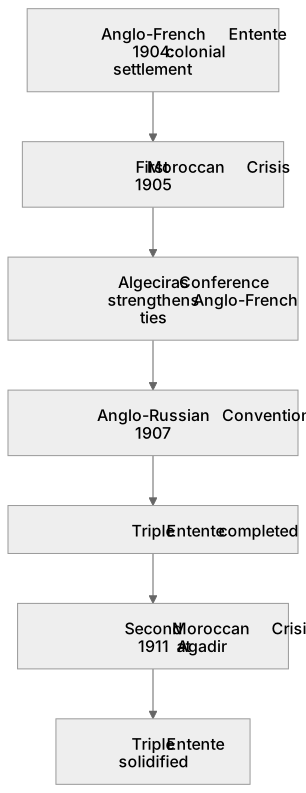
Put it in order
Put these steps in the order they happen.
- 1. Triple Entente solidified
- 2. Second Moroccan Crisis 1911 at Agadir
- 3. Algeciras Conference strengthens Anglo-French ties
- 4. Triple Entente completed
- 5. Anglo-French Entente 1904: colonial settlement
- 6. First Moroccan Crisis 1905
- 7. Anglo-Russian Convention 1907
Put the events in order
Put these events in the order they happened, earliest first.
- 1. Second Moroccan Crisis at Agadir
- 2. Anglo-French Entente resolved colonial disputes
- 3. Anglo-Russian Convention completed the Triple Entente
- 4. First Moroccan Crisis tested Anglo-French friendship
Label the diagram
Some boxes have lost their names. Pick the right name for each number.
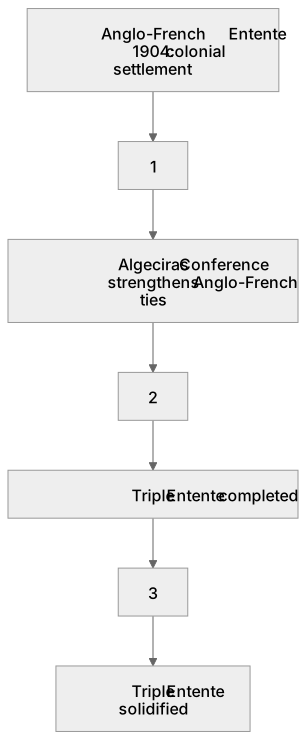
1Box 1
2Box 2
3Box 3
There is more to this lesson
The full lesson goes on to check your understanding and help you earn the marks. Create a free account to carry on, with your progress saved.
A week of Premium from your first lesson · Then the free plan continues · No card, no charge
Test your understanding of 2K International Relations and Global Conflict, c1890–1941 (A-level only) – The Great Powers and Crises, 1900–1911: Evolving alliances: the Moroccan crises; Anglo-French Entente; the formation of the Triple Entente
Active recall beats re-reading. Take an instant quiz now to test what you’ve learned and lock it into long-term memory.
A week of Premium from your first lesson · Then the free plan continues · No card, no charge