AQA · A-Level · History
Course version: 7042 · Version from Sept 2017
Forces of instability: Balkan nationalism and its significance for…
Full specification wording
2K International Relations and Global Conflict, c1890–1941 (A-level only) – The Great Powers and Crises, 1900–1911: Forces of instability: Balkan nationalism and its significance for Austria-Hungary and Russia; militarism and the position of the German army in the Second Reich; the arms and naval races; military plans
Balkan nationalism severely destabilised Europe, threatening Austria-Hungary’s multi-ethnic empire with fragmentation while offering Russia opportunities to expand its influence through Pan-Slavism.
Checked against the AQA 7042 specification (opens in a new tab) on .
- Point 1 of 4
- 4 key terms
Study notes
From the checked teaching notes for this specification point.
The idea
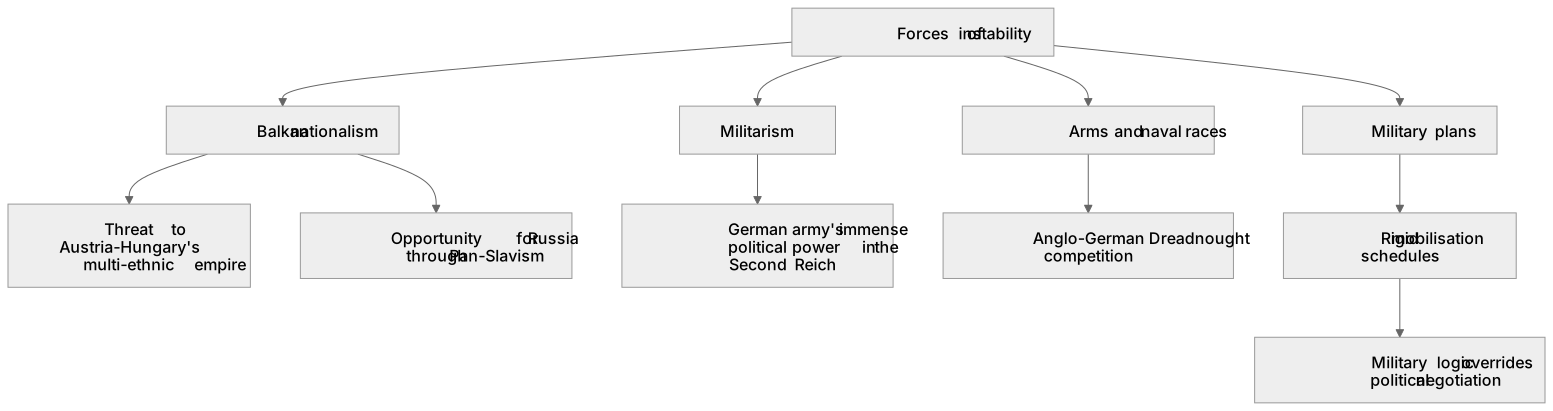
Balkan nationalism severely destabilised Europe, threatening Austria-Hungary’s multi-ethnic empire with fragmentation while offering Russia opportunities to expand its influence through Pan-Slavism. Concurrently, militarism permeated the Second Reich, where the German army held immense political power, largely unaccountable to the Reichstag. This culture fuelled intense arms and naval races, notably the Anglo-German competition over Dreadnought construction, which heightened mutual suspicions. Furthermore, rigid military plans, such as Germany's Schlieffen Plan and France's Plan XVII, created a dangerous inflexibility. These mobilisation schedules meant that once a crisis escalated, military logic often overrode political negotiation.
What earns the marks
- Explain how Balkan nationalism threatened the territorial integrity of Austria-Hungary while aligning with Russia's strategic goal of supporting Slavic states.
- Assess the political dominance of the German army within the Second Reich and its influence on foreign policy decision-making.
- Analyse the impact of the Anglo-German naval race on diplomatic relations, specifically how it pushed Britain away from 'splendid isolation'.
- Evaluate how rigid military timetables, such as the Schlieffen Plan, restricted diplomatic options during crises by demanding rapid mobilisation.
Common mistakes and how to put them right
Confusing the arms race with the naval race.
Put it right: The naval race was primarily Anglo-German, whereas the arms race involved expanding land armies across all major continental powers.
Assuming the Schlieffen Plan was a purely defensive strategy.
Put it right: It was an aggressive preemptive strike designed to defeat France before turning to Russia.
Stating that Russia controlled Balkan nationalism.
Put it right: Russia supported Pan-Slavism to gain influence, but Balkan states like Serbia acted independently to achieve their own nationalist goals.
Exam tips
- Link the position of the German army directly to the failure of civilian politicians to control foreign policy during the July Crisis.
- Use specific examples, such as the launch of HMS Dreadnought in 1906, to illustrate the scale and intensity of the naval race.
- When discussing military plans, emphasise the concept of 'mobilisation meaning war' to explain why the crisis escalated so rapidly.
Try the lesson
The start of the 2K International Relations and Global Conflict, c1890–1941 (A-level only) – The Great Powers and Crises, 1900–1911: Forces of instability: Balkan nationalism and its significance for Austria-Hungary and Russia; militarism and the position of the German army in the Second Reich; the arms and naval races; military plans lesson, made from checked teaching notes for this specification point.
Have a go first
What was the primary focus of the Anglo-German naval race in the early twentieth century?
Listen
Balkan nationalism severely destabilised Europe, threatening Austria-Hungary’s multi-ethnic empire with fragmentation while offering Russia opportunities to expand its influence through Pan-Slavism. Concurrently, militarism permeated the Second Reich, where the German army held immense political power, largely unaccountable to the Reichstag. This culture fuelled intense arms and naval races, notably the Anglo-German competition over Dreadnought construction, which heightened mutual suspicions. Furthermore, rigid military plans, such as Germany's Schlieffen Plan and France's Plan XVII, created a dangerous inflexibility. These mobilisation schedules meant that once a crisis escalated, military logic often overrode political negotiation. A strong answer earns marks for these points. Explain how Balkan nationalism threatened the territorial integrity of Austria-Hungary while aligning with Russia's strategic goal of supporting Slavic states. Assess the political dominance of the German army within the Second Reich and its influence on foreign policy decision-making. Analyse the impact of the Anglo-German naval race on diplomatic relations, specifically how it pushed Britain away from 'splendid isolation'. Evaluate how rigid military timetables, such as the Schlieffen Plan, restricted diplomatic options during crises by demanding rapid mobilisation. Exam tip: Link the position of the German army directly to the failure of civilian politicians to control foreign policy during the July Crisis.
See it
Key words
Say what each word means before you turn the card.
Militarism
Try answering aloud or in your head before turning the card.
Balkan nationalism
Try answering aloud or in your head before turning the card.
Arms and naval races
Try answering aloud or in your head before turning the card.
Military plans
Try answering aloud or in your head before turning the card.
See every definition
- Militarism
- A culture that permeated the Second Reich, where the German army held immense political power, largely unaccountable to the Reichstag.
- Balkan nationalism
- A force that severely destabilised Europe, threatening Austria-Hungary's multi-ethnic empire with fragmentation while offering Russia opportunities to expand its influence through Pan-Slavism.
- Arms and naval races
- Intense competitions, notably the Anglo-German competition over Dreadnought construction, which heightened mutual suspicions.
- Military plans
- Rigid mobilisation schedules, such as Germany's Schlieffen Plan and France's Plan XVII, that created a dangerous inflexibility and meant military logic often overrode political negotiation.
Label the diagram
Some boxes have lost their names. Pick the right name for each number.
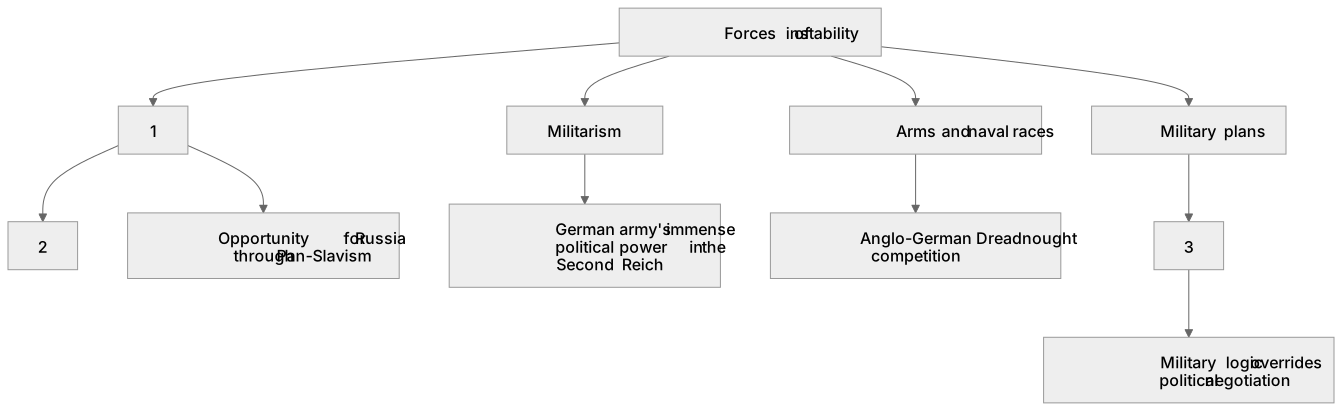
1Box 1
2Box 2
3Box 3
There is more to this lesson
The full lesson goes on to check your understanding and help you earn the marks. Create a free account to carry on, with your progress saved.
A week of Premium from your first lesson · Then the free plan continues · No card, no charge
Test your understanding of 2K International Relations and Global Conflict, c1890–1941 (A-level only) – The Great Powers and Crises, 1900–1911: Forces of instability: Balkan nationalism and its significance for Austria-Hungary and Russia; militarism and the position of the German army in the Second Reich; the arms and naval races; military plans
Active recall beats re-reading. Take an instant quiz now to test what you’ve learned and lock it into long-term memory.
A week of Premium from your first lesson · Then the free plan continues · No card, no charge