AQA · A-Level · History
Course version: 7042 · Version from Sept 2017
Italian foreign policies: the Triple Alliance; colonial ambitions in…
Full specification wording
2L Italy and Fascism, c1900–1945 – 1926 The Crisis of Liberal Italy, c1900–1915: Italian foreign policies: the Triple Alliance; colonial ambitions in Abyssinia and Libya; Italy’s decision to enter the war in 1915
Liberal Italy's foreign policy sought 'Great Power' status but often revealed underlying weaknesses.
Checked against the AQA 7042 specification (opens in a new tab) on .
- Point 4 of 4
- 4 key terms
Study notes
From the checked teaching notes for this specification point.
The idea
Liberal Italy's foreign policy sought 'Great Power' status but often revealed underlying weaknesses. Despite joining the Triple Alliance with Germany and Austria-Hungary in 1882, Italy's relationship with Austria remained strained over unredeemed lands (terre irredente). Colonial ambitions yielded mixed results: the disastrous defeat at Adowa in Abyssinia (1896) humiliated the nation, whereas the invasion of Libya (1911) succeeded but strengthened domestic nationalism. When the First World War began, Italy initially declared neutrality. However, lured by the secret Treaty of London (1915), which promised significant territorial gains, Italy abandoned the Triple Alliance and entered the war on the side of the Entente.
What earns the marks
- Analyse the strategic reasons for Italy joining the Triple Alliance and the inherent tensions regarding Austrian-held Italian territories.
- Evaluate the domestic and international impact of the 1896 defeat at Adowa in Abyssinia on Italy's great power ambitions.
- Assess the motivations for the 1911 Libyan War and its role in destabilising Giolitti's domestic political balance by emboldening nationalists.
- Explain the diplomatic manoeuvring and domestic pressures (the interventionist crisis) that led to the signing of the Treaty of London and entry into the First World War in 1915.
Common mistakes and how to put them right
Stating Italy fought alongside the Triple Alliance in 1915.
Put it right: Clarify that Italy declared neutrality in 1914 and joined the Entente against Austria-Hungary in 1915.
Confusing the outcomes of the Abyssinian and Libyan campaigns.
Put it right: Abyssinia (1896) was a humiliating defeat, while Libya (1911-12) was a military victory but politically destabilising.
Assuming the decision to enter the First World War was universally popular.
Put it right: Highlight that the majority of parliament and the public opposed intervention, which was pushed through by the King, Salandra, and vocal nationalists.
Exam tips
- Connect foreign policy to domestic politics, demonstrating how the Libyan War emboldened nationalists and alienated socialists, fatally undermining Giolitti.
- Use the concept of 'terre irredente' (unredeemed lands) to explain why the Triple Alliance was fundamentally flawed and unpopular for Italy.
- When discussing 1915, evaluate the relative importance of diplomatic promises in the Treaty of London versus domestic nationalist pressure in forcing intervention.
Try the lesson
The start of the 2L Italy and Fascism, c1900–1945 – 1926 The Crisis of Liberal Italy, c1900–1915: Italian foreign policies: the Triple Alliance; colonial ambitions in Abyssinia and Libya; Italy’s decision to enter the war in 1915 lesson, made from checked teaching notes for this specification point.
Have a go first
Which two European powers were allied with Italy in the Triple Alliance, originally formed in 1882 and renewed in the early 20th century?
Listen
Liberal Italy's foreign policy sought 'Great Power' status but often revealed underlying weaknesses. Despite joining the Triple Alliance with Germany and Austria-Hungary in 1882, Italy's relationship with Austria remained strained over unredeemed lands (terre irredente). Colonial ambitions yielded mixed results: the disastrous defeat at Adowa in Abyssinia (1896) humiliated the nation, whereas the invasion of Libya (1911) succeeded but strengthened domestic nationalism. When the First World War began, Italy initially declared neutrality. However, lured by the secret Treaty of London (1915), which promised significant territorial gains, Italy abandoned the Triple Alliance and entered the war on the side of the Entente. A strong answer earns marks for these points. Analyse the strategic reasons for Italy joining the Triple Alliance and the inherent tensions regarding Austrian-held Italian territories. Evaluate the domestic and international impact of the 1896 defeat at Adowa in Abyssinia on Italy's great power ambitions. Assess the motivations for the 1911 Libyan War and its role in destabilising Giolitti's domestic political balance by emboldening nationalists. Explain the diplomatic manoeuvring and domestic pressures (the interventionist crisis) that led to the signing of the Treaty of London and entry into the First World War in 1915. A common slip: Stating Italy fought alongside the Triple Alliance in 1915. Instead, clarify that Italy declared neutrality in 1914 and joined the Entente against Austria-Hungary in 1915. Exam tip: Connect foreign policy to domestic politics, demonstrating how the Libyan War emboldened nationalists and alienated socialists, fatally undermining Giolitti.
See it
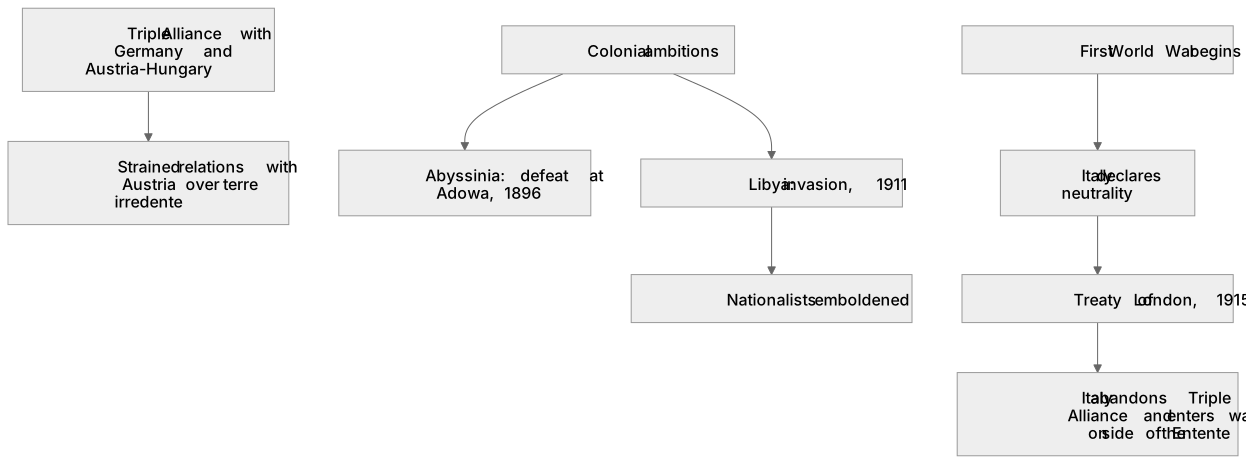
Put the events in order
Put these events in the order they happened, earliest first.
- 1. Italy entered the war on the side of the Entente
- 2. Italy joined the Triple Alliance with Germany and Austria-Hungary
- 3. Invasion of Libya succeeded but strengthened domestic nationalism
- 4. Disastrous defeat at Adowa in Abyssinia humiliated the nation
Key words
Say what each word means before you turn the card.
Triple Alliance
Try answering aloud or in your head before turning the card.
terre irredente
Try answering aloud or in your head before turning the card.
Treaty of London
Try answering aloud or in your head before turning the card.
interventionist crisis
Try answering aloud or in your head before turning the card.
See every definition
- Triple Alliance
- The alliance with Germany and Austria-Hungary that Italy joined in 1882, though its relationship with Austria remained strained over unredeemed lands.
- terre irredente
- Unredeemed lands held by Austria that strained Italy's relationship with Austria within the Triple Alliance.
- Treaty of London
- The secret treaty of 1915 that promised significant territorial gains and lured Italy to abandon the Triple Alliance and enter the war on the side of the Entente.
- interventionist crisis
- The domestic pressures that, together with diplomatic manoeuvring, led to the signing of the Treaty of London and entry into the First World War in 1915.
Label the diagram
Some boxes have lost their names. Pick the right name for each number.
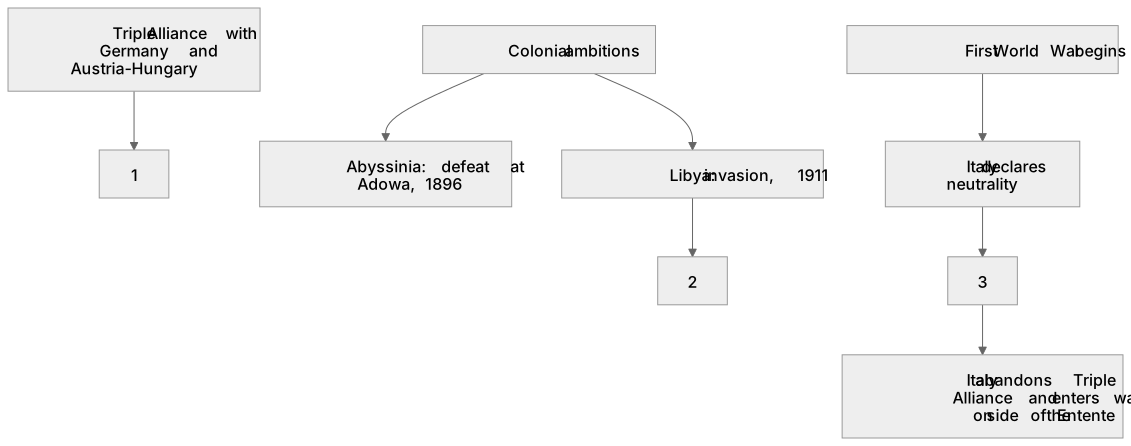
1Box 1
2Box 2
3Box 3
There is more to this lesson
The full lesson goes on to check your understanding and help you earn the marks. Create a free account to carry on, with your progress saved.
A week of Premium from your first lesson · Then the free plan continues · No card, no charge
Test your understanding of 2L Italy and Fascism, c1900–1945 – 1926 The Crisis of Liberal Italy, c1900–1915: Italian foreign policies: the Triple Alliance; colonial ambitions in Abyssinia and Libya; Italy’s decision to enter the war in 1915
Active recall beats re-reading. Take an instant quiz now to test what you’ve learned and lock it into long-term memory.
A week of Premium from your first lesson · Then the free plan continues · No card, no charge