AQA · A-Level · History
Course version: 7042 · Version from Sept 2017
Challenges to the ruling elites: industrialisation and social change; the…
Full specification wording
2L Italy and Fascism, c1900–1945 – 1926 The Crisis of Liberal Italy, c1900–1915: Challenges to the ruling elites: industrialisation and social change; the rise of socialism and new political movements
Early 20th-century Italy experienced rapid industrialisation, particularly in the northern 'industrial triangle' of Milan, Turin, and Genoa.
Checked against the AQA 7042 specification (opens in a new tab) on .
- Point 3 of 4
Study notes
From the checked teaching notes for this specification point.
The idea
Early 20th-century Italy experienced rapid industrialisation, particularly in the northern 'industrial triangle' of Milan, Turin, and Genoa. This economic shift drove profound social change, including mass urbanisation and the emergence of a large industrial working class, which challenged the traditional, land-owning ruling elites. In response to poor working conditions and political marginalisation, socialism grew rapidly, culminating in the formation of the Italian Socialist Party (PSI) in 1892. Simultaneously, other new political movements emerged to challenge the liberal state, including aggressive nationalism and political Catholicism, forcing liberal politicians like Giolitti to attempt difficult balancing acts to maintain control.
What earns the marks
- Explain the geographic concentration of industrialisation in the North and its exacerbation of the North-South economic divide.
- Analyse how rapid urbanisation and poor living conditions fuelled the growth of the industrial working class and militant trade unionism.
- Evaluate the rise of the Italian Socialist Party (PSI) and its internal divisions between reformists led by Turati and revolutionary maximalists.
- Assess the emergence of new political movements, such as the Italian Nationalist Association (ANI), and their specific ideological challenges to the liberal ruling elite.
Common mistakes and how to put them right
Assuming industrialisation affected all of Italy equally.
Put it right: Emphasise that it was heavily concentrated in the northern 'industrial triangle', widening the North-South divide.
Treating the socialist movement as entirely unified.
Put it right: Distinguish between the reformist wing willing to work with Giolitti and the revolutionary maximalist wing.
Ignoring non-socialist political movements.
Put it right: Ensure you also discuss the rise of nationalism and political Catholicism as distinct challenges to the liberal elites.
Exam tips
- Use specific examples, such as the growth of Fiat in Turin or Pirelli in Milan, to illustrate the scale and nature of industrialisation.
- Link social changes directly to political consequences, showing how urbanisation created a receptive audience for socialist and syndicalist agitators.
- When evaluating Giolitti's system of transformismo, assess how the rise of mass political movements made this system of elite political management increasingly unworkable.
Try the lesson
The start of the 2L Italy and Fascism, c1900–1945 – 1926 The Crisis of Liberal Italy, c1900–1915: Challenges to the ruling elites: industrialisation and social change; the rise of socialism and new political movements lesson, made from checked teaching notes for this specification point.
Have a go first
Which political movement emerged as a significant mass challenge to the Liberal ruling elite in Italy during the early 20th century, drawing support from the growing industrial working class?
Listen
Early 20th-century Italy experienced rapid industrialisation, particularly in the northern 'industrial triangle' of Milan, Turin, and Genoa. This economic shift drove profound social change, including mass urbanisation and the emergence of a large industrial working class, which challenged the traditional, land-owning ruling elites. In response to poor working conditions and political marginalisation, socialism grew rapidly, culminating in the formation of the Italian Socialist Party (PSI) in 1892. Simultaneously, other new political movements emerged to challenge the liberal state, including aggressive nationalism and political Catholicism, forcing liberal politicians like Giolitti to attempt difficult balancing acts to maintain control. A strong answer earns marks for these points. Explain the geographic concentration of industrialisation in the North and its exacerbation of the North-South economic divide. Analyse how rapid urbanisation and poor living conditions fuelled the growth of the industrial working class and militant trade unionism. Evaluate the rise of the Italian Socialist Party (PSI) and its internal divisions between reformists led by Turati and revolutionary maximalists. Assess the emergence of new political movements, such as the Italian Nationalist Association (ANI), and their specific ideological challenges to the liberal ruling elite. A common slip: Assuming industrialisation affected all of Italy equally. Instead, emphasise that it was heavily concentrated in the northern 'industrial triangle', widening the North-South divide. Exam tip: Use specific examples, such as the growth of Fiat in Turin or Pirelli in Milan, to illustrate the scale and nature of industrialisation.
See it
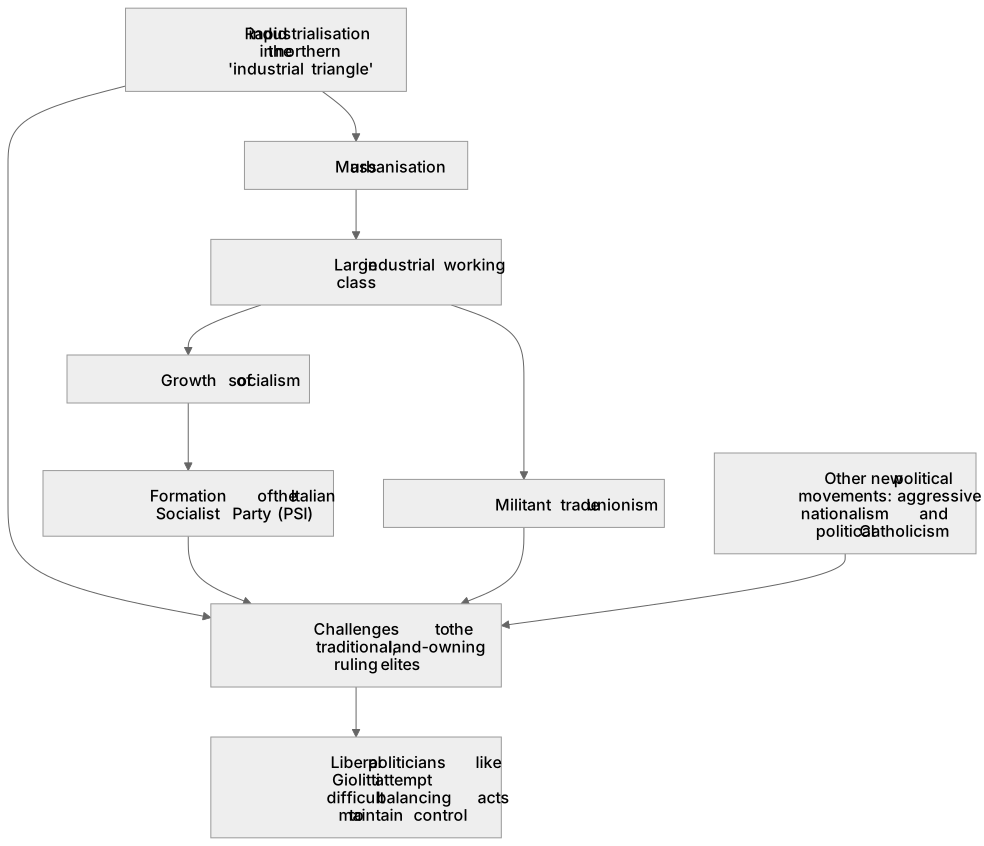
Label the diagram
Some boxes have lost their names. Pick the right name for each number.
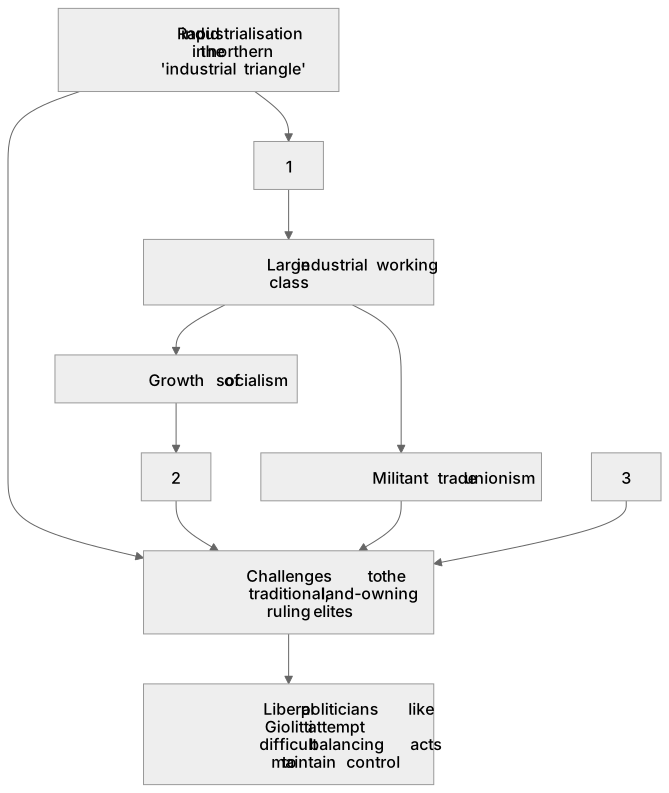
1Box 1
2Box 2
3Box 3
There is more to this lesson
The full lesson goes on to check your understanding and help you earn the marks. Create a free account to carry on, with your progress saved.
A week of Premium from your first lesson · Then the free plan continues · No card, no charge
Test your understanding of 2L Italy and Fascism, c1900–1945 – 1926 The Crisis of Liberal Italy, c1900–1915: Challenges to the ruling elites: industrialisation and social change; the rise of socialism and new political movements
Active recall beats re-reading. Take an instant quiz now to test what you’ve learned and lock it into long-term memory.
A week of Premium from your first lesson · Then the free plan continues · No card, no charge