AQA · A-Level · History
Course version: 7042 · Version from Sept 2017
The political, economic and social condition of Italy c1900: the legacy of…
Full specification wording
2L Italy and Fascism, c1900–1945 – 1926 The Crisis of Liberal Italy, c1900–1915: The political, economic and social condition of Italy c1900: the legacy of unification; divisions between North and South; the conflict between Church and State; class divisions
Italy in 1900 was a deeply fractured nation, burdened by the legacy of a rushed unification (Risorgimento) that created a state but failed to forge a unified national identity.
Checked against the AQA 7042 specification (opens in a new tab) on .
- Point 1 of 4
- 4 key terms
Study notes
From the checked teaching notes for this specification point.
The idea
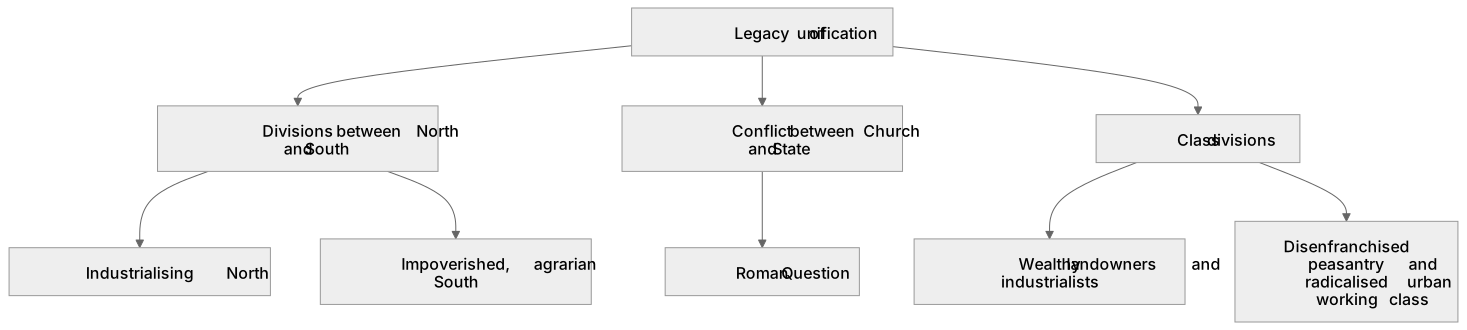
Italy in 1900 was a deeply fractured nation, burdened by the legacy of a rushed unification (Risorgimento) that created a state but failed to forge a unified national identity. The 'Roman Question' alienated the Catholic majority, as the Pope forbade participation in the new secular state. Economically, a severe North-South divide (the Questione Meridionale) persisted; the industrialising North contrasted sharply with the impoverished, agrarian South, leading to mass emigration. Furthermore, stark class divisions plagued both regions, with wealthy landowners and industrialists exploiting a disenfranchised peasantry and a growing, radicalised urban working class, fuelling socialist unrest.
What earns the marks
- Explain the 'Roman Question' and how the papal decree Non Expedit weakened the political legitimacy of the new Italian state.
- Analyse the economic disparities of the 'Questione Meridionale', contrasting Northern industrial growth (e.g., Fiat in Turin) with Southern agricultural stagnation.
- Evaluate the social impact of class divisions, noting how restricted franchise and poverty led to the rise of the Italian Socialist Party (PSI) and mass emigration.
- Assess the legacy of the Risorgimento as a 'royal conquest' by Piedmont, which imposed its laws and taxes on the rest of Italy, fostering deep regional resentment.
Common mistakes and how to put them right
Assuming unification resolved Italy's internal conflicts.
Put it right: Emphasise that unification was largely a Piedmontese expansion that exacerbated regional and social tensions.
Treating the North and South as economically identical before 1900.
Put it right: Highlight the specific industrialisation of the Northern triangle versus the latifundia (large estates) system dominating the Southern economy.
Describing Non Expedit as a papal encyclical.
Put it right: Accurately identify Non Expedit as a papal decree or instruction that forbade Catholics from voting or holding office.
Exam tips
- Use the term 'Questione Meridionale' (Southern Question) to demonstrate precise historical knowledge of the North-South economic and social divide.
- Link the restricted franchise to the growth of extra-parliamentary opposition, such as socialism and anarchism, among the working classes.
- When discussing the legacy of unification, contrast the patriotic myth of the Risorgimento with the reality of Piedmontese dominance and Southern alienation.
Try the lesson
The start of the 2L Italy and Fascism, c1900–1945 – 1926 The Crisis of Liberal Italy, c1900–1915: The political, economic and social condition of Italy c1900: the legacy of unification; divisions between North and South; the conflict between Church and State; class divisions lesson, made from checked teaching notes for this specification point.
Have a go first
Which of the following best describes the official position of the Catholic Church towards the Italian state in the year 1900?
Listen
Italy in 1900 was a deeply fractured nation, burdened by the legacy of a rushed unification (Risorgimento) that created a state but failed to forge a unified national identity. The 'Roman Question' alienated the Catholic majority, as the Pope forbade participation in the new secular state. Economically, a severe North-South divide (the Questione Meridionale) persisted; the industrialising North contrasted sharply with the impoverished, agrarian South, leading to mass emigration. Furthermore, stark class divisions plagued both regions, with wealthy landowners and industrialists exploiting a disenfranchised peasantry and a growing, radicalised urban working class, fuelling socialist unrest. A strong answer earns marks for these points. Explain the 'Roman Question' and how the papal decree Non Expedit weakened the political legitimacy of the new Italian state. Analyse the economic disparities of the 'Questione Meridionale', contrasting Northern industrial growth (e.g., Fiat in Turin) with Southern agricultural stagnation. Evaluate the social impact of class divisions, noting how restricted franchise and poverty led to the rise of the Italian Socialist Party (PSI) and mass emigration. Assess the legacy of the Risorgimento as a 'royal conquest' by Piedmont, which imposed its laws and taxes on the rest of Italy, fostering deep regional resentment. A common slip: Assuming unification resolved Italy's internal conflicts. Instead, Emphasise that unification was largely a Piedmontese expansion that exacerbated regional and social tensions. Exam tip: Use the term 'Questione Meridionale' (Southern Question) to demonstrate precise historical knowledge of the North-South economic and social divide.
See it
Key words
Say what each word means before you turn the card.
Risorgimento
Try answering aloud or in your head before turning the card.
Roman Question
Try answering aloud or in your head before turning the card.
Questione Meridionale
Try answering aloud or in your head before turning the card.
Non Expedit
Try answering aloud or in your head before turning the card.
See every definition
- Risorgimento
- A rushed unification that created a state but failed to forge a unified national identity.
- Roman Question
- The conflict between Church and State that alienated the Catholic majority, as the Pope forbade participation in the new secular state.
- Questione Meridionale
- A severe North-South divide in which the industrialising North contrasted sharply with the impoverished, agrarian South, leading to mass emigration.
- Non Expedit
- A papal decree that forbade Catholics from voting or holding office, weakening the political legitimacy of the new Italian state.
Label the diagram
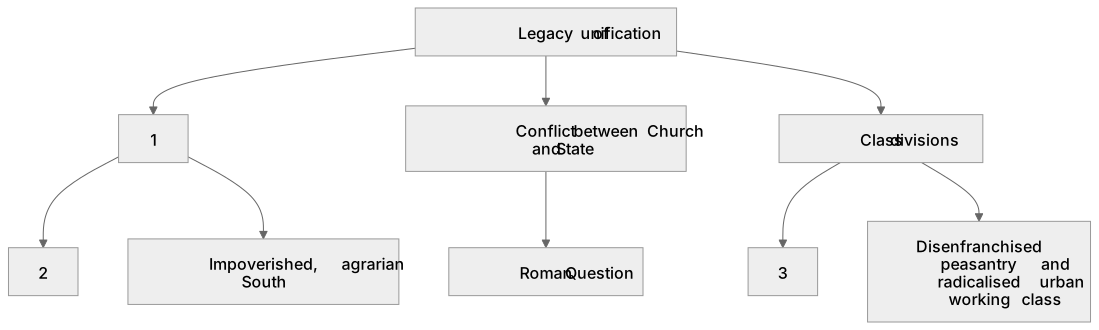
Some boxes have lost their names. Pick the right name for each number.
1Box 1
2Box 2
3Box 3
There is more to this lesson
The full lesson goes on to check your understanding and help you earn the marks. Create a free account to carry on, with your progress saved.
A week of Premium from your first lesson · Then the free plan continues · No card, no charge
Test your understanding of 2L Italy and Fascism, c1900–1945 – 1926 The Crisis of Liberal Italy, c1900–1915: The political, economic and social condition of Italy c1900: the legacy of unification; divisions between North and South; the conflict between Church and State; class divisions
Active recall beats re-reading. Take an instant quiz now to test what you’ve learned and lock it into long-term memory.
A week of Premium from your first lesson · Then the free plan continues · No card, no charge