AQA · A-Level · History
Course version: 7042 · Version from Sept 2017
The political system and Giolittianism: the role of the monarchy; the…
Full specification wording
2L Italy and Fascism, c1900–1945 – 1926 The Crisis of Liberal Italy, c1900–1915: The political system and Giolittianism: the role of the monarchy; the dominance of government by the liberal oligarchy; anticlericalism; the role of Giolitti
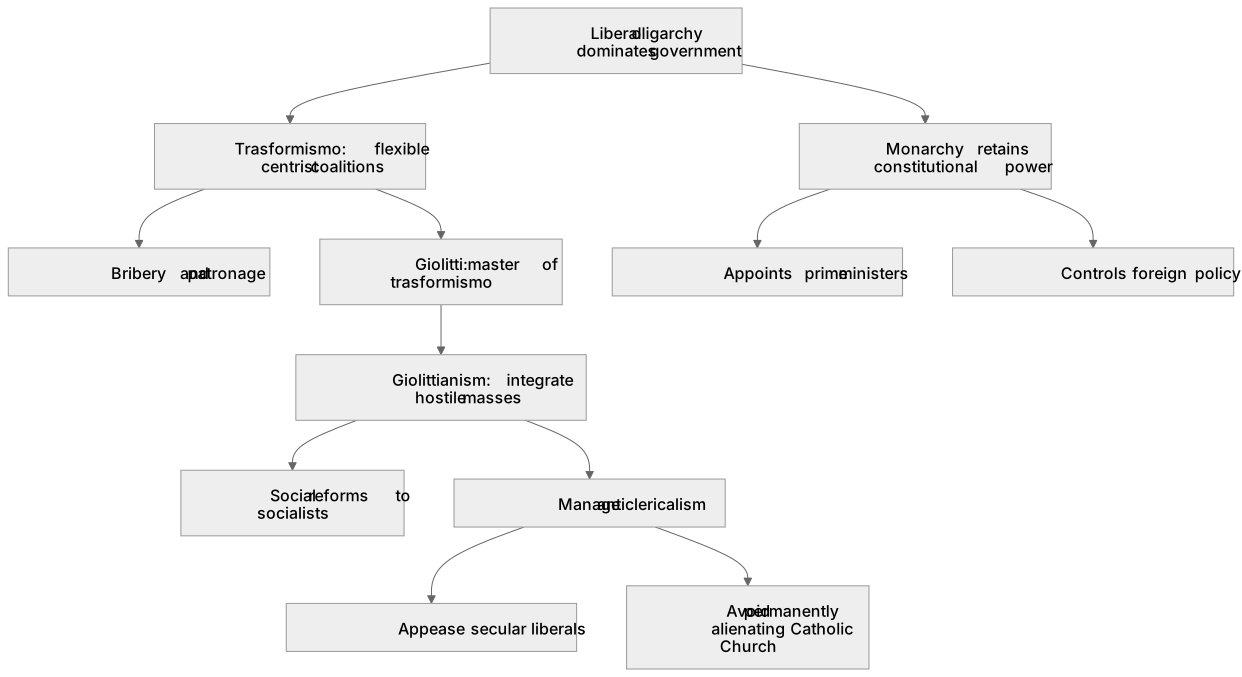
The Italian political system c1900 was dominated by a liberal oligarchy, a narrow elite who maintained power through 'trasformismo'—forming flexible, centrist coalitions through bribery and…
Checked against the AQA 7042 specification (opens in a new tab) on .
- Point 2 of 4
- 4 key terms
Study notes
From the checked teaching notes for this specification point.
The idea
The Italian political system c1900 was dominated by a liberal oligarchy, a narrow elite who maintained power through 'trasformismo'—forming flexible, centrist coalitions through bribery and patronage rather than distinct party ideologies. The monarchy retained significant constitutional power, including the ability to appoint prime ministers and control foreign policy. Within this system, Giovanni Giolitti emerged as the master of trasformismo. 'Giolittianism' aimed to integrate hostile masses into the liberal state by balancing competing interests, offering social reforms to socialists while simultaneously managing anticlericalism to appease secular liberals without permanently alienating the Catholic Church. This delicate balancing act defined early 20th-century Italian politics.
What earns the marks
- Define 'trasformismo' as the method by which the liberal oligarchy maintained dominance, bypassing ideological differences to form pragmatic, often corrupt, coalitions.
- Explain the constitutional role of the monarchy under the Statuto Albertino, highlighting the King's power over the military, foreign policy, and the appointment of the Prime Minister.
- Analyse Giolitti's strategy of 'Giolittianism', focusing on his attempts to absorb extreme groups (Socialists, Catholics, Nationalists) into the liberal parliamentary system.
- Evaluate the impact of anticlericalism within the liberal oligarchy, noting how it complicated Giolitti's efforts to gain Catholic electoral support against the rising socialist threat.
Common mistakes and how to put them right
Confusing the liberal oligarchy with a modern democratic party system.
Put it right: Explain that the liberals were a narrow, wealthy elite operating through personal factions and patronage, not mass political parties.
Assuming the Italian monarch was merely a figurehead.
Put it right: Detail the active political and military powers retained by the King, which allowed him to heavily influence government formation and foreign affairs.
Viewing Giolitti as a radical reformer.
Put it right: Characterise Giolitti as a pragmatic, conservative liberal whose reforms were tactical concessions designed to preserve the existing political order.
Exam tips
- Use the concept of 'trasformismo' explicitly to explain why Italian governments were frequently unstable yet dominated by the same liberal politicians.
- When evaluating Giolitti's success, distinguish between his short-term tactical victories in parliament and his long-term failure to create a genuinely unified national sentiment.
- Connect anticlericalism to the broader liberal ideology of the time, showing why an alliance with the Catholic Church was politically dangerous for Giolitti.
Try the lesson
The start of the 2L Italy and Fascism, c1900–1945 – 1926 The Crisis of Liberal Italy, c1900–1915: The political system and Giolittianism: the role of the monarchy; the dominance of government by the liberal oligarchy; anticlericalism; the role of Giolitti lesson, made from checked teaching notes for this specification point.
Have a go first
Which term describes the political practice used by the liberal oligarchy in Italy around 1900 to maintain control by forming flexible, centrist coalitions?
Listen
The Italian political system c1900 was dominated by a liberal oligarchy, a narrow elite who maintained power through 'trasformismo'—forming flexible, centrist coalitions through bribery and patronage rather than distinct party ideologies. The monarchy retained significant constitutional power, including the ability to appoint prime ministers and control foreign policy. Within this system, Giovanni Giolitti emerged as the master of trasformismo. Giolittianism' aimed to integrate hostile masses into the liberal state by balancing competing interests, offering social reforms to socialists while simultaneously managing anticlericalism to appease secular liberals without permanently alienating the Catholic Church. This delicate balancing act defined early 20th-century Italian politics. A strong answer earns marks for these points. Define 'trasformismo' as the method by which the liberal oligarchy maintained dominance, bypassing ideological differences to form pragmatic, often corrupt, coalitions. Explain the constitutional role of the monarchy under the Statuto Albertino, highlighting the King's power over the military, foreign policy, and the appointment of the Prime Minister. Analyse Giolitti's strategy of 'Giolittianism', focusing on his attempts to absorb extreme groups (Socialists, Catholics, Nationalists) into the liberal parliamentary system. Evaluate the impact of anticlericalism within the liberal oligarchy, noting how it complicated Giolitti's efforts to gain Catholic electoral support against the rising socialist threat. A common slip: Confusing the liberal oligarchy with a modern democratic party system. Instead, Explain that the liberals were a narrow, wealthy elite operating through personal factions and patronage, not mass political parties. Exam tip: Use the concept of 'trasformismo' explicitly to explain why Italian governments were frequently unstable yet dominated by the same liberal politicians.
See it
Key words
Say what each word means before you turn the card.
trasformismo
Try answering aloud or in your head before turning the card.
liberal oligarchy
Try answering aloud or in your head before turning the card.
Giolittianism
Try answering aloud or in your head before turning the card.
anticlericalism
Try answering aloud or in your head before turning the card.
See every definition
- trasformismo
- The method by which the liberal oligarchy maintained dominance, bypassing ideological differences to form pragmatic, often corrupt, coalitions.
- liberal oligarchy
- A narrow, wealthy elite operating through personal factions and patronage, not mass political parties.
- Giolittianism
- A strategy of absorbing extreme groups into the liberal parliamentary system by balancing competing interests.
- anticlericalism
- A force within the liberal oligarchy that complicated efforts to gain Catholic electoral support against the rising socialist threat.
Label the diagram
Some boxes have lost their names. Pick the right name for each number.
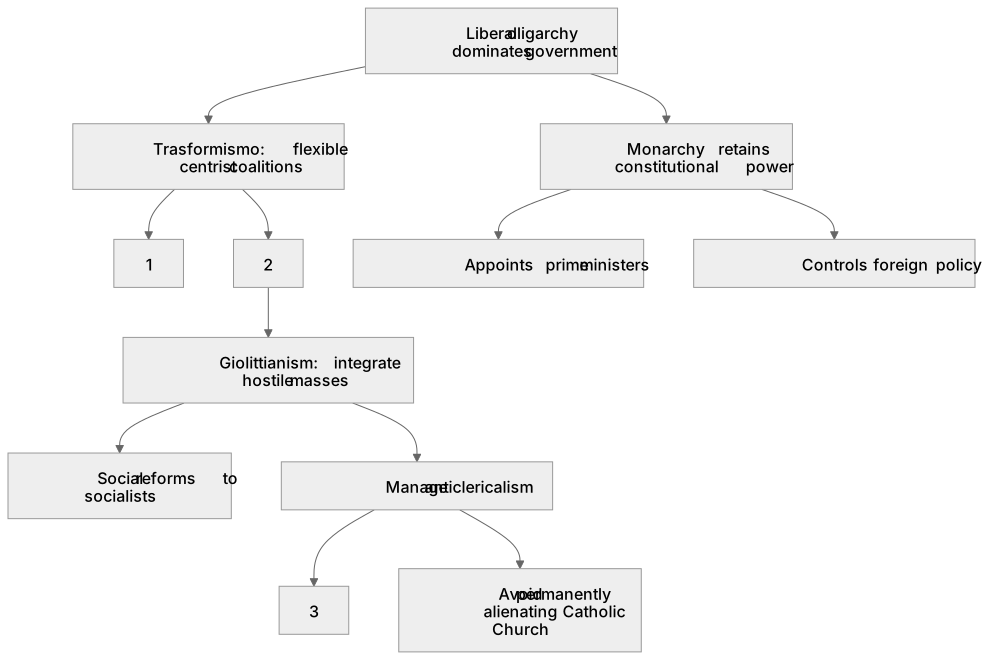
1Box 1
2Box 2
3Box 3
There is more to this lesson
The full lesson goes on to check your understanding and help you earn the marks. Create a free account to carry on, with your progress saved.
A week of Premium from your first lesson · Then the free plan continues · No card, no charge
Test your understanding of 2L Italy and Fascism, c1900–1945 – 1926 The Crisis of Liberal Italy, c1900–1915: The political system and Giolittianism: the role of the monarchy; the dominance of government by the liberal oligarchy; anticlericalism; the role of Giolitti
Active recall beats re-reading. Take an instant quiz now to test what you’ve learned and lock it into long-term memory.
A week of Premium from your first lesson · Then the free plan continues · No card, no charge