AQA · A-Level · History
Course version: 7042 · Version from Sept 2017
The slide towards war: the Spanish Civil War; changing relations with…
Full specification wording
2L Italy and Fascism, c1900–1945 – Fascist foreign policies, 1926–1940 (A-level only): The slide towards war: the Spanish Civil War; changing relations with Hitler’s Germany; the Pact of Steel; the invasion of Albania; the neutrality of Italy in 1939 and the extent of Italy’s military preparedness by 1940
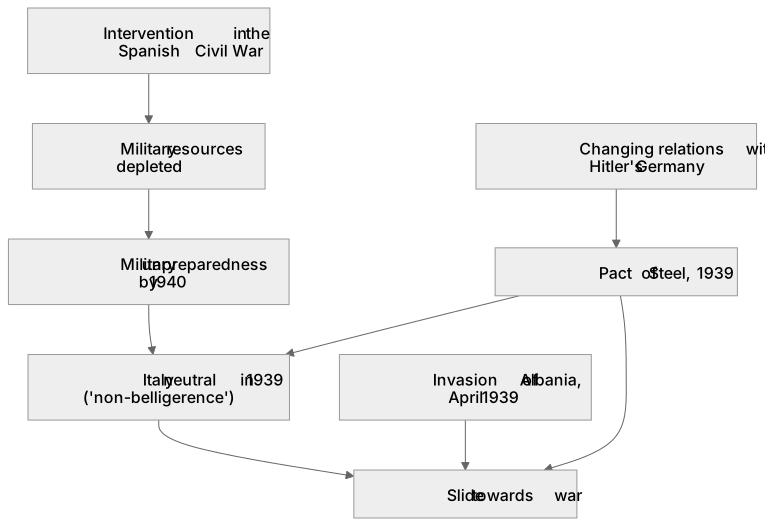
Italy’s slide towards war began with intervention in the Spanish Civil War, which severely depleted military resources.
Checked against the AQA 7042 specification (opens in a new tab) on .
- Point 4 of 4
- 4 key terms
Study notes
From the checked teaching notes for this specification point.
The idea
Italy’s slide towards war began with intervention in the Spanish Civil War, which severely depleted military resources. This period saw changing relations with Hitler’s Germany, evolving from the 1936 Rome-Berlin Axis to the formal military alliance of the 1939 Pact of Steel. Seeking to match German expansion, Mussolini launched the invasion of Albania in April 1939. Despite the Pact of Steel, Italy declared neutrality (termed 'non-belligerence') when war began in September 1939. This hesitation reflected the dire extent of Italy’s military preparedness by 1940; the armed forces lacked modern equipment and raw materials, having exhausted their reserves in Spain and Abyssinia, leaving the nation fundamentally unready for a major European conflict.
What earns the marks
- Assess the impact of the Spanish Civil War on Italy, focusing on the massive economic cost and the depletion of military stockpiles.
- Trace the changing relations with Germany, from the Stresa Front's collapse to the ideological and military alignment solidified by the 1939 Pact of Steel.
- Explain the invasion of Albania as a reactive measure by Mussolini to assert Italian dominance in the Balkans and mirror Hitler's territorial gains.
- Evaluate the reasons for Italy's 'non-belligerence' in 1939, contrasting the aggressive rhetoric of the Pact of Steel with the reality of severe military unpreparedness.
- Analyse the extent of Italy's military weakness by 1940, including outdated weaponry, lack of industrial capacity, and insufficient raw materials.
Common mistakes and how to put them right
Confusing Italy's 1939 status as strict neutrality.
Put it right: Use Mussolini's specific term 'non-belligerence' to show he still supported Germany ideologically but was not yet fighting.
Assuming the Pact of Steel forced Italy into war in 1939.
Put it right: Note that Mussolini had informed Hitler that Italy would not be ready for war until at least 1943, making the 1939 outbreak premature for Italy.
Stating the invasion of Albania was a major military triumph.
Put it right: Recognise that while successful, it was against a very weak opponent and highlighted logistical flaws in the Italian military.
Exam tips
- Connect Italy's military unpreparedness in 1940 directly to the prolonged interventions in Abyssinia and the Spanish Civil War.
- Analyse the Pact of Steel as a diplomatic blunder by Mussolini, who committed Italy to an offensive alliance without securing a guaranteed timeline for war.
- Use the concept of 'parallel war' to explain Mussolini's motivations for invading Albania and his eventual entry into the Second World War.
Try the lesson
The start of the 2L Italy and Fascism, c1900–1945 – Fascist foreign policies, 1926–1940 (A-level only): The slide towards war: the Spanish Civil War; changing relations with Hitler’s Germany; the Pact of Steel; the invasion of Albania; the neutrality of Italy in 1939 and the extent of Italy’s military preparedness by 1940 lesson, made from checked teaching notes for this specification point.
Have a go first
What was the primary motivation for Mussolini's decision to order the Italian invasion of Albania in April 1939?
Listen
Italy’s slide towards war began with intervention in the Spanish Civil War, which severely depleted military resources. This period saw changing relations with Hitler’s Germany, evolving from the 1936 Rome-Berlin Axis to the formal military alliance of the 1939 Pact of Steel. Seeking to match German expansion, Mussolini launched the invasion of Albania in April 1939. Despite the Pact of Steel, Italy declared neutrality (termed 'non-belligerence') when war began in September 1939. This hesitation reflected the dire extent of Italy’s military preparedness by 1940; the armed forces lacked modern equipment and raw materials, having exhausted their reserves in Spain and Abyssinia, leaving the nation fundamentally unready for a major European conflict. A strong answer earns marks for these points. Assess the impact of the Spanish Civil War on Italy, focusing on the massive economic cost and the depletion of military stockpiles. Trace the changing relations with Germany, from the Stresa Front's collapse to the ideological and military alignment solidified by the 1939 Pact of Steel. Explain the invasion of Albania as a reactive measure by Mussolini to assert Italian dominance in the Balkans and mirror Hitler's territorial gains. Evaluate the reasons for Italy's 'non-belligerence' in 1939, contrasting the aggressive rhetoric of the Pact of Steel with the reality of severe military unpreparedness. A common slip: Confusing Italy's 1939 status as strict neutrality. Instead, use Mussolini's specific term 'non-belligerence' to show he still supported Germany ideologically but was not yet fighting. Exam tip: Connect Italy's military unpreparedness in 1940 directly to the prolonged interventions in Abyssinia and the Spanish Civil War.
See it
Put the events in order
Put these events in the order they happened, earliest first.
- 1. Rome-Berlin Axis formed with Hitler's Germany
- 2. Italy's military preparedness found severely lacking
- 3. Pact of Steel signed with Germany
Key words
Say what each word means before you turn the card.
Military preparedness
Try answering aloud or in your head before turning the card.
Diplomatic realignment
Try answering aloud or in your head before turning the card.
Fascist foreign policy
Try answering aloud or in your head before turning the card.
Economic weakness
Try answering aloud or in your head before turning the card.
See every definition
- Military preparedness
- By 1940 the armed forces lacked modern equipment and raw materials, having exhausted their reserves in Spain and Abyssinia, leaving the nation fundamentally unready for a major European conflict.
- Diplomatic realignment
- Changing relations with Hitler's Germany evolved from the 1936 Rome-Berlin Axis to the formal military alliance of the 1939 Pact of Steel.
- Fascist foreign policy
- Seeking to match German expansion, Mussolini launched the invasion of Albania in April 1939.
- Economic weakness
- The Spanish Civil War severely depleted military resources, and intervention carried a massive economic cost.
Label the diagram
Some boxes have lost their names. Pick the right name for each number.
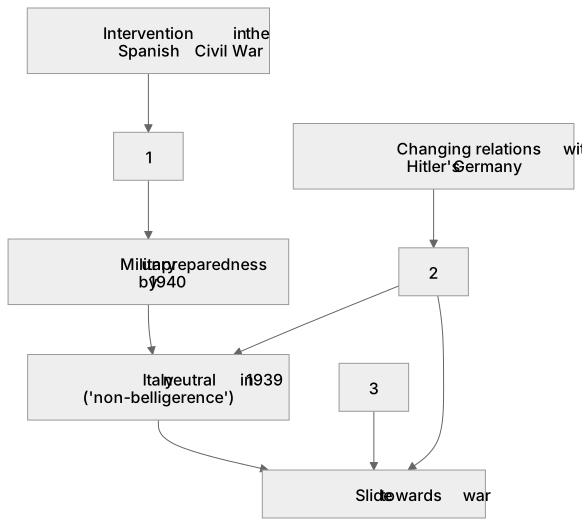
1Box 1
2Box 2
3Box 3
There is more to this lesson
The full lesson goes on to check your understanding and help you earn the marks. Create a free account to carry on, with your progress saved.
A week of Premium from your first lesson · Then the free plan continues · No card, no charge
Test your understanding of 2L Italy and Fascism, c1900–1945 – Fascist foreign policies, 1926–1940 (A-level only): The slide towards war: the Spanish Civil War; changing relations with Hitler’s Germany; the Pact of Steel; the invasion of Albania; the neutrality of Italy in 1939 and the extent of Italy’s military preparedness by 1940
Active recall beats re-reading. Take an instant quiz now to test what you’ve learned and lock it into long-term memory.
A week of Premium from your first lesson · Then the free plan continues · No card, no charge