AQA · A-Level · History
Course version: 7042 · Version from Sept 2017
The decision to enter the war: Mussolini’s war aims; Italy’s contribution…
Full specification wording
2L Italy and Fascism, c1900–1945 – Fascist Italy and war, 1940–1945 (A-level only): The decision to enter the war: Mussolini’s war aims; Italy’s contribution to the conquest of France; the implications for Italy of the continuation of the war
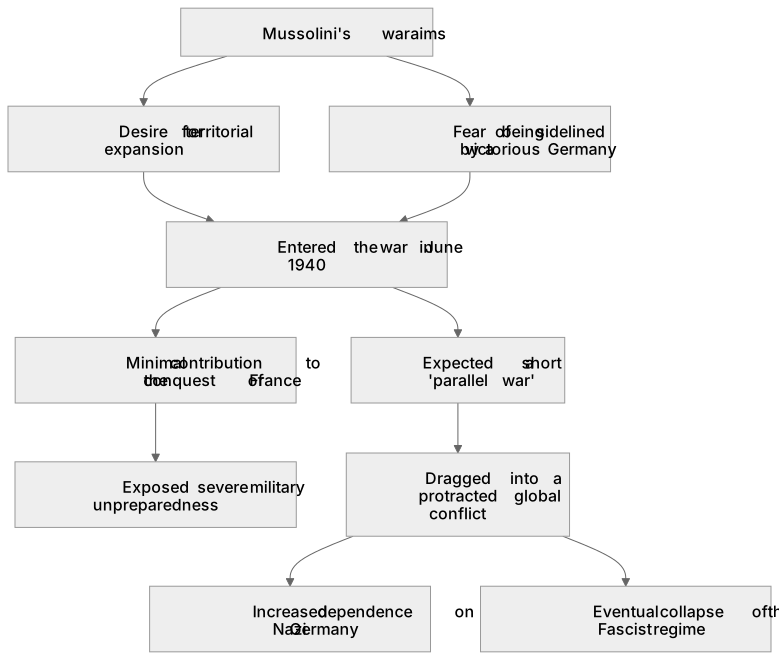
Mussolini entered the war in June 1940 driven by a desire for territorial expansion and fear of being sidelined by a victorious Germany.
Checked against the AQA 7042 specification (opens in a new tab) on .
- Point 1 of 4
- 4 key terms
Study notes
From the checked teaching notes for this specification point.
The idea
Mussolini entered the war in June 1940 driven by a desire for territorial expansion and fear of being sidelined by a victorious Germany. His war aims focused on dominating the Mediterranean and expanding Italy's African empire. Italy’s contribution to the conquest of France was minimal; attacking a largely defeated French army in the Alps yielded negligible gains and exposed severe military unpreparedness. The implications of the war's continuation were disastrous. Expecting a short 'parallel war', Italy was dragged into a protracted global conflict. This exposed the fundamental weaknesses of the Italian economy and military, leading to increased dependence on Nazi Germany and the eventual collapse of the Fascist regime.
What earns the marks
- Explain Mussolini's motivations for entering the war, including ideological goals and the fear of missing out on the spoils of a German victory.
- Detail Mussolini's specific war aims, such as establishing dominance in the Mediterranean and expanding territories in North and East Africa.
- Assess the limited nature of Italy's military contribution to the fall of France, noting the delayed entry and poor performance in the Alpine offensive.
- Analyse the negative implications of a prolonged war for Italy, highlighting the mismatch between Mussolini's ambitions and Italy's economic and military realities.
Common mistakes and how to put them right
Claiming Italy entered the war in September 1939 alongside Germany.
Put it right: State that Italy remained non-belligerent until June 1940, entering only when French defeat seemed certain.
Overstating Italy's role in the defeat of France.
Put it right: Emphasise that France was already effectively defeated by Germany before Italy launched its largely unsuccessful Alpine offensive.
Assuming Italy was fully prepared for a long war.
Put it right: Explain that Mussolini anticipated a short war and Italy lacked the industrial capacity and raw materials for a protracted conflict.
Exam tips
- Use the concept of a 'parallel war' to explain how Mussolini intended to fight alongside, but independently of, Germany to achieve Italian aims.
- Contrast Mussolini's grand rhetoric regarding the Mediterranean with the reality of Italy's military performance against France.
- When discussing the implications of the war's continuation, link military failures directly to underlying economic weaknesses.
Try the lesson
The start of the 2L Italy and Fascism, c1900–1945 – Fascist Italy and war, 1940–1945 (A-level only): The decision to enter the war: Mussolini’s war aims; Italy’s contribution to the conquest of France; the implications for Italy of the continuation of the war lesson, made from checked teaching notes for this specification point.
Have a go first
What was Mussolini's primary motivation for declaring war on Britain and France in June 1940?
Listen
Mussolini entered the war in June 1940 driven by a desire for territorial expansion and fear of being sidelined by a victorious Germany. His war aims focused on dominating the Mediterranean and expanding Italy's African empire. Italy’s contribution to the conquest of France was minimal; attacking a largely defeated French army in the Alps yielded negligible gains and exposed severe military unpreparedness. The implications of the war's continuation were disastrous. Expecting a short 'parallel war', Italy was dragged into a protracted global conflict. This exposed the fundamental weaknesses of the Italian economy and military, leading to increased dependence on Nazi Germany and the eventual collapse of the Fascist regime. A strong answer earns marks for these points. Explain Mussolini's motivations for entering the war, including ideological goals and the fear of missing out on the spoils of a German victory. Detail Mussolini's specific war aims, such as establishing dominance in the Mediterranean and expanding territories in North and East Africa. Assess the limited nature of Italy's military contribution to the fall of France, noting the delayed entry and poor performance in the Alpine offensive. Analyse the negative implications of a prolonged war for Italy, highlighting the mismatch between Mussolini's ambitions and Italy's economic and military realities. A common slip: Claiming Italy entered the war in September 1939 alongside Germany. Instead, State that Italy remained non-belligerent until June 1940, entering only when French defeat seemed certain. Exam tip: Use the concept of a 'parallel war' to explain how Mussolini intended to fight alongside, but independently of, Germany to achieve Italian aims.
See it
Key words
Say what each word means before you turn the card.
Imperialism and territorial expansion
Try answering aloud or in your head before turning the card.
Military unpreparedness
Try answering aloud or in your head before turning the card.
The gap between Fascist propaganda and reality
Try answering aloud or in your head before turning the card.
The shifting dynamic of the Rome-Berlin Axis
Try answering aloud or in your head before turning the card.
See every definition
- Imperialism and territorial expansion
- Mussolini's desire to dominate the Mediterranean and expand Italy's African empire, which drove his decision to enter the war.
- Military unpreparedness
- Severe weakness exposed by attacking a largely defeated French army in the Alps, which yielded negligible gains.
- The gap between Fascist propaganda and reality
- The contrast between Mussolini's grand rhetoric regarding the Mediterranean and the reality of Italy's military performance against France.
- The shifting dynamic of the Rome-Berlin Axis
- Increased dependence on Nazi Germany as a protracted global conflict exposed the fundamental weaknesses of the Italian economy and military.
Label the diagram
Some boxes have lost their names. Pick the right name for each number.
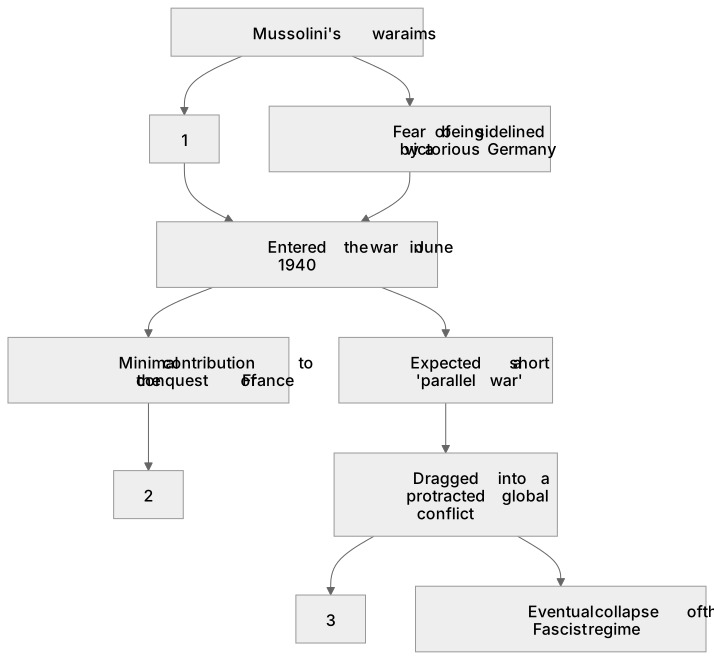
1Box 1
2Box 2
3Box 3
There is more to this lesson
The full lesson goes on to check your understanding and help you earn the marks. Create a free account to carry on, with your progress saved.
A week of Premium from your first lesson · Then the free plan continues · No card, no charge
Test your understanding of 2L Italy and Fascism, c1900–1945 – Fascist Italy and war, 1940–1945 (A-level only): The decision to enter the war: Mussolini’s war aims; Italy’s contribution to the conquest of France; the implications for Italy of the continuation of the war
Active recall beats re-reading. Take an instant quiz now to test what you’ve learned and lock it into long-term memory.
A week of Premium from your first lesson · Then the free plan continues · No card, no charge