AQA · A-Level · History
Course version: 7042 · Version from Sept 2017
Italy’s war effort: military campaigns; the impact of the war on the…
Full specification wording
2L Italy and Fascism, c1900–1945 – Fascist Italy and war, 1940–1945 (A-level only): Italy’s war effort: military campaigns; the impact of the war on the economy and the Italian people; the relationship with Nazi Germany
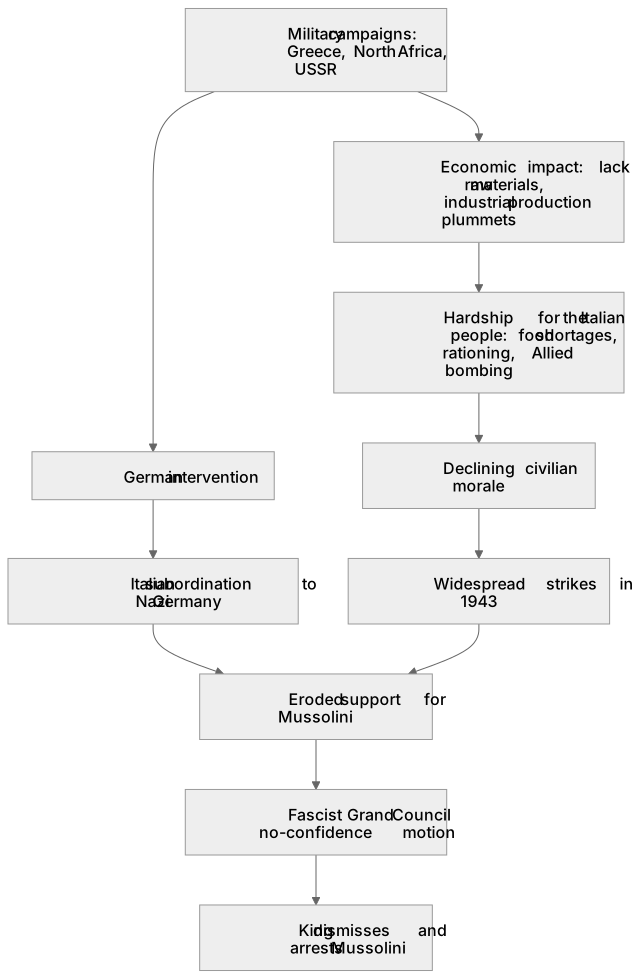
Italy’s war effort featured disastrous military campaigns in Greece, North Africa, and the USSR, shattering the illusion of Fascist might.
Checked against the AQA 7042 specification (opens in a new tab) on .
- Point 2 of 4
- 4 key terms
Study notes
From the checked teaching notes for this specification point.
The idea
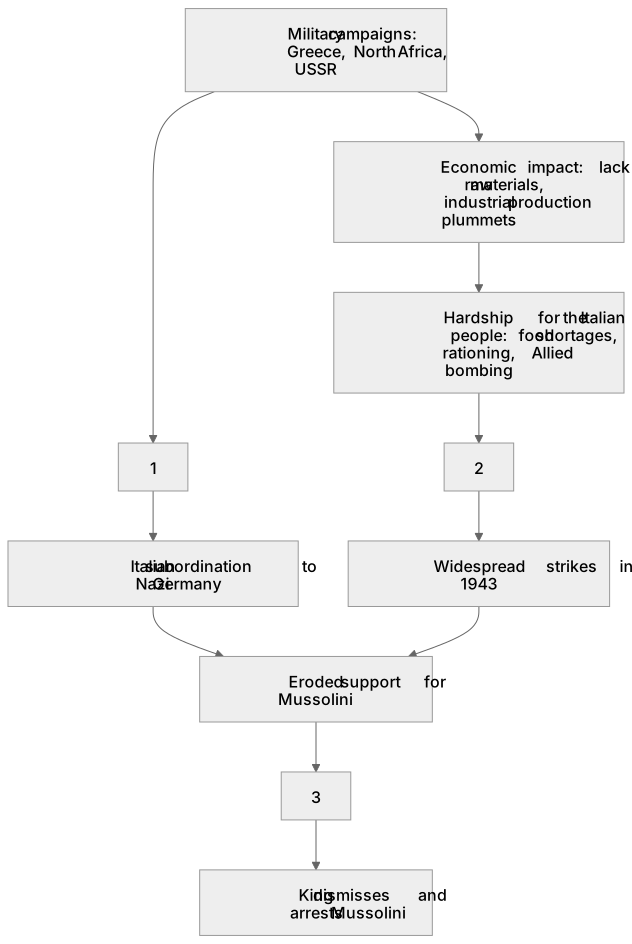
Italy’s war effort featured disastrous military campaigns in Greece, North Africa, and the USSR, shattering the illusion of Fascist might. These failures necessitated German intervention, altering the relationship with Nazi Germany to Italian subordination. The economic impact was catastrophic; lacking raw materials, industrial production plummeted. For the Italian people, the war brought severe hardship. Food shortages, rationing, and Allied bombing devastated civilian morale, sparking widespread strikes in 1943. The combination of military humiliation, economic ruin, and civilian suffering eroded support for Mussolini. The Fascist Grand Council passed a no-confidence motion, leading to the King dismissing and arresting Mussolini.
What earns the marks
- Evaluate the failure of Italian military campaigns in key theatres such as Greece and North Africa, noting the structural weaknesses of the armed forces.
- Analyse the catastrophic impact of the war on the Italian economy, focusing on the lack of raw materials and the failure to mobilise industry effectively.
- Assess the social impact of the war on the Italian people, including the effects of rationing, bombing, and declining living standards on civilian morale.
- Explain how military failures led to Italy's increasing subordination to Nazi Germany, ending Mussolini's hopes of a 'parallel war'.
Common mistakes and how to put them right
Treating the Italian military as completely incompetent without acknowledging structural issues.
Put it right: Explain that failures were largely due to poor equipment, lack of supplies, and outdated tactics rather than just poor soldiering.
Ignoring the domestic resistance before Mussolini's fall.
Put it right: Highlight the significance of the March 1943 strikes in northern Italy as evidence of collapsing civilian morale and opposition to the war.
Describing the relationship with Germany as static.
Put it right: Trace the shift from Mussolini's initial attempt at an independent 'parallel war' to complete dependence on German military bailouts.
Stating the Fascist Grand Council directly overthrew Mussolini.
Put it right: Clarify that the Council passed a vote of no confidence, but it was King Victor Emmanuel III who constitutionally dismissed and arrested him.
Exam tips
- Link military failures directly to economic weaknesses; for example, the inability to produce sufficient tanks or aircraft due to steel shortages.
- Use the 1943 strikes in Turin and Milan as key evidence when discussing the impact of the war on the Italian people and the loss of consensus.
- When evaluating the relationship with Germany, contrast Mussolini's ideological posturing with the reality of German commanders taking control of joint operations.
Try the lesson
The start of the 2L Italy and Fascism, c1900–1945 – Fascist Italy and war, 1940–1945 (A-level only): Italy’s war effort: military campaigns; the impact of the war on the economy and the Italian people; the relationship with Nazi Germany lesson, made from checked teaching notes for this specification point.
Have a go first
Which military campaign initiated by Mussolini in October 1940 resulted in a disastrous defeat that required German intervention?
Listen
Italy’s war effort featured disastrous military campaigns in Greece, North Africa, and the USSR, shattering the illusion of Fascist might. These failures necessitated German intervention, altering the relationship with Nazi Germany to Italian subordination. The economic impact was catastrophic; lacking raw materials, industrial production plummeted. For the Italian people, the war brought severe hardship. Food shortages, rationing, and Allied bombing devastated civilian morale, sparking widespread strikes in 1943. The combination of military humiliation, economic ruin, and civilian suffering eroded support for Mussolini. The Fascist Grand Council passed a no-confidence motion, leading to the King dismissing and arresting Mussolini. A strong answer earns marks for these points. Evaluate the failure of Italian military campaigns in key theatres such as Greece and North Africa, noting the structural weaknesses of the armed forces. Analyse the catastrophic impact of the war on the Italian economy, focusing on the lack of raw materials and the failure to mobilise industry effectively. Assess the social impact of the war on the Italian people, including the effects of rationing, bombing, and declining living standards on civilian morale. Explain how military failures led to Italy's increasing subordination to Nazi Germany, ending Mussolini's hopes of a 'parallel war'. A common slip: Treating the Italian military as completely incompetent without acknowledging structural issues. Instead, Explain that failures were largely due to poor equipment, lack of supplies, and outdated tactics rather than just poor soldiering. Exam tip: Link military failures directly to economic weaknesses; for example, the inability to produce sufficient tanks or aircraft due to steel shortages.
See it
Key words
Say what each word means before you turn the card.
The collapse of the Fascist consensus
Try answering aloud or in your head before turning the card.
Economic mismanagement and structural weakness
Try answering aloud or in your head before turning the card.
The reality of the Rome-Berlin Axis
Try answering aloud or in your head before turning the card.
Total war and civilian suffering
Try answering aloud or in your head before turning the card.
See every definition
- The collapse of the Fascist consensus
- The erosion of support for Mussolini caused by military humiliation, economic ruin and civilian suffering, shown by widespread strikes in 1943.
- Economic mismanagement and structural weakness
- Catastrophic economic impact in which, lacking raw materials, industrial production plummeted and industry failed to mobilise effectively.
- The reality of the Rome-Berlin Axis
- The shift from Mussolini's hopes of a 'parallel war' to Italian subordination, as failures necessitated German intervention and German commanders took control of joint operations.
- Total war and civilian suffering
- Severe hardship for the Italian people through food shortages, rationing and Allied bombing, which devastated civilian morale and declining living standards.
Label the diagram
Some boxes have lost their names. Pick the right name for each number.
1Box 1
2Box 2
3Box 3
There is more to this lesson
The full lesson goes on to check your understanding and help you earn the marks. Create a free account to carry on, with your progress saved.
A week of Premium from your first lesson · Then the free plan continues · No card, no charge
Test your understanding of 2L Italy and Fascism, c1900–1945 – Fascist Italy and war, 1940–1945 (A-level only): Italy’s war effort: military campaigns; the impact of the war on the economy and the Italian people; the relationship with Nazi Germany
Active recall beats re-reading. Take an instant quiz now to test what you’ve learned and lock it into long-term memory.
A week of Premium from your first lesson · Then the free plan continues · No card, no charge