AQA · A-Level · History
Course version: 7042 · Version from Sept 2017
The fall of Mussolini in 1943: Allied invasion of Sicily and the crisis of…
Full specification wording
2L Italy and Fascism, c1900–1945 – Fascist Italy and war, 1940–1945 (A-level only): The fall of Mussolini in 1943: Allied invasion of Sicily and the crisis of the Fascist regime; the overthrow of Mussolini by the Fascist Grand Council and the King; the ‘Forty Five Days’ and the continuation of war and civil war in Italy
The July 1943 Allied invasion of Sicily triggered a fatal crisis for the Fascist regime, exposing military weakness and destroying morale.
Checked against the AQA 7042 specification (opens in a new tab) on .
- Point 3 of 4
- 4 key terms
Study notes
From the checked teaching notes for this specification point.
The idea
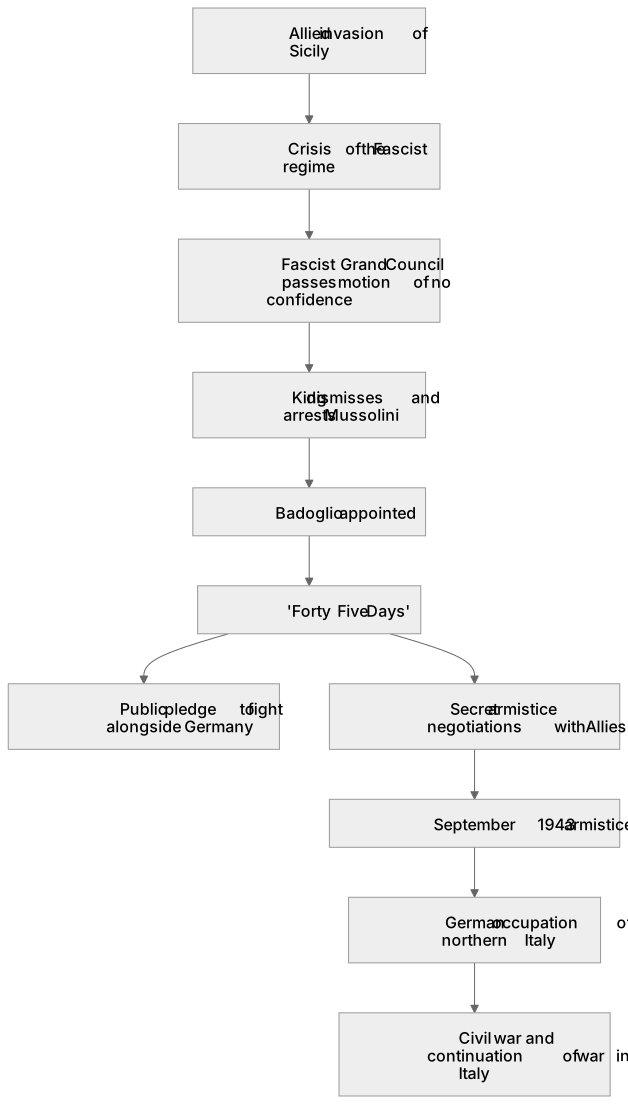
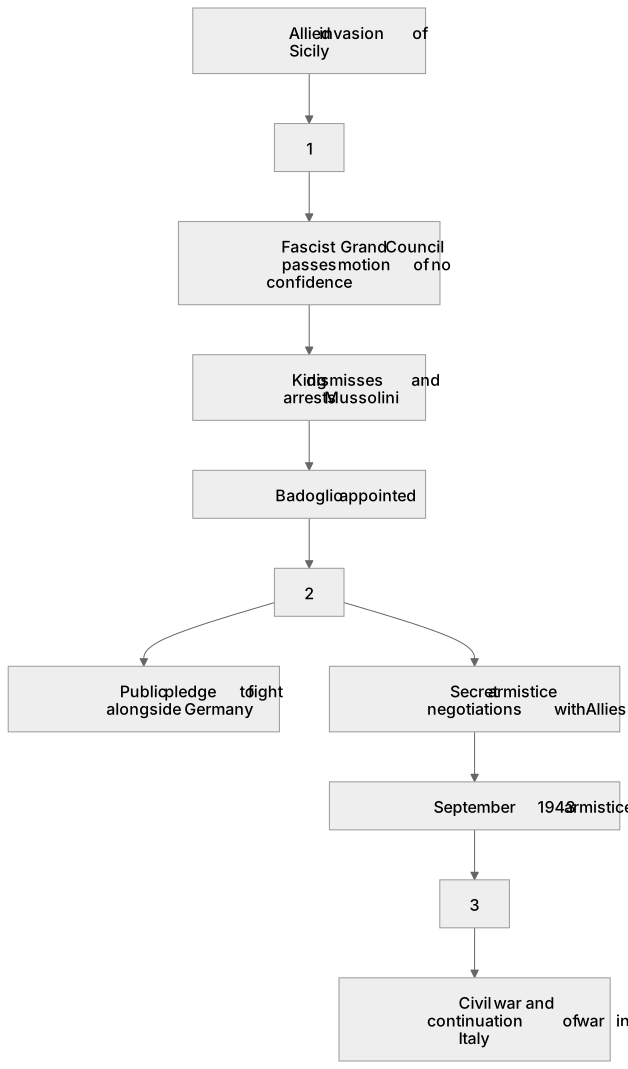
The July 1943 Allied invasion of Sicily triggered a fatal crisis for the Fascist regime, exposing military weakness and destroying morale. Consequently, dissident Fascists led by Dino Grandi passed a motion of no confidence at the Fascist Grand Council. King Victor Emmanuel III then dismissed and arrested Mussolini, replacing him with Marshal Badoglio. This began the 'Forty Five Days', where Badoglio publicly pledged to fight alongside Germany while secretly negotiating an Allied armistice. The September 1943 armistice provoked immediate German occupation of northern Italy, plunging the nation into a brutal civil war and ensuring the continuation of the wider conflict on Italian soil.
What earns the marks
- Assess the impact of the Allied invasion of Sicily (Operation Husky) in catalysing the collapse of domestic support and military morale.
- Analyse the motivations of the Fascist Grand Council members, particularly Dino Grandi, in voting against Mussolini on 25 July 1943.
- Evaluate the constitutional role of King Victor Emmanuel III in dismissing Mussolini and appointing Marshal Badoglio.
- Explain the dual nature of the 'Forty Five Days', focusing on Badoglio's secret armistice negotiations despite public assurances to Germany.
- Examine how the September 1943 armistice led directly to German occupation and the outbreak of civil war in Italy.
Common mistakes and how to put them right
Claiming the Allies captured Rome before Mussolini's fall.
Put it right by stating Mussolini was overthrown in July 1943 following the invasion of Sicily, long before Rome fell in 1944.
Assuming the Fascist Grand Council legally dismissed Mussolini.
Put it right by noting the Council only passed a motion of no confidence, and it was the King's constitutional prerogative that formally removed him.
Stating the war in Italy ended with the 1943 armistice.
Put it right by explaining the armistice triggered German occupation and a bitter civil war that lasted until 1945.
Exam tips
- Use the 'Forty Five Days' to demonstrate the chaotic transition of power and the lack of clear direction from the King and Badoglio.
- When discussing Mussolini's fall, weigh the long-term structural weaknesses of the regime against the short-term trigger of the Sicilian invasion.
- Highlight the division within the Fascist elite to show that Mussolini's overthrow was largely an internal coup rather than a popular revolution.
Try the lesson
The start of the 2L Italy and Fascism, c1900–1945 – Fascist Italy and war, 1940–1945 (A-level only): The fall of Mussolini in 1943: Allied invasion of Sicily and the crisis of the Fascist regime; the overthrow of Mussolini by the Fascist Grand Council and the King; the ‘Forty Five Days’ and the continuation of war and civil war in Italy lesson, made from checked teaching notes for this specification point.
Have a go first
Which military event in July 1943 directly precipitated the crisis of the Fascist regime and led to the convening of the Fascist Grand Council?
Listen
The July 1943 Allied invasion of Sicily triggered a fatal crisis for the Fascist regime, exposing military weakness and destroying morale. Consequently, dissident Fascists led by Dino Grandi passed a motion of no confidence at the Fascist Grand Council. King Victor Emmanuel III then dismissed and arrested Mussolini, replacing him with Marshal Badoglio. This began the 'Forty Five Days', where Badoglio publicly pledged to fight alongside Germany while secretly negotiating an Allied armistice. The September 1943 armistice provoked immediate German occupation of northern Italy, plunging the nation into a brutal civil war and ensuring the continuation of the wider conflict on Italian soil. A strong answer earns marks for these points. Assess the impact of the Allied invasion of Sicily (Operation Husky) in catalysing the collapse of domestic support and military morale. Analyse the motivations of the Fascist Grand Council members, particularly Dino Grandi, in voting against Mussolini on 25 July 1943. Evaluate the constitutional role of King Victor Emmanuel III in dismissing Mussolini and appointing Marshal Badoglio. Explain the dual nature of the 'Forty Five Days', focusing on Badoglio's secret armistice negotiations despite public assurances to Germany. A common slip: Claiming the Allies captured Rome before Mussolini's fall. Instead, stating Mussolini was overthrown in July 1943 following the invasion of Sicily, long before Rome fell in 1944. Exam tip: Use the 'Forty Five Days' to demonstrate the chaotic transition of power and the lack of clear direction from the King and Badoglio.
See it
Key words
Say what each word means before you turn the card.
Military failure and regime collapse
Try answering aloud or in your head before turning the card.
Constitutional authority and the monarchy
Try answering aloud or in your head before turning the card.
Internal party opposition
Try answering aloud or in your head before turning the card.
Civil conflict and foreign occupation
Try answering aloud or in your head before turning the card.
See every definition
- Military failure and regime collapse
- The July 1943 Allied invasion of Sicily triggered a fatal crisis for the Fascist regime, exposing military weakness and destroying morale.
- Constitutional authority and the monarchy
- King Victor Emmanuel III dismissed and arrested Mussolini, replacing him with Marshal Badoglio, using his constitutional prerogative to formally remove him.
- Internal party opposition
- Dissident Fascists led by Dino Grandi passed a motion of no confidence at the Fascist Grand Council against Mussolini.
- Civil conflict and foreign occupation
- The September 1943 armistice provoked immediate German occupation of northern Italy, plunging the nation into a brutal civil war and ensuring the continuation of the wider conflict on Italian soil.
Label the diagram
Some boxes have lost their names. Pick the right name for each number.
1Box 1
2Box 2
3Box 3
There is more to this lesson
The full lesson goes on to check your understanding and help you earn the marks. Create a free account to carry on, with your progress saved.
A week of Premium from your first lesson · Then the free plan continues · No card, no charge
Test your understanding of 2L Italy and Fascism, c1900–1945 – Fascist Italy and war, 1940–1945 (A-level only): The fall of Mussolini in 1943: Allied invasion of Sicily and the crisis of the Fascist regime; the overthrow of Mussolini by the Fascist Grand Council and the King; the ‘Forty Five Days’ and the continuation of war and civil war in Italy
Active recall beats re-reading. Take an instant quiz now to test what you’ve learned and lock it into long-term memory.
A week of Premium from your first lesson · Then the free plan continues · No card, no charge