AQA · A-Level · History
Course version: 7042 · Version from Sept 2017
Italy’s war effort: aims and expectations; military campaigns; Caporetto;…
Full specification wording
2L Italy and Fascism, c1900–1945 – The collapse of Liberal Italy and Mussolini’s Rise to Power, 1915–1922: Italy’s war effort: aims and expectations; military campaigns; Caporetto; the impact of war and defeat on the Home Front
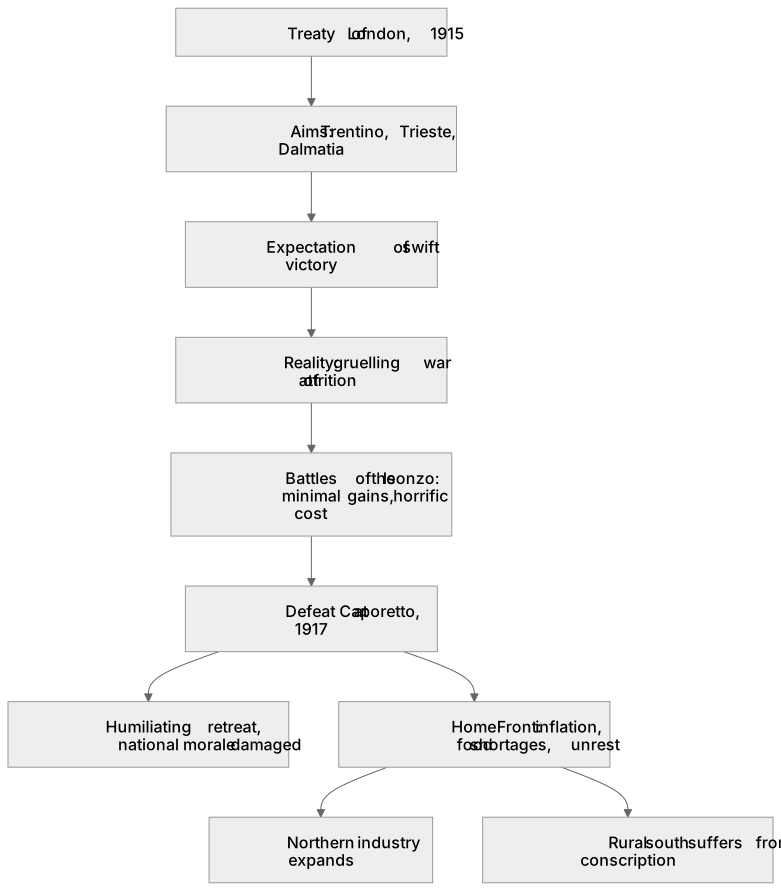
Italy entered the First World War in 1915 driven by the Treaty of London, expecting a swift victory to secure irredentist lands like Trentino and Trieste.
Checked against the AQA 7042 specification (opens in a new tab) on .
- Point 1 of 4
- 4 key terms
Study notes
From the checked teaching notes for this specification point.
The idea
Italy entered the First World War in 1915 driven by the Treaty of London, expecting a swift victory to secure irredentist lands like Trentino and Trieste. However, the reality was a gruelling war of attrition. Military campaigns, notably the eleven Battles of the Isonzo, yielded minimal gains at a horrific human cost. The catastrophic defeat at Caporetto in 1917 forced a humiliating retreat, severely damaging national morale. On the Home Front, the war effort and subsequent defeats exacerbated existing socio-economic divides. While northern industries like Fiat expanded rapidly to meet military demands, the rural south suffered from mass conscription. Severe inflation, food shortages, and falling real wages triggered widespread unrest, including the 1917 Turin bread riots, deeply fracturing Italian society.
What earns the marks
- Explain the territorial aims outlined in the 1915 Treaty of London, focusing on the desire to claim Trentino, Trieste, and Dalmatia.
- Assess the nature of the military campaigns, particularly the static, high-casualty trench warfare along the Isonzo river under General Cadorna.
- Analyse the causes and consequences of the 1917 Battle of Caporetto, including the loss of 300,000 men as prisoners and the subsequent replacement of Cadorna with Diaz.
- Evaluate the economic impact on the Home Front, contrasting the massive growth of northern heavy industry with the agricultural decline and inflation affecting the peasantry.
Common mistakes and how to put them right
Claiming Italy fought alongside Germany and Austria-Hungary during the First World War.
Put it right: Italy was part of the Triple Alliance but declared neutrality in 1914, later joining the Entente powers in 1915.
Assuming the Home Front experienced uniform economic devastation.
Put it right: Recognise that while workers and peasants suffered from inflation and food shortages, major industrialists experienced significant economic booms due to state contracts.
Treating Caporetto as the end of Italy's military involvement.
Put it right: Note that Italy recovered from Caporetto, successfully defending the Piave line and eventually winning the Battle of Vittorio Veneto in 1918.
Exam tips
- When discussing Caporetto, link the military failure to the exacerbation of political and social tensions on the Home Front.
- Use specific statistics, such as the growth of Fiat's workforce or the inflation rate, to substantiate arguments about the war's economic impact.
- Contrast the initial expectations of interventionists in 1915 with the grim reality of the military campaigns to evaluate the psychological impact of the war.
Try the lesson
The start of the 2L Italy and Fascism, c1900–1945 – The collapse of Liberal Italy and Mussolini’s Rise to Power, 1915–1922: Italy’s war effort: aims and expectations; military campaigns; Caporetto; the impact of war and defeat on the Home Front lesson, made from checked teaching notes for this specification point.
Have a go first
What was the primary territorial aim that motivated Italy's entry into the First World War in 1915?
Listen
Italy entered the First World War in 1915 driven by the Treaty of London, expecting a swift victory to secure irredentist lands like Trentino and Trieste. However, the reality was a gruelling war of attrition. Military campaigns, notably the eleven Battles of the Isonzo, yielded minimal gains at a horrific human cost. The catastrophic defeat at Caporetto in 1917 forced a humiliating retreat, severely damaging national morale. On the Home Front, the war effort and subsequent defeats exacerbated existing socio-economic divides. While northern industries like Fiat expanded rapidly to meet military demands, the rural south suffered from mass conscription. Severe inflation, food shortages, and falling real wages triggered widespread unrest, including the 1917 Turin bread riots, deeply fracturing Italian society. A strong answer earns marks for these points. Explain the territorial aims outlined in the 1915 Treaty of London, focusing on the desire to claim Trentino, Trieste, and Dalmatia. Assess the nature of the military campaigns, particularly the static, high-casualty trench warfare along the Isonzo river under General Cadorna. Analyse the causes and consequences of the 1917 Battle of Caporetto, including the loss of 300,000 men as prisoners and the subsequent replacement of Cadorna with Diaz. Evaluate the economic impact on the Home Front, contrasting the massive growth of northern heavy industry with the agricultural decline and inflation affecting the peasantry. A common slip: Claiming Italy fought alongside Germany and Austria-Hungary during the First World War. Instead, Italy was part of the Triple Alliance but declared neutrality in 1914, later joining the Entente powers in 1915. Exam tip: When discussing Caporetto, link the military failure to the exacerbation of political and social tensions on the Home Front.
See it
Key words
Say what each word means before you turn the card.
Treaty of London
Try answering aloud or in your head before turning the card.
Caporetto
Try answering aloud or in your head before turning the card.
Home Front
Try answering aloud or in your head before turning the card.
Battles of the Isonzo
Try answering aloud or in your head before turning the card.
See every definition
- Treaty of London
- The 1915 agreement that drove Italy to enter the First World War, expecting a swift victory to secure irredentist lands like Trentino and Trieste.
- Caporetto
- The catastrophic defeat in 1917 that forced a humiliating retreat and severely damaged national morale.
- Home Front
- The domestic setting where the war effort and subsequent defeats exacerbated existing socio-economic divides.
- Battles of the Isonzo
- Eleven military campaigns that yielded minimal gains at a horrific human cost.
Label the diagram
Some boxes have lost their names. Pick the right name for each number.
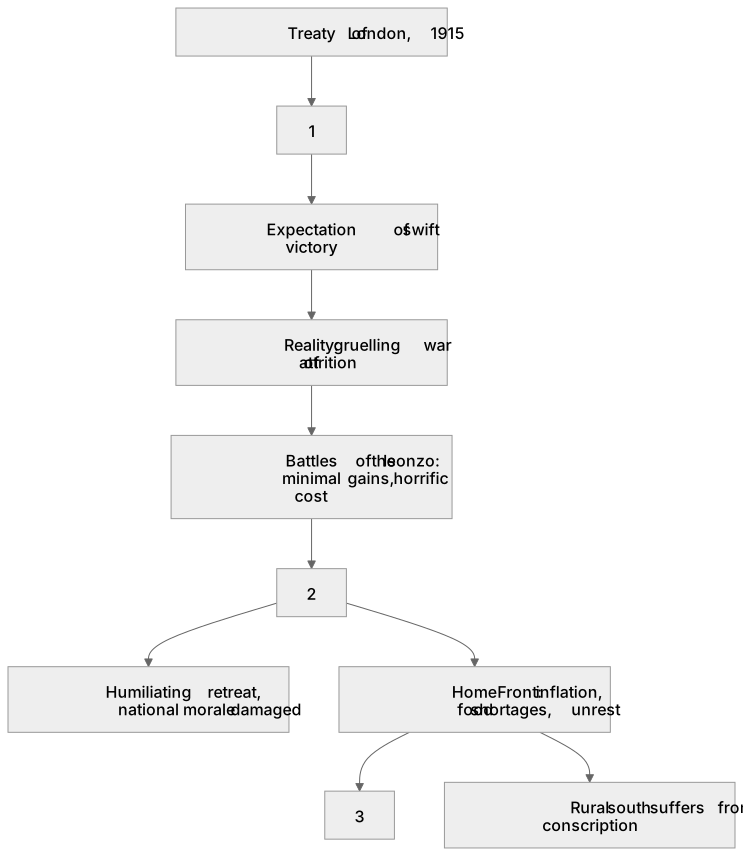
1Box 1
2Box 2
3Box 3
There is more to this lesson
The full lesson goes on to check your understanding and help you earn the marks. Create a free account to carry on, with your progress saved.
A week of Premium from your first lesson · Then the free plan continues · No card, no charge
Test your understanding of 2L Italy and Fascism, c1900–1945 – The collapse of Liberal Italy and Mussolini’s Rise to Power, 1915–1922: Italy’s war effort: aims and expectations; military campaigns; Caporetto; the impact of war and defeat on the Home Front
Active recall beats re-reading. Take an instant quiz now to test what you’ve learned and lock it into long-term memory.
A week of Premium from your first lesson · Then the free plan continues · No card, no charge