AQA · A-Level · History
Course version: 7042 · Version from Sept 2017
Italy and the ‘Mutilated Victory’: reactions within Italy to the post-war…
Full specification wording
2L Italy and Fascism, c1900–1945 – The collapse of Liberal Italy and Mussolini’s Rise to Power, 1915–1922: Italy and the ‘Mutilated Victory’: reactions within Italy to the post-war peace settlement and treaties; the seizure of Fiume by d’Annunzio
Following the First World War, Italian nationalists popularised the myth of the 'Mutilated Victory' (vittoria mutilata), arguing that Italy had been betrayed by its allies at the Paris Peace…
Checked against the AQA 7042 specification (opens in a new tab) on .
- Point 2 of 4
- 4 key terms
Study notes
From the checked teaching notes for this specification point.
The idea
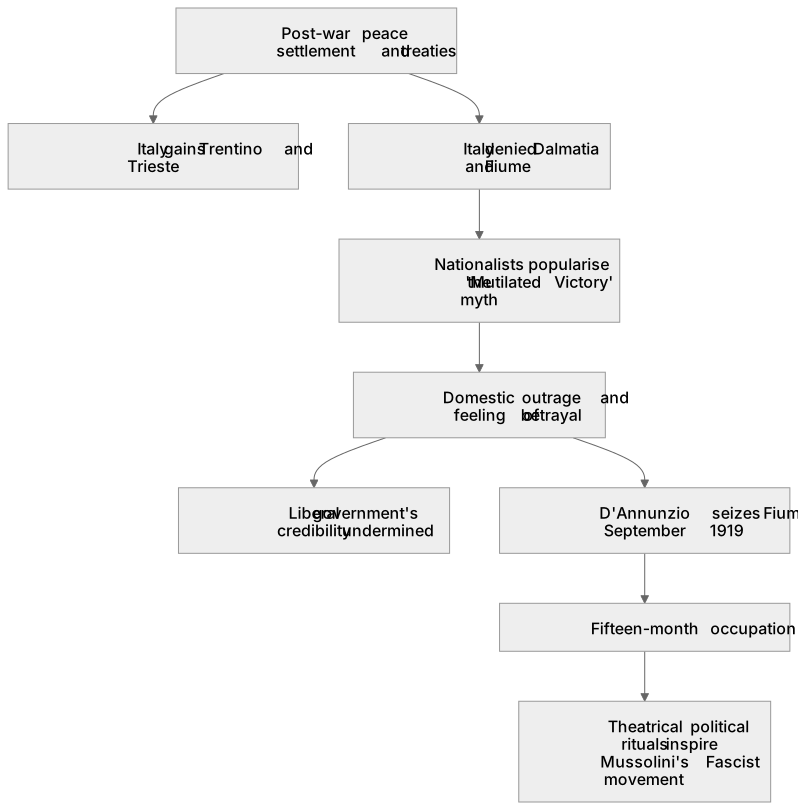
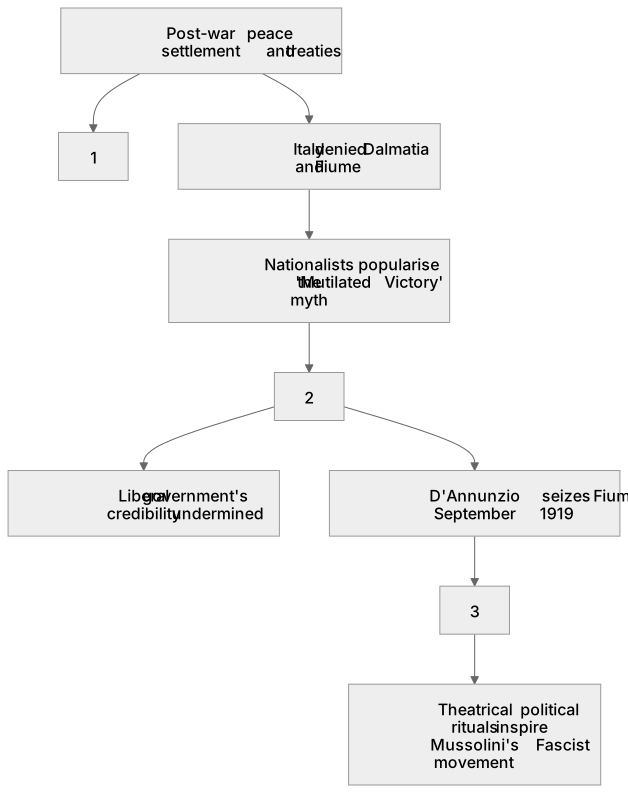
Following the First World War, Italian nationalists popularised the myth of the 'Mutilated Victory' (vittoria mutilata), arguing that Italy had been betrayed by its allies at the Paris Peace Conference. Despite gaining Trentino and Trieste through the Treaty of Saint-Germain, Italy was denied Dalmatia and the port city of Fiume, contradicting the 1915 Treaty of London and the principle of national self-determination. This sparked intense domestic outrage, severely undermining the Liberal government's credibility. In September 1919, the nationalist poet Gabriele d'Annunzio capitalised on this fury by leading an armed force of mutinous soldiers to seize Fiume. His fifteen-month occupation served as a powerful propaganda tool, establishing theatrical political rituals that directly inspired Mussolini's Fascist movement.
What earns the marks
- Define the concept of the 'Mutilated Victory' and explain how it was used by nationalists to discredit the Liberal government.
- Detail the specific territorial outcomes of the post-war peace treaties, noting the acquisition of Trentino and Trieste but the failure to secure Dalmatia and Fiume.
- Analyse the domestic reaction to the peace settlements, focusing on the widespread feeling of national humiliation and betrayal by the Entente powers.
- Evaluate the significance of Gabriele d'Annunzio's seizure of Fiume in 1919, including his use of paramilitary tactics, black shirts, and balcony speeches.
Common mistakes and how to put them right
Stating that Italy gained no territory at all from the post-war peace settlements.
Put it right: Specify that Italy did achieve its primary irredentist goals of Trentino, Trieste, and the South Tyrol, but failed to gain its broader imperial demands.
Confusing d'Annunzio's occupation of Fiume with a Fascist operation led by Mussolini.
Put it right: Clarify that d'Annunzio acted independently, though his methods and aesthetics heavily influenced Mussolini's later Fascist movement.
Assuming the 'Mutilated Victory' was an objective reality rather than a political construct.
Put it right: Discuss the 'Mutilated Victory' as a powerful nationalist myth used to mobilise opposition against the Liberal state, rather than a strictly factual assessment of the treaties.
Exam tips
- Use the phrase 'Mutilated Victory' explicitly in essays to demonstrate understanding of nationalist rhetoric and its impact on post-war Italian politics.
- Compare the diplomatic failures of Prime Minister Orlando at Versailles with the decisive, albeit illegal, direct action taken by d'Annunzio at Fiume.
- Highlight how the Fiume endeavour exposed the weakness of the Liberal government, which hesitated for over a year before finally removing d'Annunzio by force.
Try the lesson
The start of the 2L Italy and Fascism, c1900–1945 – The collapse of Liberal Italy and Mussolini’s Rise to Power, 1915–1922: Italy and the ‘Mutilated Victory’: reactions within Italy to the post-war peace settlement and treaties; the seizure of Fiume by d’Annunzio lesson, made from checked teaching notes for this specification point.
Have a go first
Who coined the phrase 'mutilated victory' to describe Italy's dissatisfaction with the post-war peace settlements?
Listen
Following the First World War, Italian nationalists popularised the myth of the 'Mutilated Victory' (vittoria mutilata), arguing that Italy had been betrayed by its allies at the Paris Peace Conference. Despite gaining Trentino and Trieste through the Treaty of Saint-Germain, Italy was denied Dalmatia and the port city of Fiume, contradicting the 1915 Treaty of London and the principle of national self-determination. This sparked intense domestic outrage, severely undermining the Liberal government's credibility. In September 1919, the nationalist poet Gabriele d'Annunzio capitalised on this fury by leading an armed force of mutinous soldiers to seize Fiume. His fifteen-month occupation served as a powerful propaganda tool, establishing theatrical political rituals that directly inspired Mussolini's Fascist movement. A strong answer earns marks for these points. Define the concept of the 'Mutilated Victory' and explain how it was used by nationalists to discredit the Liberal government. Detail the specific territorial outcomes of the post-war peace treaties, noting the acquisition of Trentino and Trieste but the failure to secure Dalmatia and Fiume. Analyse the domestic reaction to the peace settlements, focusing on the widespread feeling of national humiliation and betrayal by the Entente powers. Evaluate the significance of Gabriele d'Annunzio's seizure of Fiume in 1919, including his use of paramilitary tactics, black shirts, and balcony speeches. A common slip: Stating that Italy gained no territory at all from the post-war peace settlements. Instead, Specify that Italy did achieve its primary irredentist goals of Trentino, Trieste, and the South Tyrol, but failed to gain its broader imperial demands. Exam tip: Use the phrase 'Mutilated Victory' explicitly in essays to demonstrate understanding of nationalist rhetoric and its impact on post-war Italian politics.
See it
Key words
Say what each word means before you turn the card.
Mutilated Victory
Try answering aloud or in your head before turning the card.
Fiume
Try answering aloud or in your head before turning the card.
Treaty of Saint-Germain
Try answering aloud or in your head before turning the card.
Gabriele d'Annunzio
Try answering aloud or in your head before turning the card.
See every definition
- Mutilated Victory
- A nationalist myth arguing that Italy had been betrayed by its allies at the Paris Peace Conference, popularised after the First World War.
- Fiume
- A port city that Italy was denied, contradicting the 1915 Treaty of London and the principle of national self-determination.
- Treaty of Saint-Germain
- The treaty through which Italy gained Trentino and Trieste, though it was denied Dalmatia and Fiume.
- Gabriele d'Annunzio
- A nationalist poet who led an armed force of mutinous soldiers to seize Fiume in September 1919.
Label the diagram
Some boxes have lost their names. Pick the right name for each number.
1Box 1
2Box 2
3Box 3
There is more to this lesson
The full lesson goes on to check your understanding and help you earn the marks. Create a free account to carry on, with your progress saved.
A week of Premium from your first lesson · Then the free plan continues · No card, no charge
Test your understanding of 2L Italy and Fascism, c1900–1945 – The collapse of Liberal Italy and Mussolini’s Rise to Power, 1915–1922: Italy and the ‘Mutilated Victory’: reactions within Italy to the post-war peace settlement and treaties; the seizure of Fiume by d’Annunzio
Active recall beats re-reading. Take an instant quiz now to test what you’ve learned and lock it into long-term memory.
A week of Premium from your first lesson · Then the free plan continues · No card, no charge