AQA · A-Level · History
Course version: 7042 · Version from Sept 2017
Political breakdown and the rise of extremism: strikes; political violence…
Full specification wording
2L Italy and Fascism, c1900–1945 – The collapse of Liberal Italy and Mussolini’s Rise to Power, 1915–1922: Political breakdown and the rise of extremism: strikes; political violence and the collapse of parliamentary government
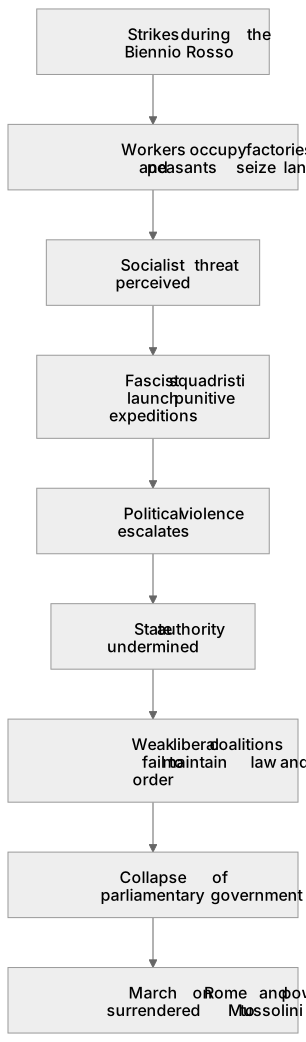
Between 1919 and 1922, Liberal Italy experienced a total political breakdown driven by the rapid rise of extremism.
Checked against the AQA 7042 specification (opens in a new tab) on .
- Point 4 of 4
- 2 key terms
Study notes
From the checked teaching notes for this specification point.
The idea
Between 1919 and 1922, Liberal Italy experienced a total political breakdown driven by the rapid rise of extremism. Widespread strikes paralysed the nation during the Biennio Rosso, with workers occupying factories and peasants seizing land. In response to this socialist threat, political violence escalated dramatically. Fascist squadristi launched brutal punitive expeditions against socialist councils and trade unions, often with the complicity of the police. This unchecked violence fatally undermined state authority. The collapse of parliamentary government culminated in the 1922 March on Rome, as successive weak liberal coalitions failed to maintain law and order, ultimately surrendering power to Mussolini.
What earns the marks
- Detail the scale and impact of the strikes during the Biennio Rosso (1919–1920), including the September 1920 factory occupations.
- Analyse the role of fascist squadrismo in systematically destroying socialist and Catholic labour organisations through extreme political violence.
- Evaluate the complicity of state institutions, such as the police and judiciary, who frequently ignored or actively supported fascist violence.
- Explain how the inability of liberal politicians like Giolitti and Facta to form stable coalitions led to the paralysis and collapse of parliamentary government.
- Assess how the fear of a Bolshevik-style revolution drove the conservative elites to view fascist extremism as a necessary evil.
Common mistakes and how to put them right
Claiming that the fascists seized power by force during the March on Rome.
Put it right: Mussolini was actually appointed Prime Minister constitutionally by the King before the marchers arrived.
Assuming the strikes were orchestrated by a unified socialist leadership.
Put it right: The strikes were often spontaneous and lacked coordinated national direction from the PSI.
Stating that political violence was exclusively fascist.
Put it right: Socialist and communist groups also engaged in violence, though they were ultimately overwhelmed by the squadristi.
Exam tips
- Contrast the perceived threat of the socialist strikes with the actual physical threat posed by fascist political violence to evaluate why the liberal state collapsed.
- Use specific examples of fascist violence, such as the destruction of the Avanti! newspaper offices, to illustrate the breakdown of law and order.
- Discuss Giolitti's failed strategy of transformismo (trying to absorb the fascists into his 1921 electoral bloc) as a key factor in the collapse of parliamentary government.
Try the lesson
The start of the 2L Italy and Fascism, c1900–1945 – The collapse of Liberal Italy and Mussolini’s Rise to Power, 1915–1922: Political breakdown and the rise of extremism: strikes; political violence and the collapse of parliamentary government lesson, made from checked teaching notes for this specification point.
Have a go first
What was the primary characteristic of the 'Biennio Rosso' (Two Red Years) in Italy between 1919 and 1920?
Listen
Between 1919 and 1922, Liberal Italy experienced a total political breakdown driven by the rapid rise of extremism. Widespread strikes paralysed the nation during the Biennio Rosso, with workers occupying factories and peasants seizing land. In response to this socialist threat, political violence escalated dramatically. Fascist squadristi launched brutal punitive expeditions against socialist councils and trade unions, often with the complicity of the police. This unchecked violence fatally undermined state authority. The collapse of parliamentary government culminated in the 1922 March on Rome, as successive weak liberal coalitions failed to maintain law and order, ultimately surrendering power to Mussolini. A strong answer earns marks for these points. Detail the scale and impact of the strikes during the Biennio Rosso (1919–1920), including the September 1920 factory occupations. Analyse the role of fascist squadrismo in systematically destroying socialist and Catholic labour organisations through extreme political violence. Evaluate the complicity of state institutions, such as the police and judiciary, who frequently ignored or actively supported fascist violence. Explain how the inability of liberal politicians like Giolitti and Facta to form stable coalitions led to the paralysis and collapse of parliamentary government. Exam tip: Contrast the perceived threat of the socialist strikes with the actual physical threat posed by fascist political violence to evaluate why the liberal state collapsed.
See it
Key words
Say what each word means before you turn the card.
Political violence
Try answering aloud or in your head before turning the card.
Breakdown of law and order
Try answering aloud or in your head before turning the card.
See every definition
- Political violence
- Escalated dramatically in response to the socialist threat, as Fascist squadristi launched brutal punitive expeditions against socialist councils and trade unions.
- Breakdown of law and order
- Unchecked violence fatally undermined state authority, as successive weak liberal coalitions failed to maintain it.
Label the diagram
Some boxes have lost their names. Pick the right name for each number.
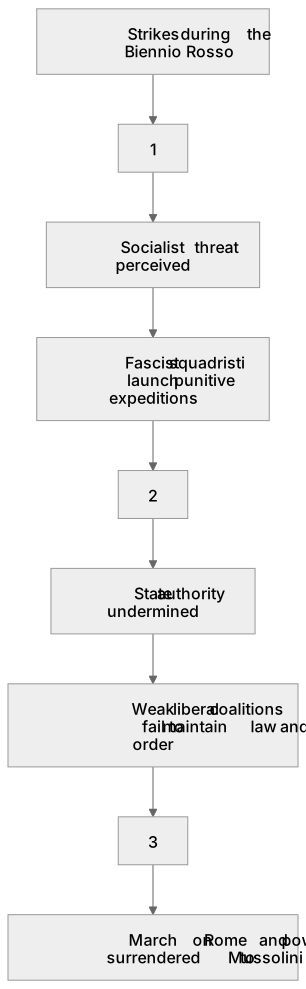
1Box 1
2Box 2
3Box 3
There is more to this lesson
The full lesson goes on to check your understanding and help you earn the marks. Create a free account to carry on, with your progress saved.
A week of Premium from your first lesson · Then the free plan continues · No card, no charge
Test your understanding of 2L Italy and Fascism, c1900–1945 – The collapse of Liberal Italy and Mussolini’s Rise to Power, 1915–1922: Political breakdown and the rise of extremism: strikes; political violence and the collapse of parliamentary government
Active recall beats re-reading. Take an instant quiz now to test what you’ve learned and lock it into long-term memory.
A week of Premium from your first lesson · Then the free plan continues · No card, no charge