AQA · A-Level · History
Course version: 7042 · Version from Sept 2017
The post-war economic crisis and social unrest: unemployment and…
Full specification wording
2L Italy and Fascism, c1900–1945 – The collapse of Liberal Italy and Mussolini’s Rise to Power, 1915–1922: The post-war economic crisis and social unrest: unemployment and inflation; government instability; the rise of the PSI; the Popolari and the Fascist Party
Following World War One, Italy suffered a severe economic crisis characterised by soaring inflation and mass unemployment as millions of demobilised soldiers returned home.
Checked against the AQA 7042 specification (opens in a new tab) on .
- Point 3 of 4
- 3 key terms
Study notes
From the checked teaching notes for this specification point.
The idea
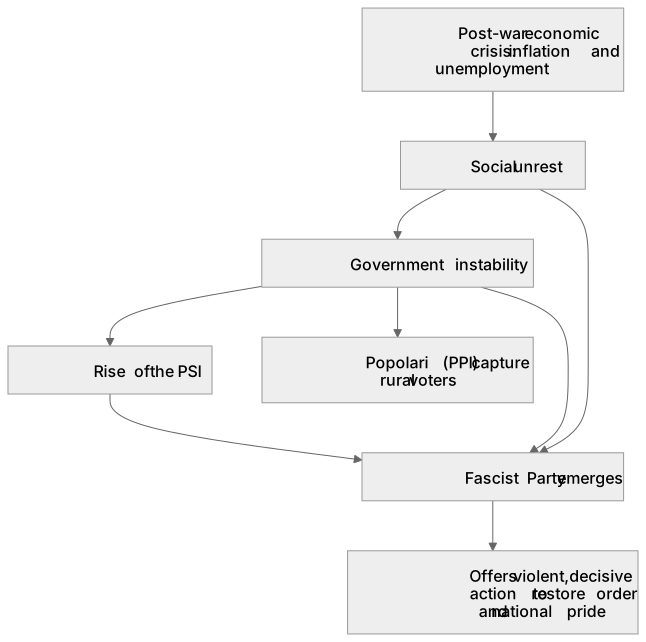
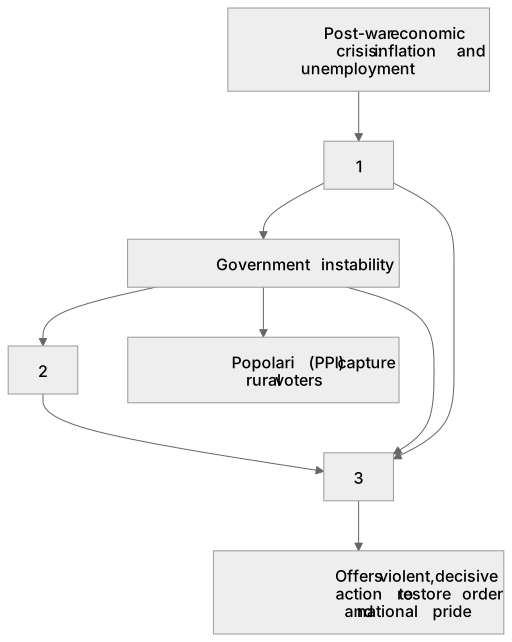
Following World War One, Italy suffered a severe economic crisis characterised by soaring inflation and mass unemployment as millions of demobilised soldiers returned home. This fuelled intense social unrest, notably during the Biennio Rosso (1919–1920). Amidst this chaos, successive liberal governments proved highly unstable and incapable of restoring order. Consequently, mass political parties surged in popularity. The Socialist Party (PSI) grew rapidly, demanding radical reform, while the newly formed Catholic Popolari (PPI) captured rural voters. Exploiting the fear of socialism and the weakness of the liberal state, Mussolini’s Fascist Party emerged, offering violent, decisive action to restore national pride and order.
What earns the marks
- Explain the impact of demobilisation on unemployment figures, which reached over two million by 1919.
- Analyse how wartime borrowing and printing money led to severe inflation, destroying the savings of the middle classes.
- Evaluate the structural weaknesses of the liberal parliamentary system, leading to short-lived, unstable coalition governments.
- Assess the electoral breakthrough of the PSI and the Popolari in the 1919 elections, which ended the liberal monopoly on power.
- Examine how the Fascist Party capitalised on middle-class fears of a socialist revolution to gain financial and political backing.
Common mistakes and how to put them right
Confusing the Popolari (PPI) with the Fascist Party.
Put it right: The Popolari were a Catholic mass party founded by Luigi Sturzo, distinct from Mussolini's movement.
Assuming the Fascist Party was immediately successful in 1919.
Put it right: They actually performed very poorly in the 1919 elections before surging in popularity in 1921.
Stating that inflation only affected the working class.
Put it right: Inflation disproportionately devastated the savings and fixed incomes of the petty bourgeoisie, driving them towards fascism.
Exam tips
- Link economic factors directly to political outcomes, showing how inflation and unemployment radicalised different social classes.
- Use the 1919 election results to demonstrate the shift from traditional liberal dominance to the era of mass parties (PSI and PPI).
- When discussing government instability, mention the failure of proportional representation to produce workable coalitions between the PSI and PPI.
Try the lesson
The start of the 2L Italy and Fascism, c1900–1945 – The collapse of Liberal Italy and Mussolini’s Rise to Power, 1915–1922: The post-war economic crisis and social unrest: unemployment and inflation; government instability; the rise of the PSI; the Popolari and the Fascist Party lesson, made from checked teaching notes for this specification point.
Have a go first
Which combination of economic factors most directly fuelled social unrest in Italy immediately following the First World War?
Listen
Following World War One, Italy suffered a severe economic crisis characterised by soaring inflation and mass unemployment as millions of demobilised soldiers returned home. This fuelled intense social unrest, notably during the Biennio Rosso (1919–1920). Amidst this chaos, successive liberal governments proved highly unstable and incapable of restoring order. Consequently, mass political parties surged in popularity. The Socialist Party (PSI) grew rapidly, demanding radical reform, while the newly formed Catholic Popolari (PPI) captured rural voters. Exploiting the fear of socialism and the weakness of the liberal state, Mussolini’s Fascist Party emerged, offering violent, decisive action to restore national pride and order. A strong answer earns marks for these points. Explain the impact of demobilisation on unemployment figures, which reached over two million by 1919. Analyse how wartime borrowing and printing money led to severe inflation, destroying the savings of the middle classes. Evaluate the structural weaknesses of the liberal parliamentary system, leading to short-lived, unstable coalition governments. Assess the electoral breakthrough of the PSI and the Popolari in the 1919 elections, which ended the liberal monopoly on power. Exam tip: Link economic factors directly to political outcomes, showing how inflation and unemployment radicalised different social classes.
See it
Key words
Say what each word means before you turn the card.
Economic instability
Try answering aloud or in your head before turning the card.
Failure of liberal democracy
Try answering aloud or in your head before turning the card.
Rise of mass movements
Try answering aloud or in your head before turning the card.
See every definition
- Economic instability
- A severe post-war crisis of soaring inflation and mass unemployment, worsened as millions of demobilised soldiers returned home.
- Failure of liberal democracy
- Successive liberal governments proved highly unstable and incapable of restoring order, ending the liberal monopoly on power.
- Rise of mass movements
- Mass political parties surged in popularity, including the PSI, the Popolari and Mussolini's Fascist Party, which offered violent, decisive action.
Label the diagram
Some boxes have lost their names. Pick the right name for each number.
1Box 1
2Box 2
3Box 3
There is more to this lesson
The full lesson goes on to check your understanding and help you earn the marks. Create a free account to carry on, with your progress saved.
A week of Premium from your first lesson · Then the free plan continues · No card, no charge
Test your understanding of 2L Italy and Fascism, c1900–1945 – The collapse of Liberal Italy and Mussolini’s Rise to Power, 1915–1922: The post-war economic crisis and social unrest: unemployment and inflation; government instability; the rise of the PSI; the Popolari and the Fascist Party
Active recall beats re-reading. Take an instant quiz now to test what you’ve learned and lock it into long-term memory.
A week of Premium from your first lesson · Then the free plan continues · No card, no charge