AQA · A-Level · History
Course version: 7042 · Version from Sept 2017
Britain in Transition, 1906–1957 – 'Never had it so good'? 1951–1957…
Full specification wording
2M Wars and Welfare: Britain in Transition, 1906–1957 – 'Never had it so good'? 1951–1957 (A-level only): Conservative governments and reasons for political dominance: Churchill, Eden and Macmillan as political leaders; domestic policies; internal Labour divisions; consensus politics
From 1951 to 1957, the Conservatives achieved political dominance under Churchill, Eden, and Macmillan.
Checked against the AQA 7042 specification (opens in a new tab) on .
- Point 1 of 4
- 4 key terms
Study notes
From the checked teaching notes for this specification point.
The idea
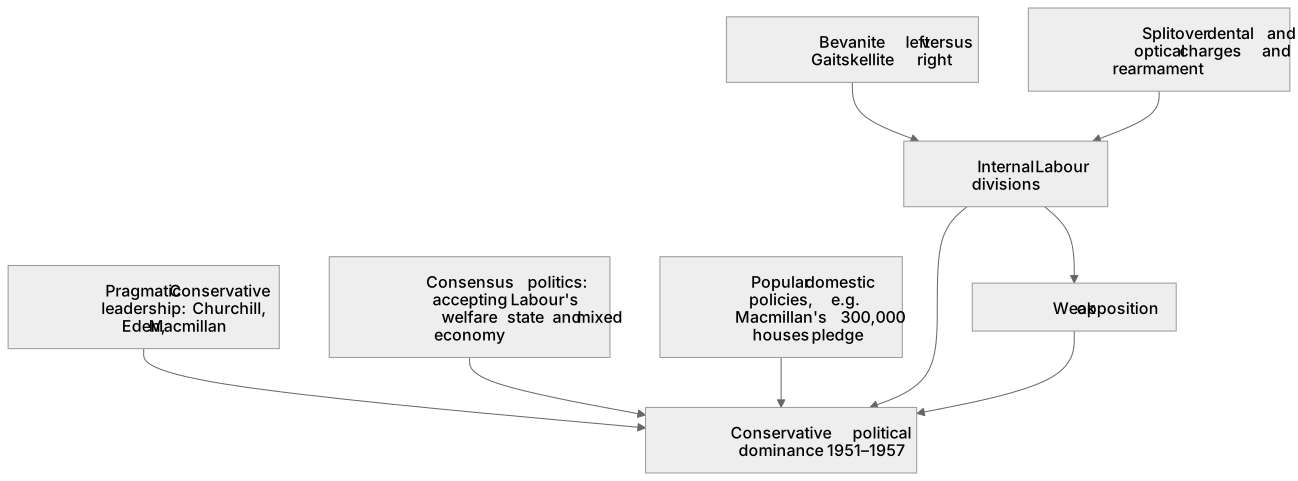
From 1951 to 1957, the Conservatives achieved political dominance under Churchill, Eden, and Macmillan. Their success relied on 'consensus politics', accepting Labour's welfare state and mixed economy. Popular domestic policies, like Macmillan's pledge to build 300,000 houses annually, cemented their appeal. Crucially, this dominance was aided by severe internal Labour divisions. The split between the Bevanite left and Gaitskellite right over dental and optical charges and rearmament rendered the opposition weak. Thus, pragmatic Conservative leadership, appealing domestic reforms, and a fractured Labour Party ensured sustained Conservative control.
What earns the marks
- Evaluate the extent to which consensus politics contributed to Conservative electoral success between 1951 and 1957.
- Assess the impact of internal Labour divisions, specifically the Bevanite split over dental and optical charges, on the Conservative Party's ability to maintain power.
- Analyse the effectiveness of Churchill, Eden, and Macmillan as political leaders in projecting stability and competence.
- Examine the role of specific domestic policies, such as the housing drive, in securing working-class and middle-class votes.
Common mistakes and how to put them right
Claiming the Conservatives dismantled the welfare state after 1951.
Put it right: Explain that the Conservatives embraced consensus politics, maintaining the welfare state and the mixed economy.
Treating the Labour Party as a united opposition during this period.
Put it right: Highlight the deep ideological divisions between the Bevanite left and the Gaitskellite right over issues like rearmament and health charges.
Attributing Conservative dominance solely to economic factors.
Put it right: Ensure you also evaluate the roles of political leadership, domestic policy successes, and opposition weakness.
Exam tips
- When discussing leadership, contrast Churchill's figurehead status with the active domestic management by figures like Macmillan and Butler.
- Use the 300,000 houses pledge as a concrete example of how the Conservatives outmanoeuvred Labour on domestic policy.
- Weigh the relative importance of Conservative strengths against Labour weaknesses when explaining political dominance.
Try the lesson
The start of the 2M Wars and Welfare: Britain in Transition, 1906–1957 – 'Never had it so good'? 1951–1957 (A-level only): Conservative governments and reasons for political dominance: Churchill, Eden and Macmillan as political leaders; domestic policies; internal Labour divisions; consensus politics lesson, made from checked teaching notes for this specification point.
Have a go first
Which of the following internal divisions significantly weakened the Labour Party and contributed to Conservative political dominance in the 1950s?
Listen
From 1951 to 1957, the Conservatives achieved political dominance under Churchill, Eden, and Macmillan. Their success relied on 'consensus politics', accepting Labour's welfare state and mixed economy. Popular domestic policies, like Macmillan's pledge to build 300,000 houses annually, cemented their appeal. Crucially, this dominance was aided by severe internal Labour divisions. The split between the Bevanite left and Gaitskellite right over dental and optical charges and rearmament rendered the opposition weak. Thus, pragmatic Conservative leadership, appealing domestic reforms, and a fractured Labour Party ensured sustained Conservative control. A strong answer earns marks for these points. Evaluate the extent to which consensus politics contributed to Conservative electoral success between 1951 and 1957. Assess the impact of internal Labour divisions, specifically the Bevanite split over dental and optical charges, on the Conservative Party's ability to maintain power. Analyse the effectiveness of Churchill, Eden, and Macmillan as political leaders in projecting stability and competence. Examine the role of specific domestic policies, such as the housing drive, in securing working-class and middle-class votes. A common slip: Claiming the Conservatives dismantled the welfare state after 1951. Instead, Explain that the Conservatives embraced consensus politics, maintaining the welfare state and the mixed economy. Exam tip: When discussing leadership, contrast Churchill's figurehead status with the active domestic management by figures like Macmillan and Butler.
See it
Key words
Say what each word means before you turn the card.
Consensus politics
Try answering aloud or in your head before turning the card.
Domestic reform
Try answering aloud or in your head before turning the card.
Party divisions
Try answering aloud or in your head before turning the card.
Political leadership
Try answering aloud or in your head before turning the card.
See every definition
- Consensus politics
- Accepting Labour's welfare state and mixed economy, on which Conservative success from 1951 to 1957 relied.
- Domestic reform
- Popular domestic policies, such as Macmillan's pledge to build 300,000 houses annually, which cemented Conservative appeal.
- Party divisions
- Severe internal Labour divisions, including the split between the Bevanite left and Gaitskellite right, which rendered the opposition weak.
- Political leadership
- Pragmatic Conservative leadership under Churchill, Eden and Macmillan, which helped ensure sustained Conservative control.
Label the diagram
Some boxes have lost their names. Pick the right name for each number.
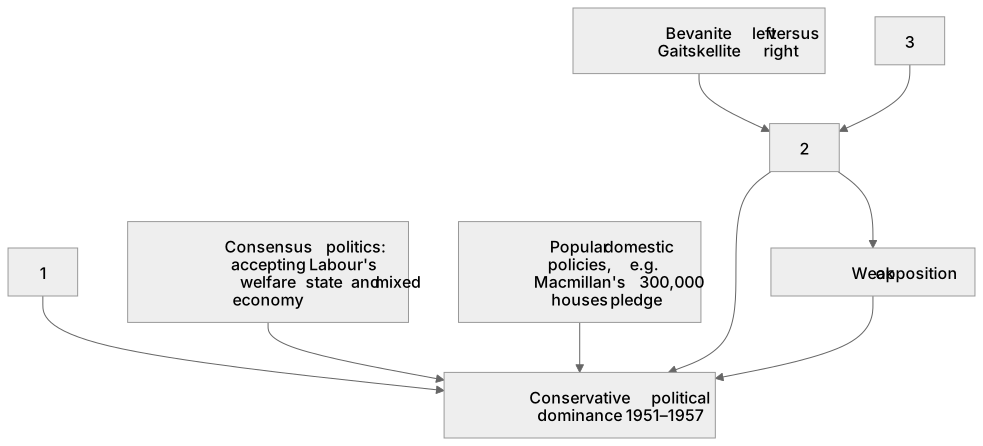
1Box 1
2Box 2
3Box 3
There is more to this lesson
The full lesson goes on to check your understanding and help you earn the marks. Create a free account to carry on, with your progress saved.
A week of Premium from your first lesson · Then the free plan continues · No card, no charge
Test your understanding of 2M Wars and Welfare: Britain in Transition, 1906–1957 – 'Never had it so good'? 1951–1957 (A-level only): Conservative governments and reasons for political dominance: Churchill, Eden and Macmillan as political leaders; domestic policies; internal Labour divisions; consensus politics
Active recall beats re-reading. Take an instant quiz now to test what you’ve learned and lock it into long-term memory.
A week of Premium from your first lesson · Then the free plan continues · No card, no charge