AQA · A-Level · History
Course version: 7042 · Version from Sept 2017
Britain in Transition, 1906–1957 – 'Never had it so good'? 1951–1957…
Full specification wording
2M Wars and Welfare: Britain in Transition, 1906–1957 – 'Never had it so good'? 1951–1957 (A-level only): Economic developments: post-war boom; balance of payments issues and 'stop-go' policies
From 1951 to 1957, Britain enjoyed a post-war boom with full employment and rising living standards, boosting consumer spending on goods like cars.
Checked against the AQA 7042 specification (opens in a new tab) on .
- Point 2 of 4
Study notes
From the checked teaching notes for this specification point.
The idea
From 1951 to 1957, Britain enjoyed a post-war boom with full employment and rising living standards, boosting consumer spending on goods like cars. However, this prosperity masked structural flaws, notably persistent balance of payments issues where import costs exceeded export revenues. To manage these crises, Chancellors used 'stop-go' policies. When the economy overheated, they applied a 'stop' by raising interest rates and taxes to suppress demand. Once the balance of payments stabilised, a 'go' phase was triggered by cutting taxes and lowering rates. This stimulated the economy but created a cycle of short-term management, failing to address the root causes of Britain's relative economic decline.
What earns the marks
- Explain the characteristics of the post-war boom, including full employment and rising consumer affluence.
- Analyse the causes and consequences of Britain's balance of payments issues during the 1950s.
- Evaluate the mechanics and effectiveness of 'stop-go' economic policies in managing inflation and trade deficits.
- Assess the long-term impact of short-term economic management on Britain's industrial competitiveness and economic growth.
Common mistakes and how to put them right
Confusing the national debt with the balance of payments deficit.
Put it right: Clearly define the balance of payments as the difference in value between a country's imports and exports.
Assuming 'stop-go' policies were a sign of economic failure at the time.
Put it right: Recognise that while they hindered long-term growth, they successfully maintained full employment and controlled inflation in the short term.
Describing the post-war boom without acknowledging underlying economic weaknesses.
Put it right: Contrast the visible rise in living standards with the structural problems in British industry and trade.
Exam tips
- Use specific examples of 'stop' measures (e.g., raising interest rates) and 'go' measures (e.g., tax cuts before an election) to illustrate your points.
- Link the balance of payments issues directly to the necessity of implementing 'stop-go' policies.
- Consider how the commitment to consensus politics and full employment limited the economic options available to Conservative Chancellors.
Try the lesson
The start of the 2M Wars and Welfare: Britain in Transition, 1906–1957 – 'Never had it so good'? 1951–1957 (A-level only): Economic developments: post-war boom; balance of payments issues and 'stop-go' policies lesson, made from checked teaching notes for this specification point.
Have a go first
In the context of the British economy during the 1950s, what was the primary characteristic of 'stop-go' policies?
Listen
From 1951 to 1957, Britain enjoyed a post-war boom with full employment and rising living standards, boosting consumer spending on goods like cars. However, this prosperity masked structural flaws, notably persistent balance of payments issues where import costs exceeded export revenues. To manage these crises, Chancellors used 'stop-go' policies. When the economy overheated, they applied a 'stop' by raising interest rates and taxes to suppress demand. Once the balance of payments stabilised, a 'go' phase was triggered by cutting taxes and lowering rates. This stimulated the economy but created a cycle of short-term management, failing to address the root causes of Britain's relative economic decline. A strong answer earns marks for these points. Explain the characteristics of the post-war boom, including full employment and rising consumer affluence. Analyse the causes and consequences of Britain's balance of payments issues during the 1950s. Evaluate the mechanics and effectiveness of 'stop-go' economic policies in managing inflation and trade deficits. Assess the long-term impact of short-term economic management on Britain's industrial competitiveness and economic growth. A common slip: Confusing the national debt with the balance of payments deficit. Instead, Clearly define the balance of payments as the difference in value between a country's imports and exports. Exam tip: Use specific examples of 'stop' measures (e.g., raising interest rates) and 'go' measures (e.g., tax cuts before an election) to illustrate your points.
See it
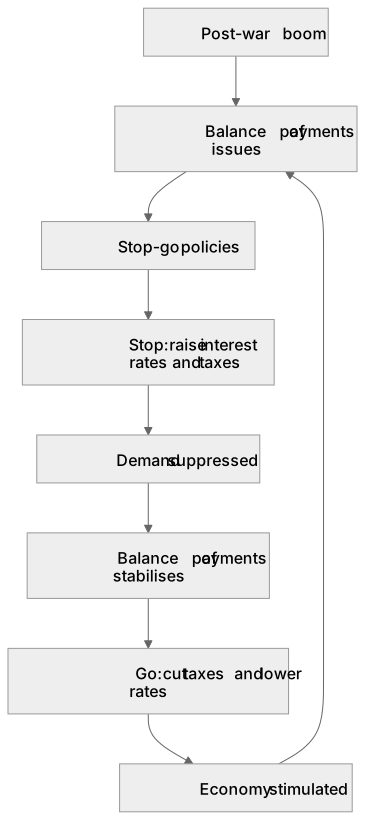
Label the diagram
Some boxes have lost their names. Pick the right name for each number.
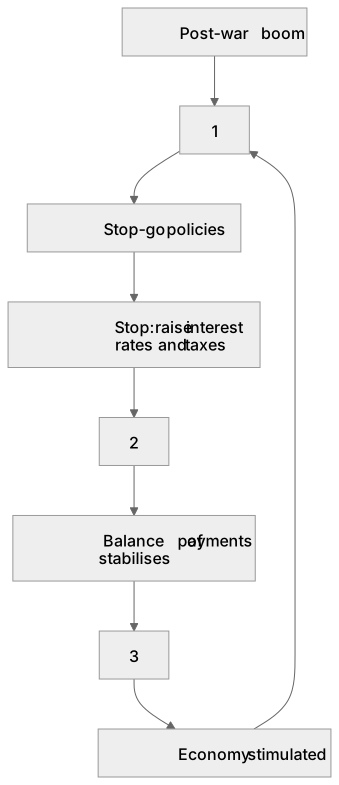
1Box 1
2Box 2
3Box 3
There is more to this lesson
The full lesson goes on to check your understanding and help you earn the marks. Create a free account to carry on, with your progress saved.
A week of Premium from your first lesson · Then the free plan continues · No card, no charge
Test your understanding of 2M Wars and Welfare: Britain in Transition, 1906–1957 – 'Never had it so good'? 1951–1957 (A-level only): Economic developments: post-war boom; balance of payments issues and 'stop-go' policies
Active recall beats re-reading. Take an instant quiz now to test what you’ve learned and lock it into long-term memory.
A week of Premium from your first lesson · Then the free plan continues · No card, no charge