AQA · A-Level · History
Course version: 7042 · Version from Sept 2017
Britain in Transition, 1906–1957 – only) The 'Hungry Thirties', 1929–1939…
Full specification wording
2M Wars and Welfare: Britain in Transition, 1906–1957 – only) The 'Hungry Thirties', 1929–1939 (A-level only): Economic issues: the Depression and financial crisis; changes to economic policy, including moving from the Gold Standard; tariff reform and imperial preference; effect on industry, agriculture and trade
The Great Depression triggered a severe financial crisis in Britain, characterised by collapsing exports and soaring unemployment.
Checked against the AQA 7042 specification (opens in a new tab) on .
- Point 2 of 4
- 4 key terms
Study notes
From the checked teaching notes for this specification point.
The idea
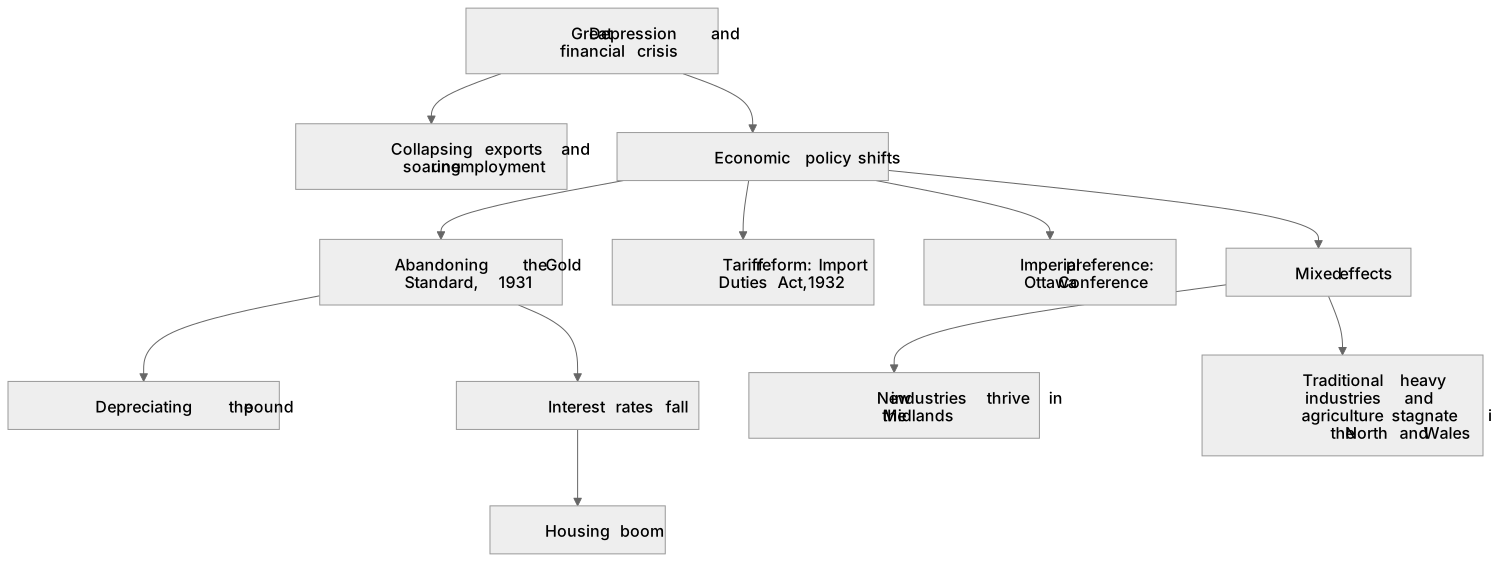
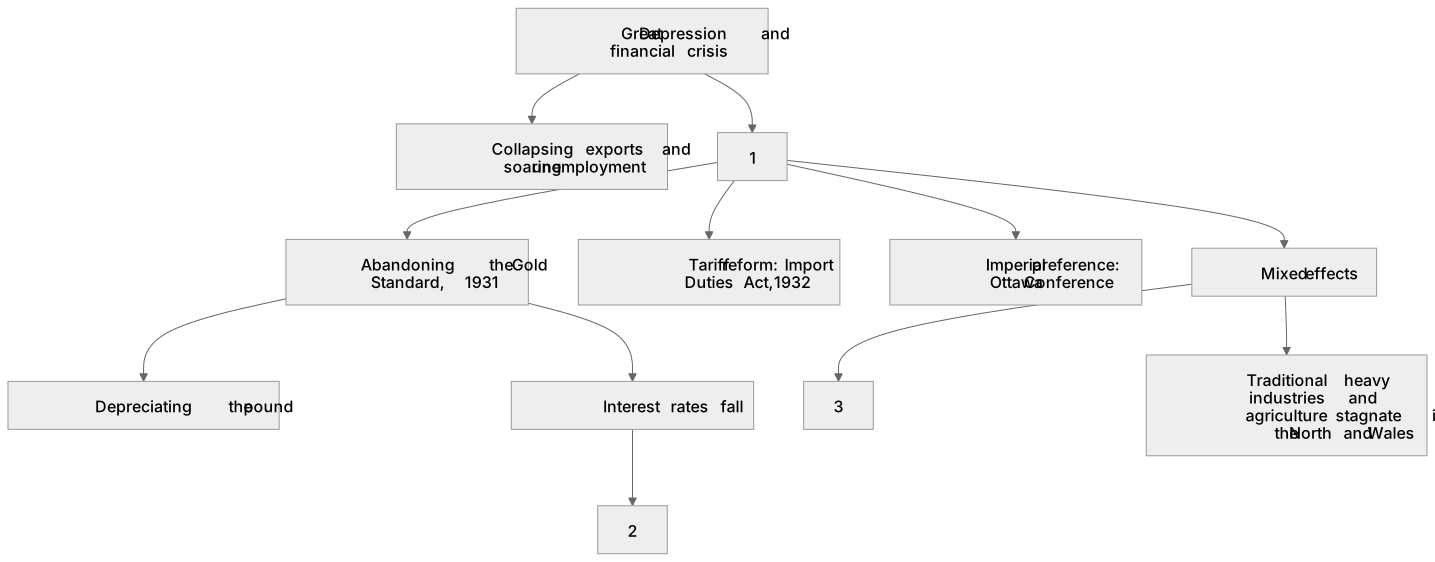
The Great Depression triggered a severe financial crisis in Britain, characterised by collapsing exports and soaring unemployment. In response, economic policy shifted dramatically. The National Government abandoned the Gold Standard in 1931, depreciating the pound to make British exports more competitive and allowing interest rates to fall, stimulating a housing boom. Furthermore, the 1932 Import Duties Act introduced tariff reform, ending free trade, while the Ottawa Conference established imperial preference to boost trade within the British Empire. These policies had mixed effects: new industries like motor manufacturing thrived in the Midlands, whereas traditional heavy industries and agriculture in the North and Wales continued to stagnate.
What earns the marks
- Explain the causes and immediate impact of the 1931 financial crisis on the British economy and international trade.
- Analyse the consequences of leaving the Gold Standard, particularly the impact of 'cheap money' on the private housing market.
- Evaluate the effectiveness of tariff reform and imperial preference in protecting British trade and agriculture from foreign competition.
- Contrast the economic fortunes of traditional heavy industries with the growth of new consumer industries during the 1930s.
Common mistakes and how to put them right
Stating that leaving the Gold Standard was a deliberate, planned policy.
Put it right: It was actually forced upon the government by a severe run on the pound.
Assuming the Depression affected the whole country equally.
Put it right: There was a stark regional divide between the relatively prosperous South and the depressed North.
Confusing tariff reform with free trade.
Put it right: Tariff reform meant introducing protectionist duties, explicitly ending Britain's long-standing commitment to free trade.
Exam tips
- Use the concept of 'cheap money' (low interest rates) to explain the uneven economic recovery and the boom in private house building.
- When discussing imperial preference, explicitly mention the 1932 Ottawa Conference as the key event where these trade agreements were negotiated.
- Provide specific examples of 'old' industries (coal, shipbuilding) versus 'new' industries (chemicals, automobiles) to illustrate regional economic disparities.
Try the lesson
The start of the 2M Wars and Welfare: Britain in Transition, 1906–1957 – only) The 'Hungry Thirties', 1929–1939 (A-level only): Economic issues: the Depression and financial crisis; changes to economic policy, including moving from the Gold Standard; tariff reform and imperial preference; effect on industry, agriculture and trade lesson, made from checked teaching notes for this specification point.
Have a go first
Which significant change to British economic policy was implemented by the National Government in September 1931 in response to the financial crisis?
Listen
The Great Depression triggered a severe financial crisis in Britain, characterised by collapsing exports and soaring unemployment. In response, economic policy shifted dramatically. The National Government abandoned the Gold Standard in 1931, depreciating the pound to make British exports more competitive and allowing interest rates to fall, stimulating a housing boom. Furthermore, the 1932 Import Duties Act introduced tariff reform, ending free trade, while the Ottawa Conference established imperial preference to boost trade within the British Empire. These policies had mixed effects: new industries like motor manufacturing thrived in the Midlands, whereas traditional heavy industries and agriculture in the North and Wales continued to stagnate. A strong answer earns marks for these points. Explain the causes and immediate impact of the 1931 financial crisis on the British economy and international trade. Analyse the consequences of leaving the Gold Standard, particularly the impact of 'cheap money' on the private housing market. Evaluate the effectiveness of tariff reform and imperial preference in protecting British trade and agriculture from foreign competition. Contrast the economic fortunes of traditional heavy industries with the growth of new consumer industries during the 1930s. Exam tip: Use the concept of 'cheap money' (low interest rates) to explain the uneven economic recovery and the boom in private house building.
See it
Key words
Say what each word means before you turn the card.
Protectionism
Try answering aloud or in your head before turning the card.
Regional inequality
Try answering aloud or in your head before turning the card.
Monetary policy
Try answering aloud or in your head before turning the card.
Economic depression
Try answering aloud or in your head before turning the card.
See every definition
- Protectionism
- Introducing tariff reform meant protectionist duties, explicitly ending Britain's long-standing commitment to free trade.
- Regional inequality
- A stark regional divide existed between the relatively prosperous South and the depressed North, with traditional heavy industries stagnating while new industries thrived in the Midlands.
- Monetary policy
- Economic policy shifted by abandoning the Gold Standard in 1931, depreciating the pound and allowing interest rates to fall, known as 'cheap money'.
- Economic depression
- The Great Depression triggered a severe financial crisis in Britain, characterised by collapsing exports and soaring unemployment.
Label the diagram
Some boxes have lost their names. Pick the right name for each number.
1Box 1
2Box 2
3Box 3
There is more to this lesson
The full lesson goes on to check your understanding and help you earn the marks. Create a free account to carry on, with your progress saved.
A week of Premium from your first lesson · Then the free plan continues · No card, no charge
Test your understanding of 2M Wars and Welfare: Britain in Transition, 1906–1957 – only) The 'Hungry Thirties', 1929–1939 (A-level only): Economic issues: the Depression and financial crisis; changes to economic policy, including moving from the Gold Standard; tariff reform and imperial preference; effect on industry, agriculture and trade
Active recall beats re-reading. Take an instant quiz now to test what you’ve learned and lock it into long-term memory.
A week of Premium from your first lesson · Then the free plan continues · No card, no charge