AQA · A-Level · History
Course version: 7042 · Version from Sept 2017
Britain in Transition, 1906–1957 – only) The 'Hungry Thirties', 1929–1939…
Full specification wording
2M Wars and Welfare: Britain in Transition, 1906–1957 – only) The 'Hungry Thirties', 1929–1939 (A-level only): Political developments: the Labour government; domestic policies and response to economic problems; the reasons for and policies of the National Government; the leadership of MacDonald, Baldwin and Chamberlain
The 1929–1931 Labour government faced severe economic challenges following the Wall Street Crash.
Checked against the AQA 7042 specification (opens in a new tab) on .
- Point 1 of 4
Study notes
From the checked teaching notes for this specification point.
The idea
The 1929–1931 Labour government faced severe economic challenges following the Wall Street Crash. Their domestic policies, including the 1930 Housing Act, were overshadowed by rising unemployment and the May Committee's demand for spending cuts, which split the cabinet. This crisis led to the formation of the National Government in 1931, initially a temporary coalition to balance the budget, but which won a massive mandate in the 1931 election. Its policies focused on economic recovery and rearmament. The era was defined by three Prime Ministers: Ramsay MacDonald's controversial decision to lead the coalition, Stanley Baldwin's steadying influence during the Abdication Crisis, and Neville Chamberlain's focus on social reform and appeasement.
What earns the marks
- Assess the impact of the May Report and the proposed unemployment benefit cuts on the collapse of the second Labour government.
- Evaluate the reasons for the formation of the National Government, distinguishing between economic necessity and political manoeuvring.
- Analyse the domestic policies of the National Government, such as the Special Areas Act 1934, in addressing unemployment.
- Compare the leadership styles and effectiveness of MacDonald, Baldwin, and Chamberlain in managing domestic crises and party unity.
Common mistakes and how to put them right
Assuming the National Government was purely a Conservative administration.
Put it right: It was a coalition, though it became increasingly Conservative-dominated over time.
Claiming MacDonald was expelled from the Labour Party before forming the National Government.
Put it right: He formed the coalition first, which subsequently led to his expulsion.
Viewing Chamberlain solely through the lens of foreign policy.
Put it right: His domestic reforms, such as the 1937 Factories Act, must also be evaluated to understand his leadership.
Exam tips
- When evaluating MacDonald's leadership, balance the accusations of betrayal from the Labour Party against his own belief that he was acting in the national interest.
- Use specific domestic policies, such as the 1930 Coal Mines Act or the 1938 Holidays with Pay Act, to support arguments about government effectiveness.
- Link political developments directly to the economic context, demonstrating how the pressures of the Depression dictated government actions and coalition formations.
Try the lesson
The start of the 2M Wars and Welfare: Britain in Transition, 1906–1957 – only) The 'Hungry Thirties', 1929–1939 (A-level only): Political developments: the Labour government; domestic policies and response to economic problems; the reasons for and policies of the National Government; the leadership of MacDonald, Baldwin and Chamberlain lesson, made from checked teaching notes for this specification point.
Have a go first
What was the primary reason for the collapse of the second Labour government and the formation of the National Government in August 1931?
Listen
The 1929–1931 Labour government faced severe economic challenges following the Wall Street Crash. Their domestic policies, including the 1930 Housing Act, were overshadowed by rising unemployment and the May Committee's demand for spending cuts, which split the cabinet. This crisis led to the formation of the National Government in 1931, initially a temporary coalition to balance the budget, but which won a massive mandate in the 1931 election. Its policies focused on economic recovery and rearmament. The era was defined by three Prime Ministers: Ramsay MacDonald's controversial decision to lead the coalition, Stanley Baldwin's steadying influence during the Abdication Crisis, and Neville Chamberlain's focus on social reform and appeasement. A strong answer earns marks for these points. Assess the impact of the May Report and the proposed unemployment benefit cuts on the collapse of the second Labour government. Evaluate the reasons for the formation of the National Government, distinguishing between economic necessity and political manoeuvring. Analyse the domestic policies of the National Government, such as the Special Areas Act 1934, in addressing unemployment. Compare the leadership styles and effectiveness of MacDonald, Baldwin, and Chamberlain in managing domestic crises and party unity. Exam tip: When evaluating MacDonald's leadership, balance the accusations of betrayal from the Labour Party against his own belief that he was acting in the national interest.
See it
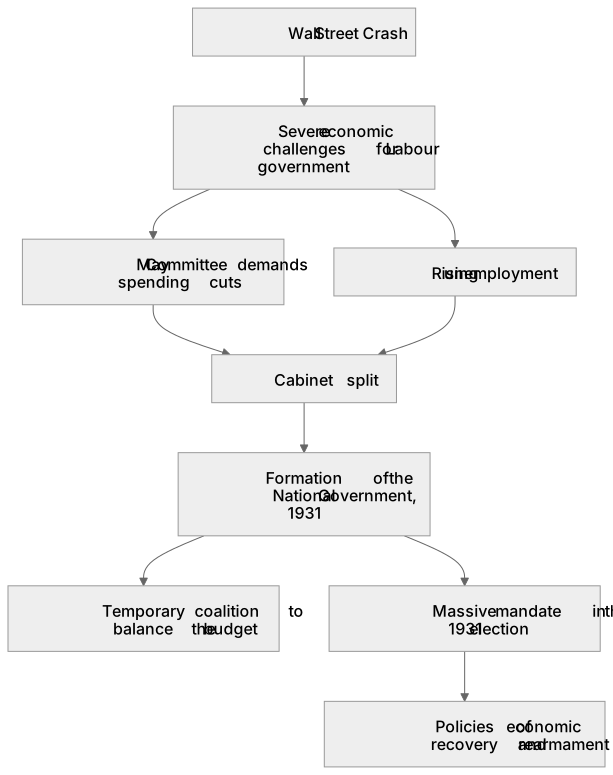
Put the events in order
Put these events in the order they happened, earliest first.
- 1. National Government formed amid economic crisis
- 2. Housing Act passed under the Labour government
- 3. Holidays with Pay Act supported arguments on government effectiveness
- 4. Special Areas Act addressed unemployment
- 5. Factories Act evaluated as Chamberlain's domestic reform
Label the diagram
Some boxes have lost their names. Pick the right name for each number.
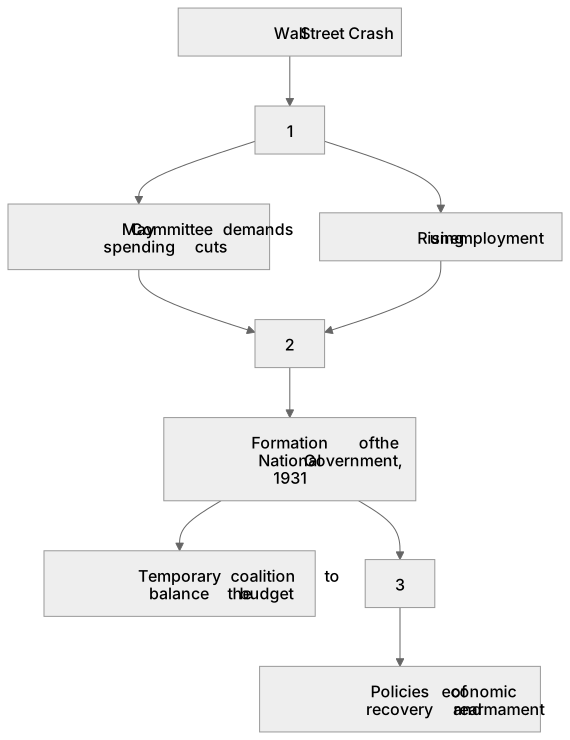
1Box 1
2Box 2
3Box 3
There is more to this lesson
The full lesson goes on to check your understanding and help you earn the marks. Create a free account to carry on, with your progress saved.
A week of Premium from your first lesson · Then the free plan continues · No card, no charge
Test your understanding of 2M Wars and Welfare: Britain in Transition, 1906–1957 – only) The 'Hungry Thirties', 1929–1939 (A-level only): Political developments: the Labour government; domestic policies and response to economic problems; the reasons for and policies of the National Government; the leadership of MacDonald, Baldwin and Chamberlain
Active recall beats re-reading. Take an instant quiz now to test what you’ve learned and lock it into long-term memory.
A week of Premium from your first lesson · Then the free plan continues · No card, no charge