AQA · A-Level · History
Course version: 7042 · Version from Sept 2017
Britain in Transition, 1906–1957 – The impact of war, 1914–1922: Economic…
Full specification wording
2M Wars and Welfare: Britain in Transition, 1906–1957 – The impact of war, 1914–1922: Economic issues: Britain's wartime economy; housing and austerity; trade unions; post-war industrial problems; the position of the staple industries and trade
The First World War required unprecedented state intervention to manage Britain's wartime economy, using temporary state control of key sectors like railways rather than permanent nationalisation.
Checked against the AQA 7042 specification (opens in a new tab) on .
- Point 2 of 4
- 4 key terms
Study notes
From the checked teaching notes for this specification point.
The idea
The First World War required unprecedented state intervention to manage Britain's wartime economy, using temporary state control of key sectors like railways rather than permanent nationalisation. Austerity measures controlled inflation. The war worsened housing shortages, prompting the 1915 Rent Restriction Act. Trade unions grew in membership, collaborating with the government but also engaging in militant action. Following the armistice, Britain faced severe post-war industrial problems, including a brief boom followed by a sharp depression in 1920. The traditional staple industries, such as coal and textiles, suffered structural decline due to lost export markets and foreign competition, severely impacting Britain's global trade.
What earns the marks
- Detail the extent of state control over Britain's wartime economy, including the creation and role of the Ministry of Munitions.
- Explain the causes of wartime austerity and the government's response to housing shortages, such as rent controls.
- Analyse the changing role and power of trade unions during the war, including the Treasury Agreement and the shop stewards' movement.
- Evaluate the causes of post-war industrial unrest, including the threat posed by the Triple Alliance.
- Assess the structural weaknesses of Britain's staple industries and their struggle to regain pre-war trade levels.
Common mistakes and how to put them right
Stating that the post-war economy immediately collapsed.
Put it right: Explain there was actually a brief, speculative post-war boom before the severe slump of 1920 to 1921.
Assuming trade unions were universally suppressed during the war.
Put it right: Note that union leaders were often integrated into government planning, though grassroots militancy did occur.
Blaming the decline of staple industries solely on the war.
Put it right: Clarify that the war accelerated existing structural issues and foreign competition that predated 1914.
Claiming the government permanently nationalised industries during WWI.
Put it right: Specify that the government exercised temporary state control and requisitioning (e.g., of railways and coal mines), which were returned to private ownership post-war.
Exam tips
- Connect the wartime expansion of trade union membership to the increased industrial militancy seen in the immediate post-war years.
- Use specific examples, such as the coal or cotton industry, to illustrate the structural decline of the staple industries.
- Contrast the government's wartime economic intervention with its rapid attempts to decontrol the economy after 1918.
Try the lesson
The start of the 2M Wars and Welfare: Britain in Transition, 1906–1957 – The impact of war, 1914–1922: Economic issues: Britain's wartime economy; housing and austerity; trade unions; post-war industrial problems; the position of the staple industries and trade lesson, made from checked teaching notes for this specification point.
Have a go first
Which of the following best describes the condition of Britain's staple industries, such as coal and textiles, in the immediate post-war period (1919-1922)?
Listen
The First World War required unprecedented state intervention to manage Britain's wartime economy, using temporary state control of key sectors like railways rather than permanent nationalisation. Austerity measures controlled inflation. The war worsened housing shortages, prompting the 1915 Rent Restriction Act. Trade unions grew in membership, collaborating with the government but also engaging in militant action. Following the armistice, Britain faced severe post-war industrial problems, including a brief boom followed by a sharp depression in 1920. The traditional staple industries, such as coal and textiles, suffered structural decline due to lost export markets and foreign competition, severely impacting Britain's global trade. A strong answer earns marks for these points. Detail the extent of state control over Britain's wartime economy, including the creation and role of the Ministry of Munitions. Explain the causes of wartime austerity and the government's response to housing shortages, such as rent controls. Analyse the changing role and power of trade unions during the war, including the Treasury Agreement and the shop stewards' movement. Evaluate the causes of post-war industrial unrest, including the threat posed by the Triple Alliance. A common slip: Stating that the post-war economy immediately collapsed. Instead, Explain there was actually a brief, speculative post-war boom before the severe slump of 1920 to 1921. Exam tip: Connect the wartime expansion of trade union membership to the increased industrial militancy seen in the immediate post-war years.
See it
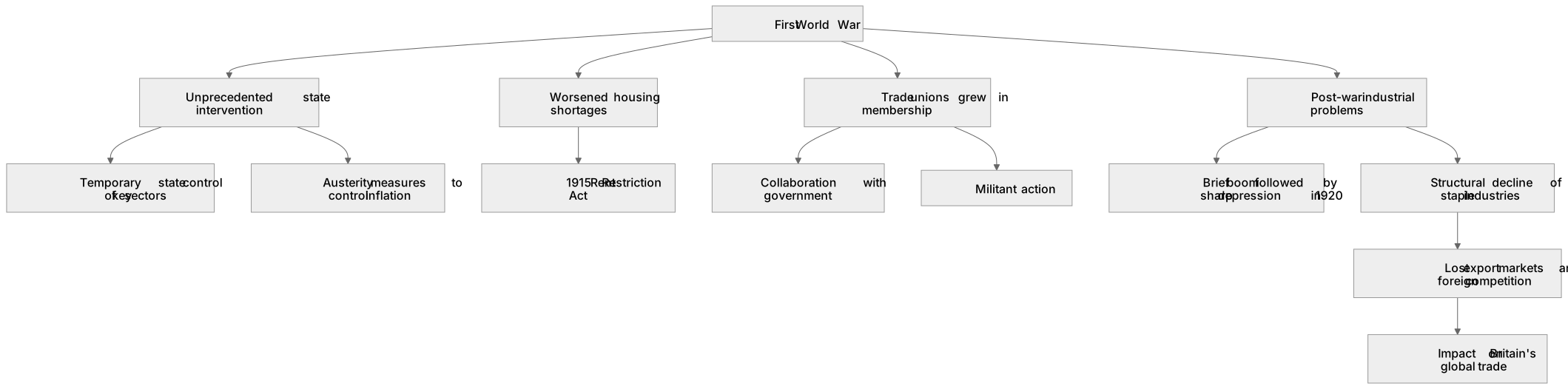
Key words
Say what each word means before you turn the card.
State intervention in the economy
Try answering aloud or in your head before turning the card.
Industrial relations and militancy
Try answering aloud or in your head before turning the card.
Structural economic decline
Try answering aloud or in your head before turning the card.
The social impact of economic policy
Try answering aloud or in your head before turning the card.
See every definition
- State intervention in the economy
- Unprecedented action to manage Britain's wartime economy, using temporary state control of key sectors like railways rather than permanent nationalisation.
- Industrial relations and militancy
- Trade unions grew in membership, collaborating with the government but also engaging in militant action.
- Structural economic decline
- The traditional staple industries, such as coal and textiles, suffered decline due to lost export markets and foreign competition, severely impacting Britain's global trade.
- The social impact of economic policy
- Austerity measures controlled inflation, and the war worsened housing shortages, prompting the 1915 Rent Restriction Act.
Label the diagram
Some boxes have lost their names. Pick the right name for each number.
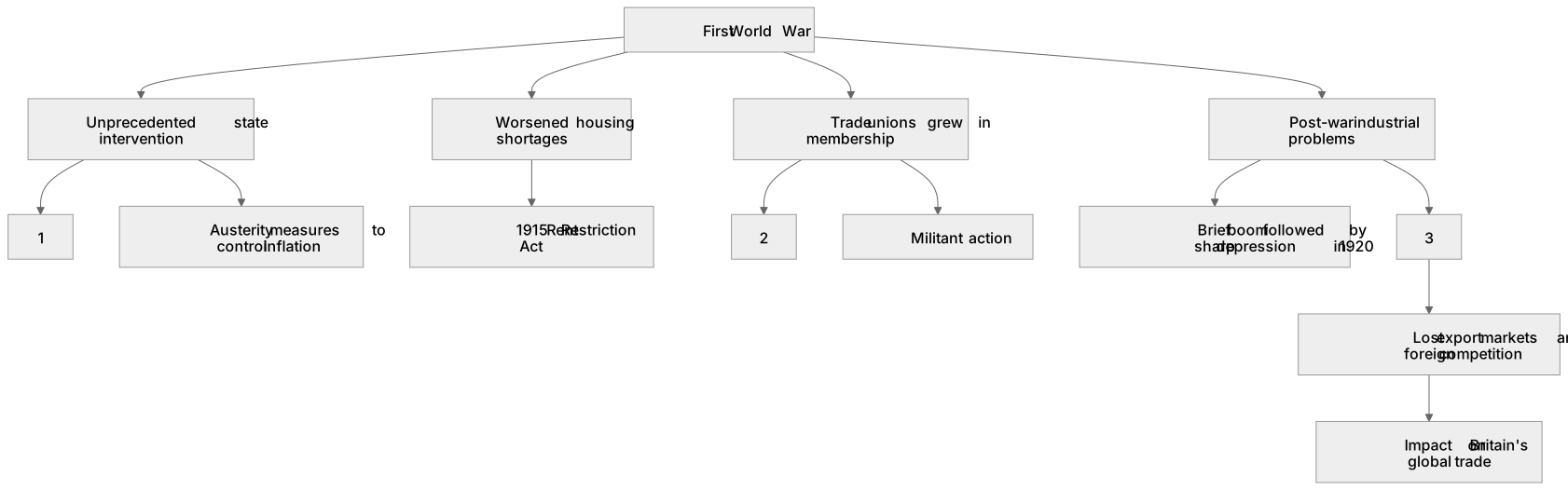
1Box 1
2Box 2
3Box 3
There is more to this lesson
The full lesson goes on to check your understanding and help you earn the marks. Create a free account to carry on, with your progress saved.
A week of Premium from your first lesson · Then the free plan continues · No card, no charge
Test your understanding of 2M Wars and Welfare: Britain in Transition, 1906–1957 – The impact of war, 1914–1922: Economic issues: Britain's wartime economy; housing and austerity; trade unions; post-war industrial problems; the position of the staple industries and trade
Active recall beats re-reading. Take an instant quiz now to test what you’ve learned and lock it into long-term memory.
A week of Premium from your first lesson · Then the free plan continues · No card, no charge