AQA · A-Level · History
Course version: 7042 · Version from Sept 2017
Britain in Transition, 1906–1957 – The impact of war, 1914–1922: Ireland:…
Full specification wording
2M Wars and Welfare: Britain in Transition, 1906–1957 – The impact of war, 1914–1922: Ireland: the Easter Rising; the war of independence and the Anglo-Irish Treaty
The 1916 Easter Rising in Dublin, led by figures like Patrick Pearse, initially lacked popular support.
Checked against the AQA 7042 specification (opens in a new tab) on .
- Point 4 of 4
Study notes
From the checked teaching notes for this specification point.
The idea
The 1916 Easter Rising in Dublin, led by figures like Patrick Pearse, initially lacked popular support. However, the British government's harsh response, including the execution of its leaders, radically shifted Irish public opinion towards republicanism and Sinn Féin. This catalyst sparked the brutal War of Independence (1919–1921), characterised by guerrilla tactics from the IRA and severe reprisals by British forces, notably the Black and Tans. The conflict culminated in the 1921 Anglo-Irish Treaty, negotiated by Michael Collins and Arthur Griffith. The Treaty established the Irish Free State as a dominion within the British Empire and confirmed the partition of Northern Ireland, a controversial compromise that subsequently triggered the Irish Civil War.
What earns the marks
- Analyse the causes of the Easter Rising and evaluate how the British execution of its leaders transformed Irish nationalist sentiment.
- Examine the guerrilla tactics employed by the IRA during the War of Independence and the impact of British counter-measures, such as the deployment of the Black and Tans.
- Assess the terms of the Anglo-Irish Treaty of 1921, specifically dominion status and the partition of the six northern counties.
- Evaluate the political consequences of the Anglo-Irish Treaty, including the split within Sinn Féin and the outbreak of the Irish Civil War.
Common mistakes and how to put them right
Confusing the Easter Rising with the War of Independence.
Put it right by distinguishing the 1916 rebellion from the sustained guerrilla war of 1919–1921.
Claiming the Anglo-Irish Treaty created a fully independent Republic of Ireland.
Put it right by stating it created the Irish Free State, which remained a dominion within the British Empire.
Stating that the Easter Rising was widely supported by the Irish public as it happened.
Put it right by explaining that public sympathy only surged after the British executed the rebel leaders.
Exam tips
- Trace the decline of the moderate Irish Parliamentary Party and the rise of Sinn Féin between 1916 and the 1918 general election.
- Use the actions of the Black and Tans to illustrate the escalation of violence and the alienation of Irish civilians during the War of Independence.
- When evaluating the Anglo-Irish Treaty, explicitly discuss the differing perspectives of Michael Collins (a stepping stone) and Éamon de Valera (a betrayal of the Republic).
Try the lesson
The start of the 2M Wars and Welfare: Britain in Transition, 1906–1957 – The impact of war, 1914–1922: Ireland: the Easter Rising; the war of independence and the Anglo-Irish Treaty lesson, made from checked teaching notes for this specification point.
Have a go first
Which of the following best describes the immediate outcome of the Easter Rising in Dublin in 1916?
Listen
The 1916 Easter Rising in Dublin, led by figures like Patrick Pearse, initially lacked popular support. However, the British government's harsh response, including the execution of its leaders, radically shifted Irish public opinion towards republicanism and Sinn Féin. This catalyst sparked the brutal War of Independence (1919–1921), characterised by guerrilla tactics from the IRA and severe reprisals by British forces, notably the Black and Tans. The conflict culminated in the 1921 Anglo-Irish Treaty, negotiated by Michael Collins and Arthur Griffith. The Treaty established the Irish Free State as a dominion within the British Empire and confirmed the partition of Northern Ireland, a controversial compromise that subsequently triggered the Irish Civil War. A strong answer earns marks for these points. Analyse the causes of the Easter Rising and evaluate how the British execution of its leaders transformed Irish nationalist sentiment. Examine the guerrilla tactics employed by the IRA during the War of Independence and the impact of British counter-measures, such as the deployment of the Black and Tans. Assess the terms of the Anglo-Irish Treaty of 1921, specifically dominion status and the partition of the six northern counties. Evaluate the political consequences of the Anglo-Irish Treaty, including the split within Sinn Féin and the outbreak of the Irish Civil War. A common slip: Confusing the Easter Rising with the War of Independence. Instead, distinguishing the 1916 rebellion from the sustained guerrilla war of 1919–1921. Exam tip: Trace the decline of the moderate Irish Parliamentary Party and the rise of Sinn Féin between 1916 and the 1918 general election.
See it
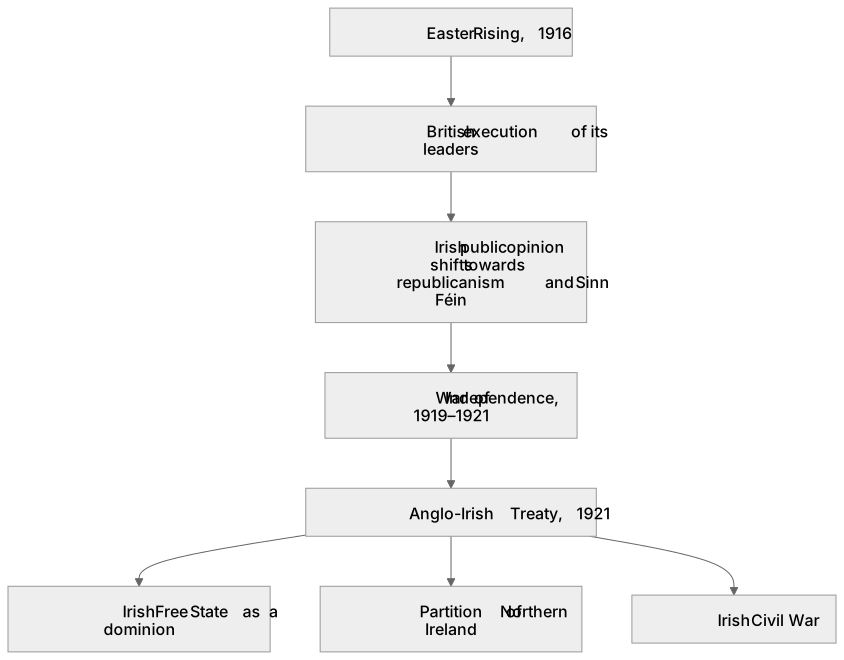
Put the events in order
Put these events in the order they happened, earliest first.
- 1. The Easter Rising took place in Dublin
- 2. The Anglo-Irish Treaty was negotiated
- 3. The War of Independence began
Label the diagram
Some boxes have lost their names. Pick the right name for each number.
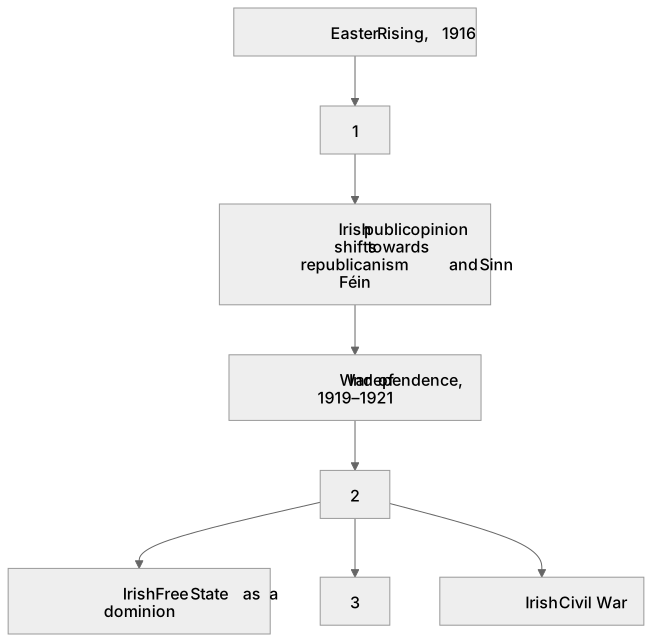
1Box 1
2Box 2
3Box 3
There is more to this lesson
The full lesson goes on to check your understanding and help you earn the marks. Create a free account to carry on, with your progress saved.
A week of Premium from your first lesson · Then the free plan continues · No card, no charge
Test your understanding of 2M Wars and Welfare: Britain in Transition, 1906–1957 – The impact of war, 1914–1922: Ireland: the Easter Rising; the war of independence and the Anglo-Irish Treaty
Active recall beats re-reading. Take an instant quiz now to test what you’ve learned and lock it into long-term memory.
A week of Premium from your first lesson · Then the free plan continues · No card, no charge