AQA · A-Level · History
Course version: 7042 · Version from Sept 2017
Britain in Transition, 1906–1957 – The Liberal crisis, 1906–1914:…
Full specification wording
2M Wars and Welfare: Britain in Transition, 1906–1957 – The Liberal crisis, 1906–1914: Challenges and crises: the constitutional crisis; the issue of female emancipation; Irish Home Rule; industrial unrest
The Liberal government faced four severe challenges and crises between 1909 and 1914.
Checked against the AQA 7042 specification (opens in a new tab) on .
- Point 4 of 4
- 4 key terms
Study notes
From the checked teaching notes for this specification point.
The idea
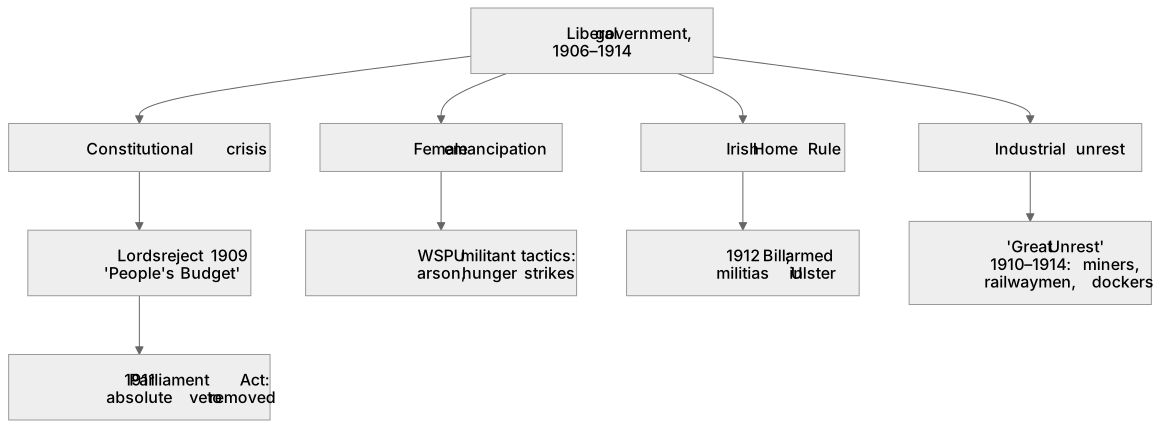
The Liberal government faced four severe challenges and crises between 1909 and 1914. The constitutional crisis erupted when the House of Lords rejected the 1909 'People's Budget', culminating in the 1911 Parliament Act which removed their absolute veto. Simultaneously, the issue of female emancipation intensified as the WSPU adopted militant suffragette tactics like arson and hunger strikes. Furthermore, Irish Home Rule brought Britain to the brink of civil war following the 1912 Bill, with armed militias forming in Ulster. Finally, severe industrial unrest swept the nation during the 'Great Unrest' (1910–1914), characterised by massive strikes by miners, railwaymen, and dockers demanding better wages and union recognition.
What earns the marks
- Explain the causes and resolution of the constitutional crisis, focusing on the rejection of the 'People's Budget' and the passing of the 1911 Parliament Act.
- Analyse the methods and impact of the campaign for female emancipation, contrasting the constitutional suffragists (NUWSS) with the militant suffragettes (WSPU).
- Assess the escalation of the Irish Home Rule crisis between 1912 and 1914, including the Curragh Mutiny and the formation of the Ulster Volunteer Force.
- Evaluate the causes and scale of industrial unrest during the 'Great Unrest', noting the influence of syndicalism and the formation of the Triple Alliance.
- Synthesise how these four concurrent crises threatened the stability of the British state and the Liberal government's control.
Common mistakes and how to put them right
Confusing the NUWSS and the WSPU.
Put it right: Clearly distinguishing the peaceful, constitutional methods of the suffragists (NUWSS) from the militant tactics of the suffragettes (WSPU).
Stating that the 1911 Parliament Act abolished the House of Lords.
Put it right by explaining it only removed their absolute veto, replacing it with a two-year delaying power.
Assuming the outbreak of World War I resolved the Irish Home Rule issue permanently.
Put it right by noting it merely suspended the implementation of the 1914 Home Rule Act, delaying the conflict.
Exam tips
- When assessing the severity of these crises, consider which posed the greatest existential threat to the British constitution and state stability.
- Link the industrial unrest to broader economic factors, such as falling real wages and the rising cost of living, rather than just political agitation.
- Use the concept of a 'Danger from Within' to structure essays comparing the relative impact of the suffragettes, trade unions, and Irish nationalists.
Try the lesson
The start of the 2M Wars and Welfare: Britain in Transition, 1906–1957 – The Liberal crisis, 1906–1914: Challenges and crises: the constitutional crisis; the issue of female emancipation; Irish Home Rule; industrial unrest lesson, made from checked teaching notes for this specification point.
Have a go first
What was the primary outcome of the Parliament Act 1911, which resolved the constitutional crisis between the House of Commons and the House of Lords?
Listen
The Liberal government faced four severe challenges and crises between 1909 and 1914. The constitutional crisis erupted when the House of Lords rejected the 1909 'People's Budget', culminating in the 1911 Parliament Act which removed their absolute veto. Simultaneously, the issue of female emancipation intensified as the WSPU adopted militant suffragette tactics like arson and hunger strikes. Furthermore, Irish Home Rule brought Britain to the brink of civil war following the 1912 Bill, with armed militias forming in Ulster. Finally, severe industrial unrest swept the nation during the 'Great Unrest' (1910–1914), characterised by massive strikes by miners, railwaymen, and dockers demanding better wages and union recognition. A strong answer earns marks for these points. Explain the causes and resolution of the constitutional crisis, focusing on the rejection of the 'People's Budget' and the passing of the 1911 Parliament Act. Analyse the methods and impact of the campaign for female emancipation, contrasting the constitutional suffragists (NUWSS) with the militant suffragettes (WSPU). Assess the escalation of the Irish Home Rule crisis between 1912 and 1914, including the Curragh Mutiny and the formation of the Ulster Volunteer Force. Evaluate the causes and scale of industrial unrest during the 'Great Unrest', noting the influence of syndicalism and the formation of the Triple Alliance. A common slip: Confusing the NUWSS and the WSPU. Instead, clearly distinguishing the peaceful, constitutional methods of the suffragists (NUWSS) from the militant tactics of the suffragettes (WSPU). Exam tip: When assessing the severity of these crises, consider which posed the greatest existential threat to the British constitution and state stability.
See it
Key words
Say what each word means before you turn the card.
Constitutional crisis
Try answering aloud or in your head before turning the card.
Female emancipation
Try answering aloud or in your head before turning the card.
Irish Home Rule
Try answering aloud or in your head before turning the card.
Industrial unrest
Try answering aloud or in your head before turning the card.
See every definition
- Constitutional crisis
- Erupted when the House of Lords rejected the 1909 'People's Budget', culminating in the 1911 Parliament Act which removed their absolute veto.
- Female emancipation
- An issue that intensified as the WSPU adopted militant suffragette tactics like arson and hunger strikes.
- Irish Home Rule
- Brought Britain to the brink of civil war following the 1912 Bill, with armed militias forming in Ulster.
- Industrial unrest
- Severe unrest swept the nation during the 'Great Unrest' (1910–1914), characterised by massive strikes by miners, railwaymen, and dockers demanding better wages and union recognition.
Label the diagram
Some boxes have lost their names. Pick the right name for each number.
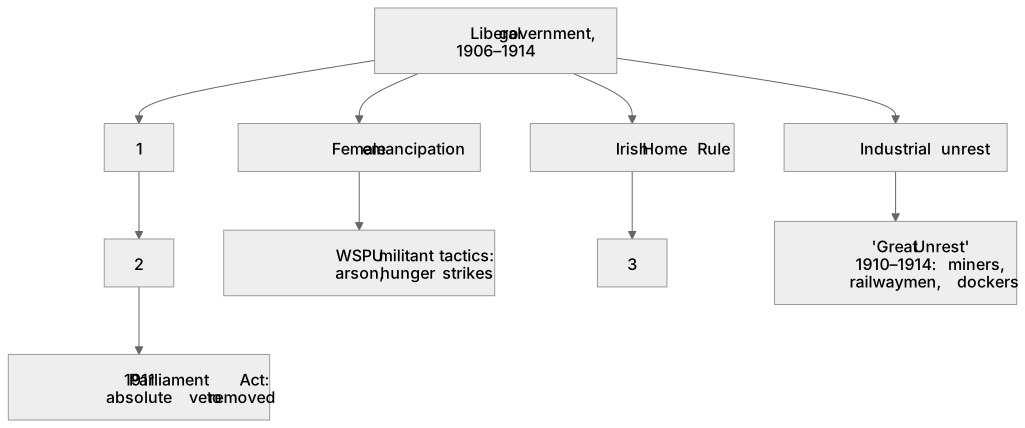
1Box 1
2Box 2
3Box 3
There is more to this lesson
The full lesson goes on to check your understanding and help you earn the marks. Create a free account to carry on, with your progress saved.
A week of Premium from your first lesson · Then the free plan continues · No card, no charge
Test your understanding of 2M Wars and Welfare: Britain in Transition, 1906–1957 – The Liberal crisis, 1906–1914: Challenges and crises: the constitutional crisis; the issue of female emancipation; Irish Home Rule; industrial unrest
Active recall beats re-reading. Take an instant quiz now to test what you’ve learned and lock it into long-term memory.
A week of Premium from your first lesson · Then the free plan continues · No card, no charge