AQA · A-Level · History
Course version: 7042 · Version from Sept 2017
Britain in Transition, 1906–1957 – The Liberal crisis, 1906–1914: Social…
Full specification wording
2M Wars and Welfare: Britain in Transition, 1906–1957 – The Liberal crisis, 1906–1914: Social issues: class division; poverty; changes in taxation; the 'People's Budget'; Liberal social and welfare reforms; reasons for legislation and its effect
Edwardian Britain faced stark class division and widespread poverty, exposed by Booth and Rowntree.
Checked against the AQA 7042 specification (opens in a new tab) on .
- Point 3 of 4
- 4 key terms
Study notes
From the checked teaching notes for this specification point.
The idea
Edwardian Britain faced stark class division and widespread poverty, exposed by Booth and Rowntree. To address this, the Liberals introduced unprecedented social and welfare reforms, including the 1908 Old Age Pensions Act and 1911 National Insurance Act. Reasons for this legislation included humanitarianism, national efficiency, and the political threat of the Labour Party. To fund these measures, Lloyd George introduced the 1909 'People's Budget', implementing radical changes in taxation like a super-tax on the wealthy. The effect of these reforms was a foundational shift away from laissez-faire attitudes towards state intervention, improving vulnerable lives while intensifying class tensions.
What earns the marks
- Identify the extent of poverty and class division in Edwardian society, referencing the findings of Booth and Rowntree.
- Explain the multifaceted reasons for Liberal legislation, including New Liberalism ideology, national efficiency concerns following the Boer War, and the electoral threat of the Labour Party.
- Detail specific Liberal social and welfare reforms, such as the provision of free school meals (1906), old age pensions (1908), and national insurance against sickness and unemployment (1911).
- Analyse the changes in taxation introduced by the 1909 'People's Budget', specifically the introduction of super-tax and land valuation taxes to fund welfare and naval expansion.
- Evaluate the effect of the reforms on British society, noting the shift from laissez-faire to state intervention and the limitations in eradicating poverty entirely.
Common mistakes and how to put them right
Claiming the Liberal reforms created a full welfare state.
Put it right by explaining that the reforms were a foundational safety net, not a comprehensive cradle-to-grave system like that of 1945.
Stating the 'People's Budget' was solely to fund social reforms.
Put it right by noting it was also designed to fund the building of Dreadnought battleships.
Assuming the working class universally welcomed the reforms.
Put it right by highlighting that many resented the compulsory wage deductions required by the 1911 National Insurance Act.
Exam tips
- When evaluating the reasons for the reforms, weigh the importance of political pragmatism against genuine ideological shifts associated with New Liberalism.
- Use specific statistics or provisions, such as the five shillings a week for over-70s, to demonstrate precise knowledge of the legislation's effects.
- Link the changes in taxation directly to the ensuing constitutional crisis to show an understanding of the interconnected nature of the period's events.
Try the lesson
The start of the 2M Wars and Welfare: Britain in Transition, 1906–1957 – The Liberal crisis, 1906–1914: Social issues: class division; poverty; changes in taxation; the 'People's Budget'; Liberal social and welfare reforms; reasons for legislation and its effect lesson, made from checked teaching notes for this specification point.
Have a go first
Which of the following was a key feature of the 1909 'People's Budget' introduced by David Lloyd George to fund social reforms?
Listen
Edwardian Britain faced stark class division and widespread poverty, exposed by Booth and Rowntree. To address this, the Liberals introduced unprecedented social and welfare reforms, including the 1908 Old Age Pensions Act and 1911 National Insurance Act. Reasons for this legislation included humanitarianism, national efficiency, and the political threat of the Labour Party. To fund these measures, Lloyd George introduced the 1909 'People's Budget', implementing radical changes in taxation like a super-tax on the wealthy. The effect of these reforms was a foundational shift away from laissez-faire attitudes towards state intervention, improving vulnerable lives while intensifying class tensions. A strong answer earns marks for these points. Identify the extent of poverty and class division in Edwardian society, referencing the findings of Booth and Rowntree. Explain the multifaceted reasons for Liberal legislation, including New Liberalism ideology, national efficiency concerns following the Boer War, and the electoral threat of the Labour Party. Detail specific Liberal social and welfare reforms, such as the provision of free school meals (1906), old age pensions (1908), and national insurance against sickness and unemployment (1911). Analyse the changes in taxation introduced by the 1909 'People's Budget', specifically the introduction of super-tax and land valuation taxes to fund welfare and naval expansion. A common slip: Claiming the Liberal reforms created a full welfare state. Instead, explaining that the reforms were a foundational safety net, not a comprehensive cradle-to-grave system like that of 1945. Exam tip: When evaluating the reasons for the reforms, weigh the importance of political pragmatism against genuine ideological shifts associated with New Liberalism.
See it
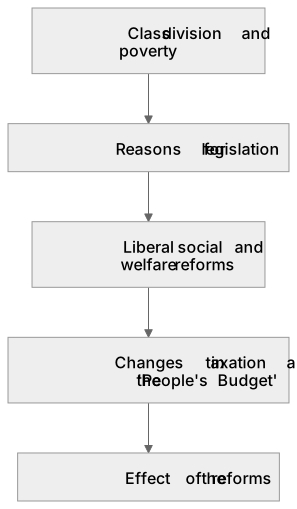
Put it in order
Put these steps in the order they happen.
- 1. Reasons for legislation
- 2. Liberal social and welfare reforms
- 3. Class division and poverty
- 4. Effect of the reforms
- 5. Changes in taxation and the 'People's Budget'
Put the events in order
Put these events in the order they happened, earliest first.
- 1. National Insurance Act against sickness and unemployment
- 2. Provision of free school meals
- 3. Lloyd George introduced the 'People's Budget'
- 4. Old Age Pensions Act introduced
Key words
Say what each word means before you turn the card.
State intervention vs laissez-faire
Try answering aloud or in your head before turning the card.
Social inequality and poverty
Try answering aloud or in your head before turning the card.
Political pragmatism and electoral survival
Try answering aloud or in your head before turning the card.
Ideological evolution
Try answering aloud or in your head before turning the card.
See every definition
- State intervention vs laissez-faire
- The effect of the reforms was a foundational shift away from laissez-faire attitudes towards state intervention, improving vulnerable lives while intensifying class tensions.
- Social inequality and poverty
- Edwardian Britain faced stark class division and widespread poverty, exposed by Booth and Rowntree.
- Political pragmatism and electoral survival
- Reasons for the legislation included humanitarianism, national efficiency, and the political threat of the Labour Party.
- Ideological evolution
- The reforms represented a foundational shift away from laissez-faire attitudes towards state intervention.
Label the diagram
Some boxes have lost their names. Pick the right name for each number.
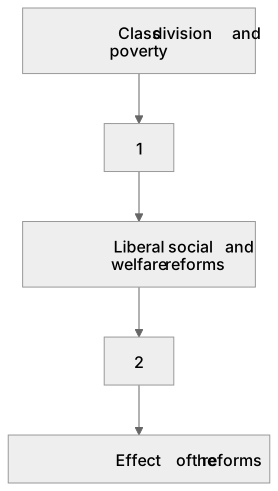
1Box 1
2Box 2
There is more to this lesson
The full lesson goes on to check your understanding and help you earn the marks. Create a free account to carry on, with your progress saved.
A week of Premium from your first lesson · Then the free plan continues · No card, no charge
Test your understanding of 2M Wars and Welfare: Britain in Transition, 1906–1957 – The Liberal crisis, 1906–1914: Social issues: class division; poverty; changes in taxation; the 'People's Budget'; Liberal social and welfare reforms; reasons for legislation and its effect
Active recall beats re-reading. Take an instant quiz now to test what you’ve learned and lock it into long-term memory.
A week of Premium from your first lesson · Then the free plan continues · No card, no charge