AQA · A-Level · History
Course version: 7042 · Version from Sept 2017
Britain in Transition, 1906–1957 – The Liberal crisis, 1906–1914: The…
Full specification wording
2M Wars and Welfare: Britain in Transition, 1906–1957 – The Liberal crisis, 1906–1914: The Liberal governments: the 1906 election; New Liberalism; the influence of Campbell- Bannerman, Asquith, Lloyd George and Churchill; the position of Labour and the Conservatives
The 1906 election delivered a Liberal landslide, driven by Conservative divisions over tariff reform.
Checked against the AQA 7042 specification (opens in a new tab) on .
- Point 1 of 4
- 4 key terms
Study notes
From the checked teaching notes for this specification point.
The idea
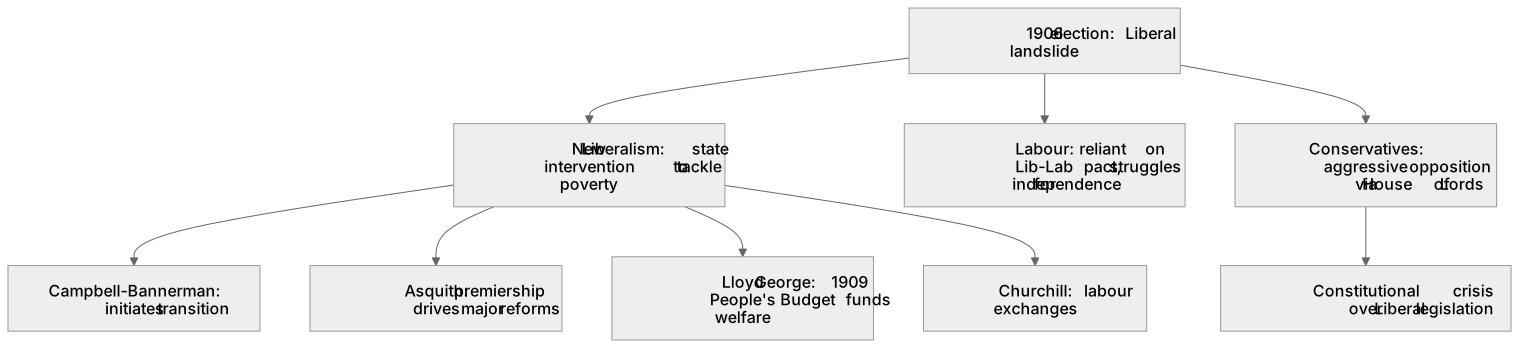
The 1906 election delivered a Liberal landslide, driven by Conservative divisions over tariff reform. This era birthed 'New Liberalism', shifting from laissez-faire to state intervention to tackle poverty. Campbell-Bannerman initiated this transition, while Asquith's premiership drove major reforms. Lloyd George championed the 1909 People's Budget to fund welfare, and Churchill spearheaded labour exchanges. Meanwhile, the nascent Labour Party struggled to assert independence despite the Lib-Lab pact. The Conservatives, reeling from defeat, adopted aggressive opposition tactics, particularly through their entrenched majority in the House of Lords, sparking a constitutional crisis over Liberal legislation.
What earns the marks
- Explain the causes of the 1906 Liberal landslide, including the Boer War fallout, Taff Vale, and Conservative splits over Tariff Reform.
- Define 'New Liberalism' as a departure from Gladstonian laissez-faire, emphasising state intervention to provide a minimum standard of living.
- Evaluate the specific contributions of key figures: Campbell-Bannerman's early leadership, Asquith's legislative drive, Lloyd George's redistributive taxation, and Churchill's labour reforms.
- Analyse the political dynamics of the opposition, noting Labour's reliance on Liberal cooperation and the Conservative strategy of using the House of Lords to block legislation.
Common mistakes and how to put them right
Confusing 'New Liberalism' with socialism.
Put it right: Emphasise that New Liberalism sought to save capitalism by addressing its worst inequalities, not abolish private property.
Assuming Labour was a powerful independent force immediately after 1906.
Put it right: Note that Labour was heavily dependent on the Lib-Lab pact and struggled to differentiate its policies from New Liberalism.
Treating the Liberal leadership as a unified bloc.
Put it right: Highlight the ideological differences and personal rivalries, particularly between traditional Liberals and radicals like Lloyd George.
Exam tips
- When discussing the 1906 election, weigh Conservative weaknesses against Liberal strengths rather than focusing on just one side.
- Use specific legislation, such as the 1908 Old Age Pensions Act, to illustrate the practical application of New Liberalism by Asquith and Lloyd George.
- Connect the Conservative position after 1906 directly to the ensuing constitutional crisis of 1909 to 1911.
Try the lesson
The start of the 2M Wars and Welfare: Britain in Transition, 1906–1957 – The Liberal crisis, 1906–1914: The Liberal governments: the 1906 election; New Liberalism; the influence of Campbell- Bannerman, Asquith, Lloyd George and Churchill; the position of Labour and the Conservatives lesson, made from checked teaching notes for this specification point.
Have a go first
Which of the following was a key factor in the Liberal Party's landslide victory in the 1906 general election?
Listen
The 1906 election delivered a Liberal landslide, driven by Conservative divisions over tariff reform. This era birthed 'New Liberalism', shifting from laissez-faire to state intervention to tackle poverty. Campbell-Bannerman initiated this transition, while Asquith's premiership drove major reforms. Lloyd George championed the 1909 People's Budget to fund welfare, and Churchill spearheaded labour exchanges. Meanwhile, the nascent Labour Party struggled to assert independence despite the Lib-Lab pact. The Conservatives, reeling from defeat, adopted aggressive opposition tactics, particularly through their entrenched majority in the House of Lords, sparking a constitutional crisis over Liberal legislation. A strong answer earns marks for these points. Explain the causes of the 1906 Liberal landslide, including the Boer War fallout, Taff Vale, and Conservative splits over Tariff Reform. Define 'New Liberalism' as a departure from Gladstonian laissez-faire, emphasising state intervention to provide a minimum standard of living. Evaluate the specific contributions of key figures: Campbell-Bannerman's early leadership, Asquith's legislative drive, Lloyd George's redistributive taxation, and Churchill's labour reforms. Analyse the political dynamics of the opposition, noting Labour's reliance on Liberal cooperation and the Conservative strategy of using the House of Lords to block legislation. A common slip: Confusing 'New Liberalism' with socialism. Instead, Emphasise that New Liberalism sought to save capitalism by addressing its worst inequalities, not abolish private property. Exam tip: When discussing the 1906 election, weigh Conservative weaknesses against Liberal strengths rather than focusing on just one side.
See it
Key words
Say what each word means before you turn the card.
New Liberalism
Try answering aloud or in your head before turning the card.
Lib-Lab pact
Try answering aloud or in your head before turning the card.
House of Lords
Try answering aloud or in your head before turning the card.
Constitutional crisis
Try answering aloud or in your head before turning the card.
See every definition
- New Liberalism
- A departure from Gladstonian laissez-faire, emphasising state intervention to provide a minimum standard of living.
- Lib-Lab pact
- An arrangement on which Labour relied and which left it struggling to differentiate its policies from New Liberalism.
- House of Lords
- The chamber where the Conservatives held an entrenched majority and used it to block Liberal legislation, sparking a constitutional crisis.
- Constitutional crisis
- A conflict over Liberal legislation sparked by the Conservative strategy of using the House of Lords to block it.
Label the diagram
Some boxes have lost their names. Pick the right name for each number.
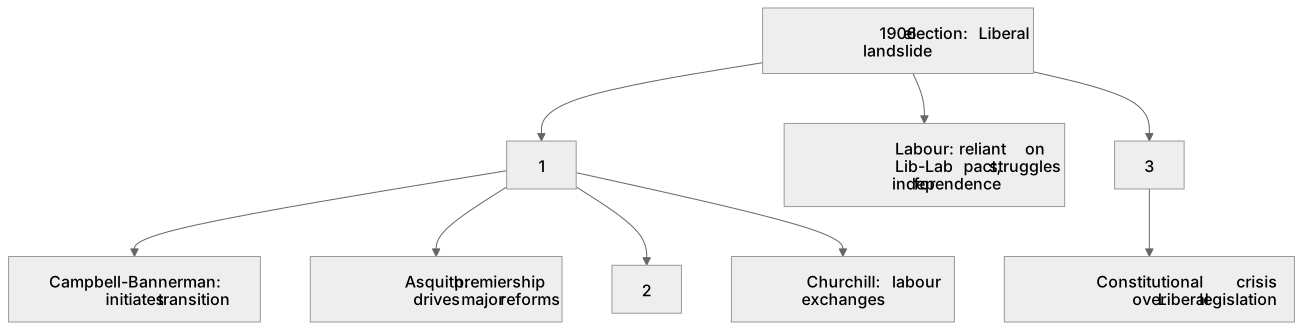
1Box 1
2Box 2
3Box 3
There is more to this lesson
The full lesson goes on to check your understanding and help you earn the marks. Create a free account to carry on, with your progress saved.
A week of Premium from your first lesson · Then the free plan continues · No card, no charge
Test your understanding of 2M Wars and Welfare: Britain in Transition, 1906–1957 – The Liberal crisis, 1906–1914: The Liberal governments: the 1906 election; New Liberalism; the influence of Campbell- Bannerman, Asquith, Lloyd George and Churchill; the position of Labour and the Conservatives
Active recall beats re-reading. Take an instant quiz now to test what you’ve learned and lock it into long-term memory.
A week of Premium from your first lesson · Then the free plan continues · No card, no charge