AQA · A-Level · History
Course version: 7042 · Version from Sept 2017
Britain in Transition, 1906–1957 – The Liberal crisis, 1906–1914: The…
Full specification wording
2M Wars and Welfare: Britain in Transition, 1906–1957 – The Liberal crisis, 1906–1914: The state of the economy: staples; 'new' industries; agriculture; trade and invisible earnings; economic concerns and external competition
Edwardian Britain's economy appeared robust but faced underlying structural weaknesses.
Checked against the AQA 7042 specification (opens in a new tab) on .
- Point 2 of 4
- 4 key terms
Study notes
From the checked teaching notes for this specification point.
The idea
Edwardian Britain's economy appeared robust but faced underlying structural weaknesses. The staple industries—coal, cotton, shipbuilding, and iron—dominated exports and employment, yet suffered from underinvestment and outdated practices. Conversely, 'new' industries like electrical engineering and motor vehicles grew slowly compared to international rivals. Agriculture remained depressed following late-19th-century price collapses, forcing a shift towards dairy and market gardening. Britain maintained global dominance through free trade and vital invisible earnings from shipping, banking, and insurance. However, growing economic concerns centred on fierce external competition, particularly the rapid industrialisation of Germany and the USA.
What earns the marks
- Assess the reliance on staple industries (coal, textiles, shipbuilding) and their vulnerability due to a lack of mechanisation and innovation.
- Evaluate the slow development of 'new' industries (chemicals, electricals) in Britain compared to the rapid advancements in rival nations.
- Explain the adaptation of the agricultural sector, noting the shift from arable farming to pastoral and market gardening in response to cheap imports.
- Analyse the critical role of invisible earnings (finance, insurance, shipping) in offsetting the visible trade deficit and sustaining the Edwardian economy.
- Discuss the economic concerns regarding external competition, specifically the overtaking of British manufacturing output by the USA and Germany.
Common mistakes and how to put them right
Stating that the British economy was in absolute decline before 1914.
Put it right: Clarify that the economy was still growing and highly profitable, but experiencing relative decline compared to the USA and Germany.
Ignoring the role of invisible earnings.
Put it right: Include services like banking, insurance, and shipping, which were crucial for maintaining Britain's balance of payments.
Assuming agriculture was completely ruined.
Put it right: Explain that while arable farming suffered from cheap foreign grain, dairy, poultry, and market gardening successfully adapted and remained profitable.
Exam tips
- Use specific comparative examples, such as German superiority in chemicals or American advances in mass production, to illustrate external competition.
- When evaluating the staple industries, distinguish between their high output and profitability in this period and their long-term structural flaws.
- Link economic concerns directly to political debates of the era, such as the Conservative campaign for Tariff Reform.
Try the lesson
The start of the 2M Wars and Welfare: Britain in Transition, 1906–1957 – The Liberal crisis, 1906–1914: The state of the economy: staples; 'new' industries; agriculture; trade and invisible earnings; economic concerns and external competition lesson, made from checked teaching notes for this specification point.
Have a go first
Which of the following industries was considered one of Britain's traditional 'staple' industries that dominated the economy in the years leading up to 1914?
Listen
Edwardian Britain's economy appeared robust but faced underlying structural weaknesses. The staple industries—coal, cotton, shipbuilding, and iron—dominated exports and employment, yet suffered from underinvestment and outdated practices. Conversely, 'new' industries like electrical engineering and motor vehicles grew slowly compared to international rivals. Agriculture remained depressed following late-19th-century price collapses, forcing a shift towards dairy and market gardening. Britain maintained global dominance through free trade and vital invisible earnings from shipping, banking, and insurance. However, growing economic concerns centred on fierce external competition, particularly the rapid industrialisation of Germany and the USA. A strong answer earns marks for these points. Assess the reliance on staple industries (coal, textiles, shipbuilding) and their vulnerability due to a lack of mechanisation and innovation. Evaluate the slow development of 'new' industries (chemicals, electricals) in Britain compared to the rapid advancements in rival nations. Explain the adaptation of the agricultural sector, noting the shift from arable farming to pastoral and market gardening in response to cheap imports. Analyse the critical role of invisible earnings (finance, insurance, shipping) in offsetting the visible trade deficit and sustaining the Edwardian economy. A common slip: Stating that the British economy was in absolute decline before 1914. Instead, Clarify that the economy was still growing and highly profitable, but experiencing relative decline compared to the USA and Germany. Exam tip: Use specific comparative examples, such as German superiority in chemicals or American advances in mass production, to illustrate external competition.
See it
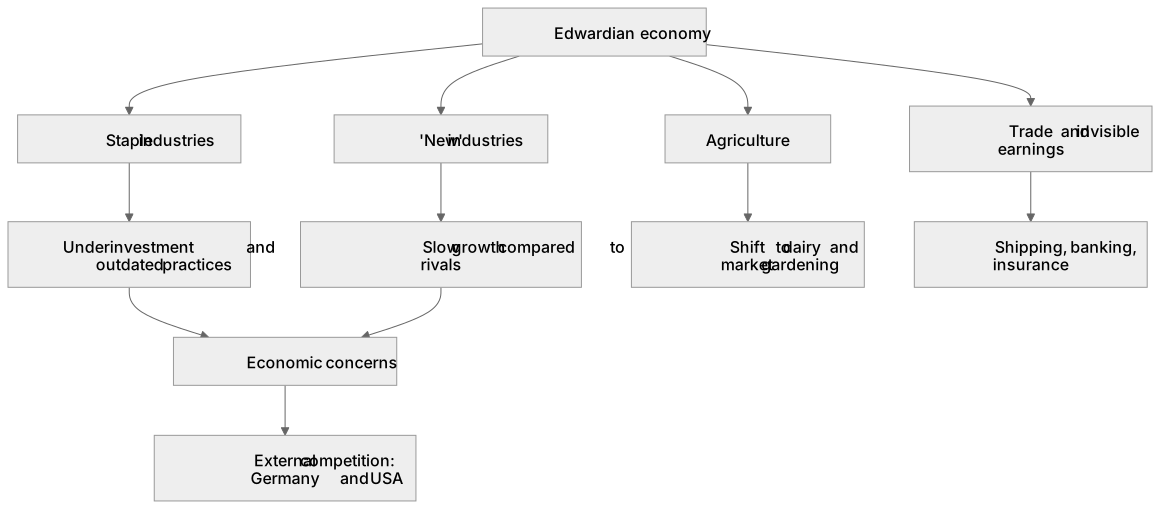
Key words
Say what each word means before you turn the card.
Relative economic decline
Try answering aloud or in your head before turning the card.
Structural imbalance
Try answering aloud or in your head before turning the card.
Globalisation and free trade
Try answering aloud or in your head before turning the card.
Industrial innovation versus stagnation
Try answering aloud or in your head before turning the card.
See every definition
- Relative economic decline
- The economy was still growing and highly profitable, but declining compared to the USA and Germany.
- Structural imbalance
- Underlying structural weaknesses existed despite an apparently robust economy, with staple industries suffering from underinvestment and outdated practices.
- Globalisation and free trade
- Britain maintained global dominance through free trade and vital invisible earnings from shipping, banking, and insurance.
- Industrial innovation versus stagnation
- Staple industries lacked mechanisation and innovation, while 'new' industries like electrical engineering and motor vehicles grew slowly compared to international rivals.
Label the diagram
Some boxes have lost their names. Pick the right name for each number.
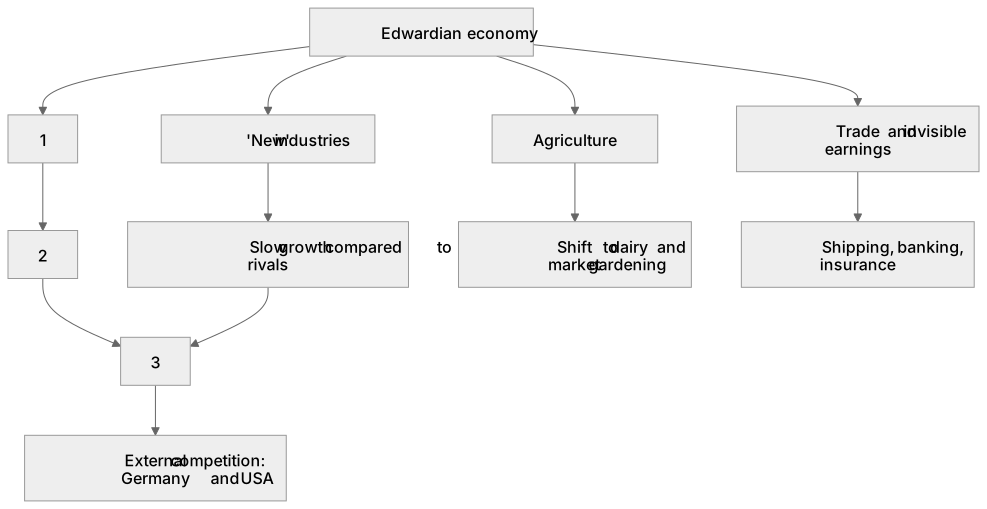
1Box 1
2Box 2
3Box 3
There is more to this lesson
The full lesson goes on to check your understanding and help you earn the marks. Create a free account to carry on, with your progress saved.
A week of Premium from your first lesson · Then the free plan continues · No card, no charge
Test your understanding of 2M Wars and Welfare: Britain in Transition, 1906–1957 – The Liberal crisis, 1906–1914: The state of the economy: staples; 'new' industries; agriculture; trade and invisible earnings; economic concerns and external competition
Active recall beats re-reading. Take an instant quiz now to test what you’ve learned and lock it into long-term memory.
A week of Premium from your first lesson · Then the free plan continues · No card, no charge