AQA · A-Level · History
Course version: 7042 · Version from Sept 2017
Britain in Transition, 1906–1957 – The People's War and Peace, 1939–1951…
Full specification wording
2M Wars and Welfare: Britain in Transition, 1906–1957 – The People's War and Peace, 1939–1951 (A-level only): Political developments: the fall of Chamberlain; Churchill as wartime leader, character and style; coalition government; the reasons for Labour victory in 1945; Attlee as Prime Minister; Labour ideology and aims
The 1939–1951 period saw profound political shifts, starting with Chamberlain's fall in May 1940 after the Norway Campaign.
Checked against the AQA 7042 specification (opens in a new tab) on .
- Point 1 of 4
- 4 key terms
Study notes
From the checked teaching notes for this specification point.
The idea
The 1939–1951 period saw profound political shifts, starting with Chamberlain's fall in May 1940 after the Norway Campaign. Churchill succeeded him, offering wartime leadership defined by inspiring rhetoric, relentless energy, and a highly personalised style. He led a vital coalition government, integrating Labour ministers like Attlee, which fostered national unity. However, Labour won a landslide victory in 1945, driven by public desire for social reform and memories of 1930s Conservative failures. As Prime Minister, Attlee provided pragmatic, understated leadership. His government was guided by democratic socialist ideology, aiming to build a comprehensive welfare state, maintain full employment, and create a mixed economy.
What earns the marks
- Assess the impact of the Norway debate on Chamberlain's resignation and Churchill's emergence as Prime Minister.
- Evaluate Churchill's leadership style, focusing on his oratorical skills, strategic interventions, and relationships with military commanders.
- Analyse the role of the wartime coalition government in normalising Labour ministers as competent national leaders.
- Explain the 1945 Labour victory by contrasting the Conservative focus on Churchill's prestige with Labour's alignment with the Beveridge Report.
- Examine Attlee's managerial leadership style and how Labour's ideology translated into aims like the welfare state and nationalisation.
Common mistakes and how to put them right
Assuming Churchill was universally popular throughout the war.
Put it right: Acknowledge the political challenges he faced, such as the 1942 motion of no confidence.
Attributing Labour's 1945 victory solely to Churchill's 'Gestapo' speech.
Put it right: Emphasise deeper structural factors like the desire for social reform and the wartime radicalisation of the electorate.
Confusing Labour's democratic socialist ideology with revolutionary socialism.
Put it right: Clarify that Labour aimed for a mixed economy and parliamentary reform, not a complete overthrow of capitalism.
Exam tips
- When evaluating Churchill's wartime leadership, balance his inspirational public persona with his often difficult relationships with his generals.
- Use the wartime coalition as a bridge to explain the 1945 election result, noting how it gave Labour leaders crucial ministerial experience.
- Contrast Attlee's quiet, committee-based leadership style with Churchill's charismatic individualism to evaluate their respective effectiveness.
Try the lesson
The start of the 2M Wars and Welfare: Britain in Transition, 1906–1957 – The People's War and Peace, 1939–1951 (A-level only): Political developments: the fall of Chamberlain; Churchill as wartime leader, character and style; coalition government; the reasons for Labour victory in 1945; Attlee as Prime Minister; Labour ideology and aims lesson, made from checked teaching notes for this specification point.
Have a go first
Which event in May 1940 was the immediate catalyst for the parliamentary debate that led to the fall of Neville Chamberlain as Prime Minister?
Listen
The 1939–1951 period saw profound political shifts, starting with Chamberlain's fall in May 1940 after the Norway Campaign. Churchill succeeded him, offering wartime leadership defined by inspiring rhetoric, relentless energy, and a highly personalised style. He led a vital coalition government, integrating Labour ministers like Attlee, which fostered national unity. However, Labour won a landslide victory in 1945, driven by public desire for social reform and memories of 1930s Conservative failures. As Prime Minister, Attlee provided pragmatic, understated leadership. His government was guided by democratic socialist ideology, aiming to build a comprehensive welfare state, maintain full employment, and create a mixed economy. A strong answer earns marks for these points. Assess the impact of the Norway debate on Chamberlain's resignation and Churchill's emergence as Prime Minister. Evaluate Churchill's leadership style, focusing on his oratorical skills, strategic interventions, and relationships with military commanders. Analyse the role of the wartime coalition government in normalising Labour ministers as competent national leaders. Explain the 1945 Labour victory by contrasting the Conservative focus on Churchill's prestige with Labour's alignment with the Beveridge Report. A common slip: Assuming Churchill was universally popular throughout the war. Instead, acknowledge the political challenges he faced, such as the 1942 motion of no confidence. Exam tip: When evaluating Churchill's wartime leadership, balance his inspirational public persona with his often difficult relationships with his generals.
See it
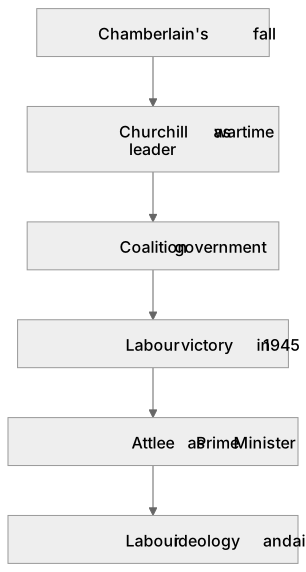
Put it in order
Put these steps in the order they happen.
- 1. Coalition government
- 2. Churchill as wartime leader
- 3. Chamberlain's fall
- 4. Labour ideology and aims
- 5. Attlee as Prime Minister
- 6. Labour victory in 1945
Put the events in order
Put these events in the order they happened, earliest first.
- 1. Chamberlain falls after the Norway Campaign
- 2. Labour wins a landslide victory
- 3. Churchill faces a motion of no confidence
Key words
Say what each word means before you turn the card.
Political leadership and style
Try answering aloud or in your head before turning the card.
Electoral change and voter behaviour
Try answering aloud or in your head before turning the card.
Ideology and political aims
Try answering aloud or in your head before turning the card.
Impact of war on domestic politics
Try answering aloud or in your head before turning the card.
See every definition
- Political leadership and style
- Churchill offered wartime leadership defined by inspiring rhetoric, relentless energy and a highly personalised style, while Attlee provided pragmatic, understated leadership.
- Electoral change and voter behaviour
- Labour won a landslide victory in 1945, driven by public desire for social reform and memories of 1930s Conservative failures.
- Ideology and political aims
- Guided by democratic socialist ideology, the government aimed to build a comprehensive welfare state, maintain full employment and create a mixed economy.
- Impact of war on domestic politics
- Chamberlain fell in May 1940 after the Norway Campaign, and Churchill led a vital coalition government integrating Labour ministers like Attlee, which fostered national unity.
Label the diagram
Some boxes have lost their names. Pick the right name for each number.
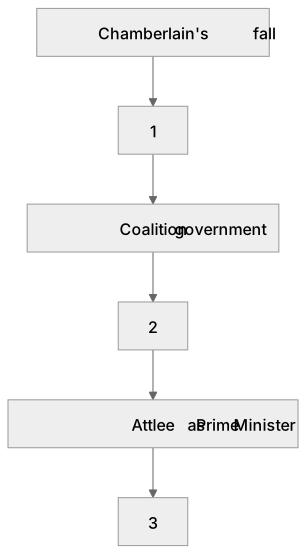
1Box 1
2Box 2
3Box 3
There is more to this lesson
The full lesson goes on to check your understanding and help you earn the marks. Create a free account to carry on, with your progress saved.
A week of Premium from your first lesson · Then the free plan continues · No card, no charge
Test your understanding of 2M Wars and Welfare: Britain in Transition, 1906–1957 – The People's War and Peace, 1939–1951 (A-level only): Political developments: the fall of Chamberlain; Churchill as wartime leader, character and style; coalition government; the reasons for Labour victory in 1945; Attlee as Prime Minister; Labour ideology and aims
Active recall beats re-reading. Take an instant quiz now to test what you’ve learned and lock it into long-term memory.
A week of Premium from your first lesson · Then the free plan continues · No card, no charge