AQA · A-Level · History
Course version: 7042 · Version from Sept 2017
Britain in Transition, 1906–1957 – The People's War and Peace, 1939–1951…
Full specification wording
2M Wars and Welfare: Britain in Transition, 1906–1957 – The People's War and Peace, 1939–1951 (A-level only): Economic issues: mobilisation of resources in wartime; the post-war economic readjustment; Labour's post-war balance of payments problems and policies, including nationalisation
Britain's wartime economy demanded total mobilisation of resources, achieved via conscription, rationing, and state direction of industry under ministers like Bevin.
Checked against the AQA 7042 specification (opens in a new tab) on .
- Point 2 of 4
Study notes
From the checked teaching notes for this specification point.
The idea
Britain's wartime economy demanded total mobilisation of resources, achieved via conscription, rationing, and state direction of industry under ministers like Bevin. Following victory, the nation faced severe post-war economic readjustment, worsened by the abrupt end of American Lend-Lease in 1945. This triggered acute balance of payments problems, as Britain struggled with massive war debts and a dollar shortage. To manage these economic issues, Labour implemented strict austerity policies, secured the 1946 Anglo-American loan, and devalued the pound in 1949. Concurrently, Labour pursued nationalisation, taking key industries like coal, railways, and steel into public ownership to modernise infrastructure and stabilise the economy.
What earns the marks
- Assess the effectiveness of state intervention in the mobilisation of wartime resources, including labour direction and rationing.
- Evaluate the severity of the post-war economic readjustment, focusing on the impact of the termination of Lend-Lease.
- Analyse the causes of Labour's balance of payments problems, particularly the dollar gap and overseas military commitments.
- Examine the policies used to address economic crises, including Stafford Cripps' austerity measures and the 1949 devaluation of the pound.
- Evaluate the economic and political success of Labour's nationalisation programme across industries such as coal, transport, and iron and steel.
Common mistakes and how to put them right
Claiming nationalisation was purely an ideological exercise.
Put it right: Explain the pragmatic economic reasons, such as the need for massive capital investment in failing industries like coal.
Confusing the balance of payments deficit with the national debt.
Put it right: Distinguish between the shortfall in foreign currency (especially dollars) from trade, and the government's internal borrowing.
Assuming the post-war economy was entirely depressed.
Put it right: Note that despite austerity and balance of payments crises, Labour successfully maintained full employment and increased exports.
Exam tips
- Link the wartime mobilisation of resources to post-war policies, showing how the public became accustomed to state intervention and central planning.
- When discussing the balance of payments, explicitly mention the 1946 Anglo-American loan and the 1949 devaluation as key policy responses.
- Differentiate between the nationalisation of public utilities (like gas) and highly contested manufacturing sectors (like steel) to show nuance in Labour's policies.
Try the lesson
The start of the 2M Wars and Welfare: Britain in Transition, 1906–1957 – The People's War and Peace, 1939–1951 (A-level only): Economic issues: mobilisation of resources in wartime; the post-war economic readjustment; Labour's post-war balance of payments problems and policies, including nationalisation lesson, made from checked teaching notes for this specification point.
Have a go first
Which of the following industries was among the first to be nationalised by Clement Attlee's Labour government following the 1945 election?
Listen
Britain's wartime economy demanded total mobilisation of resources, achieved via conscription, rationing, and state direction of industry under ministers like Bevin. Following victory, the nation faced severe post-war economic readjustment, worsened by the abrupt end of American Lend-Lease in 1945. This triggered acute balance of payments problems, as Britain struggled with massive war debts and a dollar shortage. To manage these economic issues, Labour implemented strict austerity policies, secured the 1946 Anglo-American loan, and devalued the pound in 1949. Concurrently, Labour pursued nationalisation, taking key industries like coal, railways, and steel into public ownership to modernise infrastructure and stabilise the economy. A strong answer earns marks for these points. Assess the effectiveness of state intervention in the mobilisation of wartime resources, including labour direction and rationing. Evaluate the severity of the post-war economic readjustment, focusing on the impact of the termination of Lend-Lease. Analyse the causes of Labour's balance of payments problems, particularly the dollar gap and overseas military commitments. Examine the policies used to address economic crises, including Stafford Cripps' austerity measures and the 1949 devaluation of the pound. A common slip: Claiming nationalisation was purely an ideological exercise. Instead, explain the pragmatic economic reasons, such as the need for massive capital investment in failing industries like coal. Exam tip: Link the wartime mobilisation of resources to post-war policies, showing how the public became accustomed to state intervention and central planning.
See it
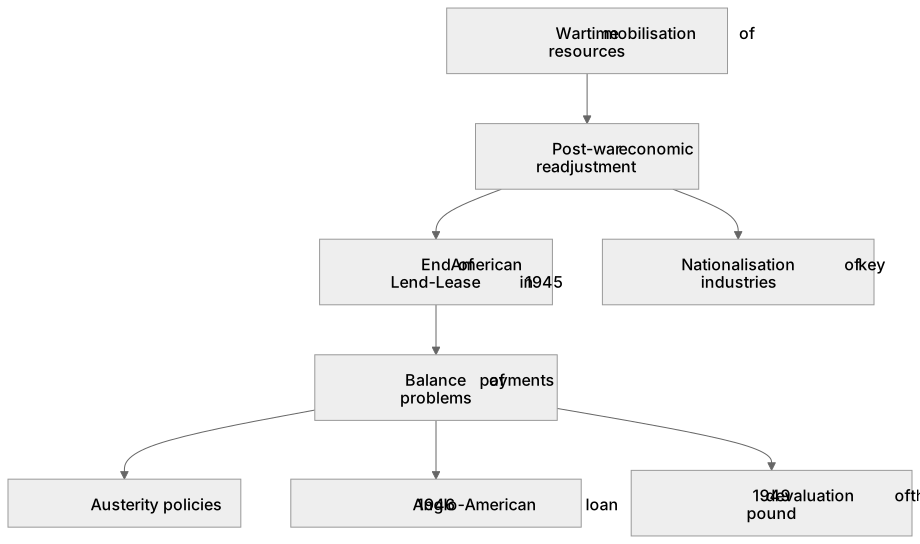
Put the events in order
Put these events in the order they happened, earliest first.
- 1. Abrupt end of American Lend-Lease worsened post-war economic readjustment
- 2. The pound was devalued
- 3. Labour secured the Anglo-American loan
Label the diagram
Some boxes have lost their names. Pick the right name for each number.
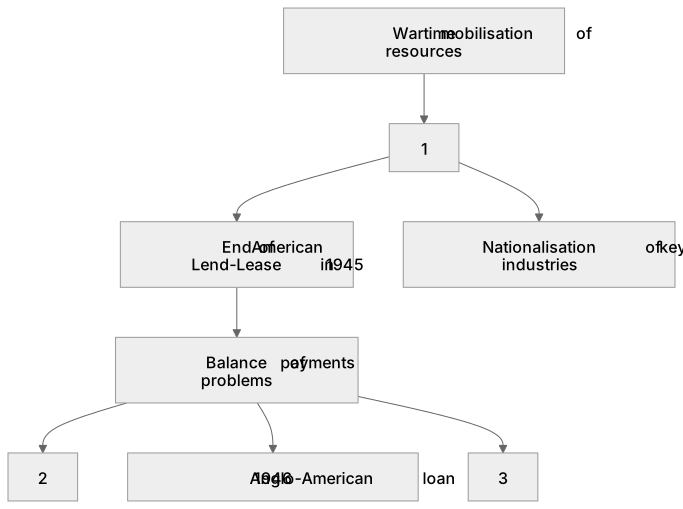
1Box 1
2Box 2
3Box 3
There is more to this lesson
The full lesson goes on to check your understanding and help you earn the marks. Create a free account to carry on, with your progress saved.
A week of Premium from your first lesson · Then the free plan continues · No card, no charge
Test your understanding of 2M Wars and Welfare: Britain in Transition, 1906–1957 – The People's War and Peace, 1939–1951 (A-level only): Economic issues: mobilisation of resources in wartime; the post-war economic readjustment; Labour's post-war balance of payments problems and policies, including nationalisation
Active recall beats re-reading. Take an instant quiz now to test what you’ve learned and lock it into long-term memory.
A week of Premium from your first lesson · Then the free plan continues · No card, no charge