AQA · A-Level · History
Course version: 7042 · Version from Sept 2017
Britain in Transition, 1906–1957 – The People's War and Peace, 1939–1951…
Full specification wording
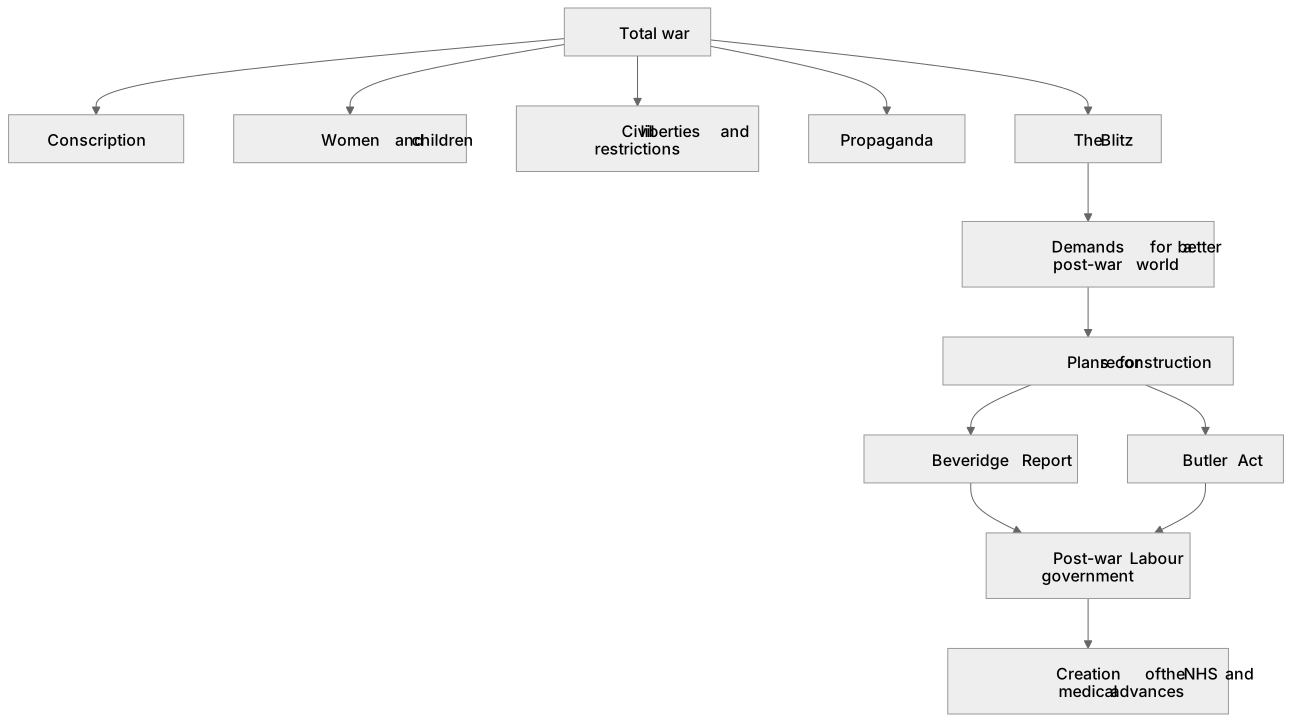
2M Wars and Welfare: Britain in Transition, 1906–1957 – The People's War and Peace, 1939–1951 (A-level only): The social and cultural impact of 'total' war: conscription; women and children; civil liberties and restrictions; propaganda; the Blitz; plans for reconstruction including Beveridge and the Butler Act; policies of post-war Labour government, including the creation of the NHS and medical advances
The Second World War was a 'total' war reshaping British society.
Checked against the AQA 7042 specification (opens in a new tab) on .
- Point 3 of 4
- 2 key terms
Study notes
From the checked teaching notes for this specification point.
The idea
The Second World War was a 'total' war reshaping British society. Conscription directed millions into forces and industry, while women took unprecedented roles. Children faced mass evacuation, disrupting family life. The state curtailed civil liberties through emergency powers, deploying propaganda to maintain morale. The Blitz brought the frontline to civilians, fostering a shared experience that fuelled demands for a better post-war world. This consensus drove reconstruction plans like the 1942 Beveridge Report and the 1944 Butler Education Act. Attlee’s post-war Labour government implemented these ideals, notably establishing the NHS in 1948 and capitalising on wartime medical advances like penicillin to build a comprehensive welfare state.
What earns the marks
- Assess the extent to which the Blitz and evacuation created a genuine 'social solidarity' or if class divisions persisted.
- Evaluate the impact of the 1942 Beveridge Report in shaping the post-war consensus and Labour's 1945 election victory.
- Analyse the significance of the 1944 Butler Education Act in introducing the tripartite system and expanding secondary education.
- Examine the creation of the NHS by Aneurin Bevan in 1948, overcoming opposition from the BMA to provide universal healthcare.
- Discuss how wartime medical advances, such as the mass production of penicillin and blood transfusions, facilitated post-war health policies.
Common mistakes and how to put them right
Claiming the NHS was created during the war.
Put it right by stating it was established by the post-war Labour government in 1948.
Assuming the Butler Act abolished private schools.
Put it right by noting it created a state tripartite system alongside private education.
Stating that women's wartime employment led to immediate, permanent equality.
Put it right by explaining that many women were forced out of heavy industry jobs when men returned.
Exam tips
- Use the concept of 'total war' to link state intervention directly to the public's expectation of post-war welfare reforms.
- When discussing propaganda, contrast the myth of the 'Blitz spirit' with the reality of looting, strikes, and class tensions to demonstrate nuanced evaluation.
- Link wartime medical advances, such as the treatment of casualties, to the logistical and ideological foundations of the NHS.
Try the lesson
The start of the 2M Wars and Welfare: Britain in Transition, 1906–1957 – The People's War and Peace, 1939–1951 (A-level only): The social and cultural impact of 'total' war: conscription; women and children; civil liberties and restrictions; propaganda; the Blitz; plans for reconstruction including Beveridge and the Butler Act; policies of post-war Labour government, including the creation of the NHS and medical advances lesson, made from checked teaching notes for this specification point.
Have a go first
Which piece of legislation, passed during the Second World War, fundamentally restructured the education system in England and Wales by introducing the tripartite system?
Listen
The Second World War was a 'total' war reshaping British society. Conscription directed millions into forces and industry, while women took unprecedented roles. Children faced mass evacuation, disrupting family life. The state curtailed civil liberties through emergency powers, deploying propaganda to maintain morale. The Blitz brought the frontline to civilians, fostering a shared experience that fuelled demands for a better post-war world. This consensus drove reconstruction plans like the 1942 Beveridge Report and the 1944 Butler Education Act. Attlee’s post-war Labour government implemented these ideals, notably establishing the NHS in 1948 and capitalising on wartime medical advances like penicillin to build a comprehensive welfare state. A strong answer earns marks for these points. Assess the extent to which the Blitz and evacuation created a genuine 'social solidarity' or if class divisions persisted. Evaluate the impact of the 1942 Beveridge Report in shaping the post-war consensus and Labour's 1945 election victory. Analyse the significance of the 1944 Butler Education Act in introducing the tripartite system and expanding secondary education. Examine the creation of the NHS by Aneurin Bevan in 1948, overcoming opposition from the BMA to provide universal healthcare. A common slip: Claiming the NHS was created during the war. Instead, stating it was established by the post-war Labour government in 1948. Exam tip: Use the concept of 'total war' to link state intervention directly to the public's expectation of post-war welfare reforms.
See it
Put the events in order
Put these events in the order they happened, earliest first.
- 1. NHS created by Aneurin Bevan
- 2. Beveridge Report shaped the post-war consensus
- 3. Labour won the general election
- 4. Butler Education Act introduced the tripartite system
Key words
Say what each word means before you turn the card.
Total war
Try answering aloud or in your head before turning the card.
Welfare state
Try answering aloud or in your head before turning the card.
See every definition
- Total war
- A war reshaping British society, directing millions into forces and industry through conscription while women took unprecedented roles.
- Welfare state
- Built by Attlee's post-war Labour government, notably through establishing the NHS in 1948 and capitalising on wartime medical advances.
Label the diagram
Some boxes have lost their names. Pick the right name for each number.
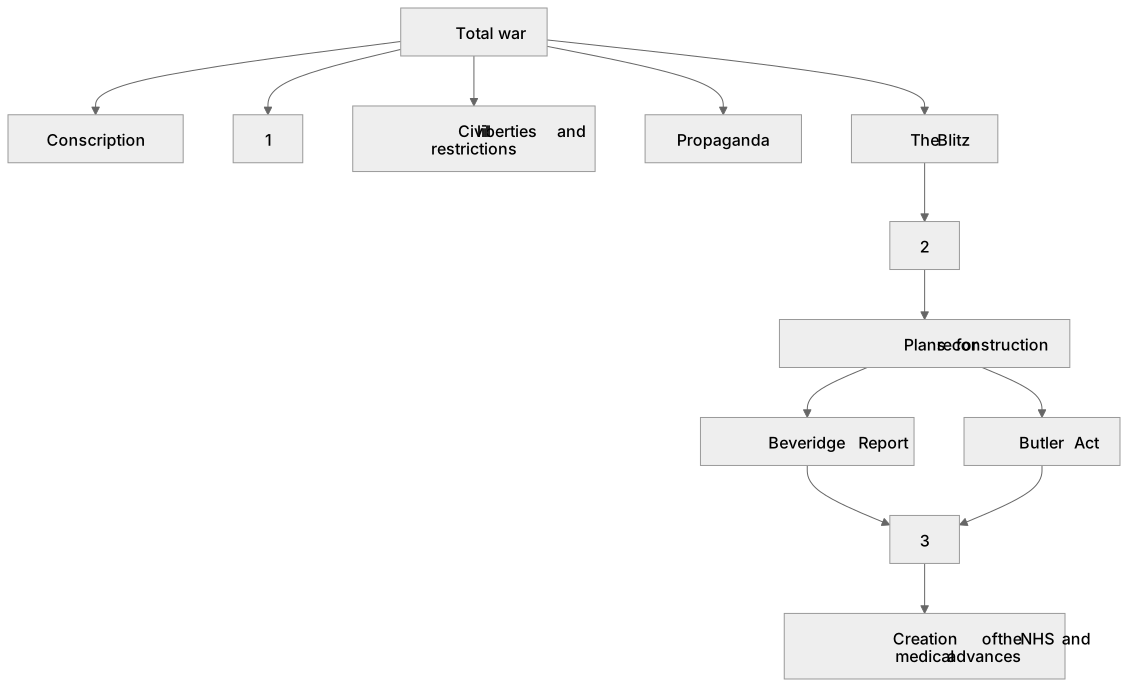
1Box 1
2Box 2
3Box 3
There is more to this lesson
The full lesson goes on to check your understanding and help you earn the marks. Create a free account to carry on, with your progress saved.
A week of Premium from your first lesson · Then the free plan continues · No card, no charge
Test your understanding of 2M Wars and Welfare: Britain in Transition, 1906–1957 – The People's War and Peace, 1939–1951 (A-level only): The social and cultural impact of 'total' war: conscription; women and children; civil liberties and restrictions; propaganda; the Blitz; plans for reconstruction including Beveridge and the Butler Act; policies of post-war Labour government, including the creation of the NHS and medical advances
Active recall beats re-reading. Take an instant quiz now to test what you’ve learned and lock it into long-term memory.
A week of Premium from your first lesson · Then the free plan continues · No card, no charge