AQA · A-Level · History
Course version: 7042 · Version from Sept 2017
Britain in Transition, 1906–1957 – The search for stability, 1922–1929:…
Full specification wording
2M Wars and Welfare: Britain in Transition, 1906–1957 – The search for stability, 1922–1929: Economic issues: post-war re-adjustment and return to Gold Standard; the problems of the coal mines; industrial disputes and the General Strike
Britain's post-war economic re-adjustment was fraught with difficulty, characterised by deflation and structural decline in staple industries.
Checked against the AQA 7042 specification (opens in a new tab) on .
- Point 2 of 4
Study notes
From the checked teaching notes for this specification point.
The idea
Britain's post-war economic re-adjustment was fraught with difficulty, characterised by deflation and structural decline in staple industries. Churchill's 1925 decision to return to the Gold Standard at the pre-war parity overvalued the pound by roughly 10%, making exports uncompetitive. This exacerbated the problems of the coal mines, which already suffered from underinvestment, foreign competition, and falling prices. Mine owners demanded wage cuts and longer hours, leading to bitter industrial disputes. When the Samuel Commission rejected nationalisation but recommended wage reductions, the TUC called the 1926 General Strike to support the miners. The strike lasted nine days before the TUC capitulated, leaving the miners to fight on alone until starvation forced their surrender, highlighting deep economic instability.
What earns the marks
- Explain the economic challenges of post-war re-adjustment, including the transition from a wartime to a peacetime economy and the loss of overseas markets.
- Analyse the economic arguments for and against returning to the Gold Standard in 1925, and its impact on export-driven industries.
- Identify the long-term and short-term problems facing the coal industry, such as lack of mechanisation, the end of wartime subsidies, and the impact of the Dawes Plan on German coal exports.
- Evaluate the causes of the 1926 General Strike, focusing on the breakdown of negotiations between the miners, mine owners, and the government.
- Assess the reasons for the failure of the General Strike, including the government's effective use of the Organisation for the Maintenance of Supplies and the TUC's reluctance to pursue a revolutionary agenda.
Common mistakes and how to put them right
Stating that the General Strike was a revolutionary attempt to overthrow the government.
Put it right by explaining it was a sympathetic strike over wages and conditions, and the TUC actively avoided revolutionary action.
Blaming Churchill entirely for the economic slump.
Put it right by acknowledging that while the return to the Gold Standard worsened conditions, structural decline in staple industries was already underway.
Confusing the Samuel Commission with the Sankey Commission.
Put it right by noting the Sankey Commission recommended nationalisation, while the Samuel Commission rejected it but proposed reorganisation and wage cuts.
Exam tips
- Link the return to the Gold Standard directly to the outbreak of the General Strike by explaining how the overvalued pound forced mine owners to cut wages to remain competitive.
- Contrast the government's thorough preparation for the General Strike with the TUC's hesitant and disorganised approach.
- Use specific statistics, such as the pre-war parity rate, to demonstrate precise knowledge of the economic policies of the period.
Try the lesson
The start of the 2M Wars and Welfare: Britain in Transition, 1906–1957 – The search for stability, 1922–1929: Economic issues: post-war re-adjustment and return to Gold Standard; the problems of the coal mines; industrial disputes and the General Strike lesson, made from checked teaching notes for this specification point.
Have a go first
What was the primary economic consequence of Winston Churchill's decision to return Britain to the Gold Standard in 1925 at the pre-war parity of $4.86?
Listen
Britain's post-war economic re-adjustment was fraught with difficulty, characterised by deflation and structural decline in staple industries. Churchill's 1925 decision to return to the Gold Standard at the pre-war parity overvalued the pound by roughly 10%, making exports uncompetitive. This exacerbated the problems of the coal mines, which already suffered from underinvestment, foreign competition, and falling prices. Mine owners demanded wage cuts and longer hours, leading to bitter industrial disputes. When the Samuel Commission rejected nationalisation but recommended wage reductions, the TUC called the 1926 General Strike to support the miners. The strike lasted nine days before the TUC capitulated, leaving the miners to fight on alone until starvation forced their surrender, highlighting deep economic instability. A strong answer earns marks for these points. Explain the economic challenges of post-war re-adjustment, including the transition from a wartime to a peacetime economy and the loss of overseas markets. Analyse the economic arguments for and against returning to the Gold Standard in 1925, and its impact on export-driven industries. Identify the long-term and short-term problems facing the coal industry, such as lack of mechanisation, the end of wartime subsidies, and the impact of the Dawes Plan on German coal exports. Evaluate the causes of the 1926 General Strike, focusing on the breakdown of negotiations between the miners, mine owners, and the government. A common slip: Stating that the General Strike was a revolutionary attempt to overthrow the government. Instead, explaining it was a sympathetic strike over wages and conditions, and the TUC actively avoided revolutionary action. Exam tip: Link the return to the Gold Standard directly to the outbreak of the General Strike by explaining how the overvalued pound forced mine owners to cut wages to remain competitive.
See it
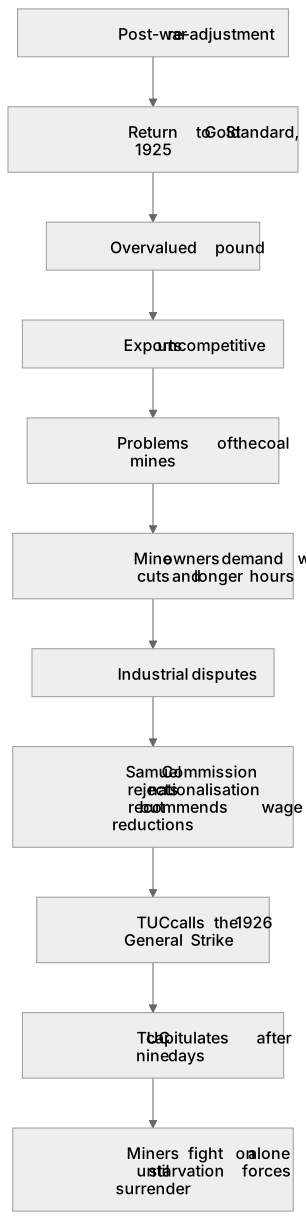
Label the diagram
Some boxes have lost their names. Pick the right name for each number.
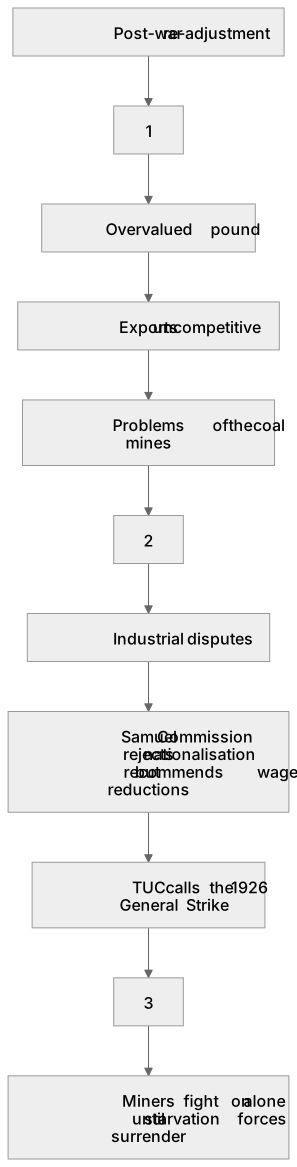
1Box 1
2Box 2
3Box 3
There is more to this lesson
The full lesson goes on to check your understanding and help you earn the marks. Create a free account to carry on, with your progress saved.
A week of Premium from your first lesson · Then the free plan continues · No card, no charge
Test your understanding of 2M Wars and Welfare: Britain in Transition, 1906–1957 – The search for stability, 1922–1929: Economic issues: post-war re-adjustment and return to Gold Standard; the problems of the coal mines; industrial disputes and the General Strike
Active recall beats re-reading. Take an instant quiz now to test what you’ve learned and lock it into long-term memory.
A week of Premium from your first lesson · Then the free plan continues · No card, no charge