AQA · A-Level · History
Course version: 7042 · Version from Sept 2017
Britain in Transition, 1906–1957 – The search for stability, 1922–1929:…
Full specification wording
2M Wars and Welfare: Britain in Transition, 1906–1957 – The search for stability, 1922–1929: Political developments: the decline of the Liberals; the 1923 election; the first Labour government: aims, reforms, international relations and collapse; the Conservative resurgence and government; the roles of Baldwin, Churchill and Chamberlain
The 1920s saw profound political realignment.
Checked against the AQA 7042 specification (opens in a new tab) on .
- Point 1 of 4
Study notes
From the checked teaching notes for this specification point.
The idea
The 1920s saw profound political realignment. The Liberal Party's decline accelerated due to the Asquith-Lloyd George split, allowing Labour to emerge as the main progressive force. The 1923 election resulted in a hung parliament and the first Labour government. MacDonald aimed to prove Labour's fitness to govern, passing Wheatley's Housing Act and improving international relations via the Dawes Plan. The Campbell Case caused the government's collapse. The subsequent 1924 election, influenced by the Zinoviev letter, saw a Conservative resurgence. Baldwin returned as Prime Minister. Churchill controversially returned Britain to the Gold Standard, while Chamberlain enacted significant social reforms, solidifying Conservative dominance.
What earns the marks
- Explain the structural and political reasons for the Liberal Party's decline, including the impact of the First World War and the expanded franchise.
- Analyse the causes and outcomes of the 1923 election, focusing on Baldwin's miscalculation regarding tariff reform.
- Evaluate the successes and failures of the first Labour government, particularly Wheatley's Housing Act and MacDonald's foreign policy achievements.
- Assess the reasons for the collapse of the Labour government, focusing on the Campbell Case, and distinguish this from the 1924 election defeat influenced by the Zinoviev letter.
- Examine the legislative record of the 1924-1929 Conservative government, highlighting Chamberlain's reforms at the Ministry of Health and Churchill's economic policies.
Common mistakes and how to put them right
Claiming the Zinoviev letter caused the collapse of the first Labour government.
Put it right: Explain that the government fell due to a vote of no confidence over the Campbell Case; the Zinoviev letter was published later and influenced the subsequent 1924 election defeat.
Confusing the roles of Churchill and Chamberlain in the 1924-1929 government.
Put it right: Identify Churchill as Chancellor of the Exchequer and Chamberlain as Minister of Health.
Assuming the first Labour government had a parliamentary majority.
Put it right: State it was a minority government dependent on Liberal support, which severely limited its radicalism.
Exam tips
- When evaluating the first Labour government, balance its short lifespan against its success in proving Labour was a moderate, responsible party capable of governing.
- Use Chamberlain's specific reforms, such as the Local Government Act 1929, as evidence of 'One Nation' Conservatism in action.
- Connect the decline of the Liberals directly to the rise of Labour, showing how the first-past-the-post electoral system punished the divided Liberal Party.
Try the lesson
The start of the 2M Wars and Welfare: Britain in Transition, 1906–1957 – The search for stability, 1922–1929: Political developments: the decline of the Liberals; the 1923 election; the first Labour government: aims, reforms, international relations and collapse; the Conservative resurgence and government; the roles of Baldwin, Churchill and Chamberlain lesson, made from checked teaching notes for this specification point.
Have a go first
Which event was the immediate catalyst for the collapse of the first Labour government in 1924?
Listen
The 1920s saw profound political realignment. The Liberal Party's decline accelerated due to the Asquith-Lloyd George split, allowing Labour to emerge as the main progressive force. The 1923 election resulted in a hung parliament and the first Labour government. MacDonald aimed to prove Labour's fitness to govern, passing Wheatley's Housing Act and improving international relations via the Dawes Plan. The Campbell Case caused the government's collapse. The subsequent 1924 election, influenced by the Zinoviev letter, saw a Conservative resurgence. Baldwin returned as Prime Minister. Churchill controversially returned Britain to the Gold Standard, while Chamberlain enacted significant social reforms, solidifying Conservative dominance. A strong answer earns marks for these points. Explain the structural and political reasons for the Liberal Party's decline, including the impact of the First World War and the expanded franchise. Analyse the causes and outcomes of the 1923 election, focusing on Baldwin's miscalculation regarding tariff reform. Evaluate the successes and failures of the first Labour government, particularly Wheatley's Housing Act and MacDonald's foreign policy achievements. Assess the reasons for the collapse of the Labour government, focusing on the Campbell Case, and distinguish this from the 1924 election defeat influenced by the Zinoviev letter. A common slip: Claiming the Zinoviev letter caused the collapse of the first Labour government. Instead, Explain that the government fell due to a vote of no confidence over the Campbell Case; the Zinoviev letter was published later and influenced the subsequent 1924 election defeat. Exam tip: When evaluating the first Labour government, balance its short lifespan against its success in proving Labour was a moderate, responsible party capable of governing.
See it
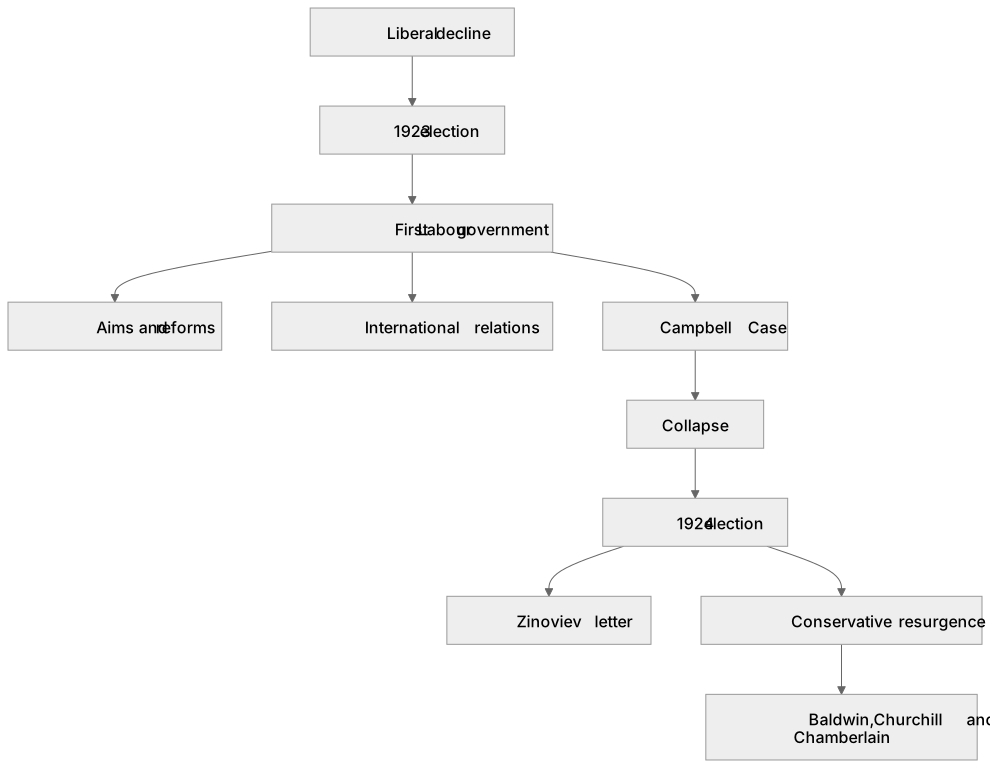
Label the diagram
Some boxes have lost their names. Pick the right name for each number.
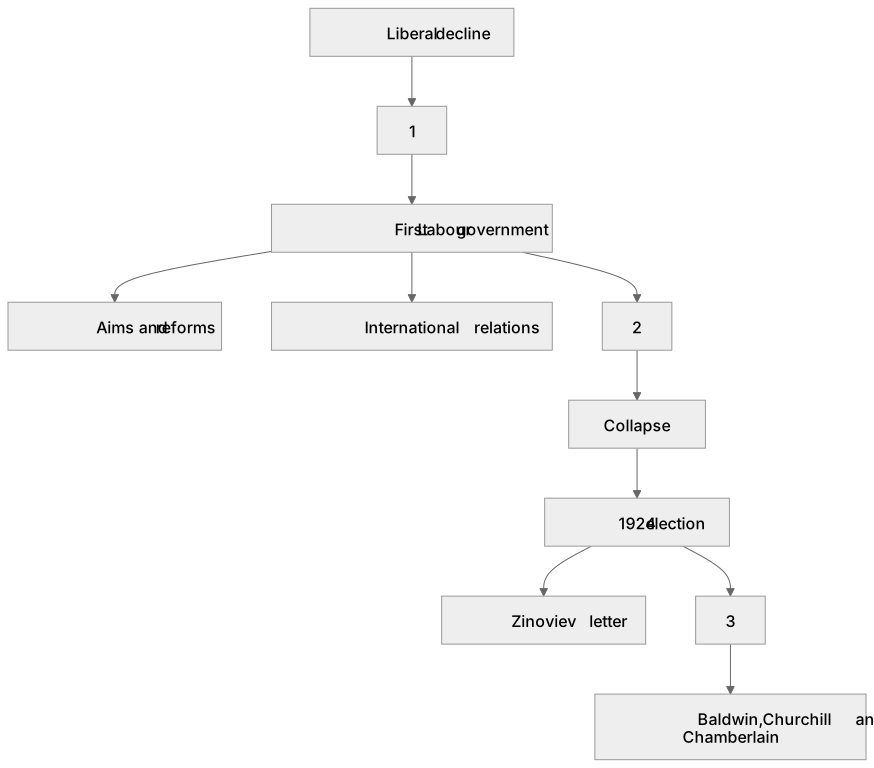
1Box 1
2Box 2
3Box 3
There is more to this lesson
The full lesson goes on to check your understanding and help you earn the marks. Create a free account to carry on, with your progress saved.
A week of Premium from your first lesson · Then the free plan continues · No card, no charge
Test your understanding of 2M Wars and Welfare: Britain in Transition, 1906–1957 – The search for stability, 1922–1929: Political developments: the decline of the Liberals; the 1923 election; the first Labour government: aims, reforms, international relations and collapse; the Conservative resurgence and government; the roles of Baldwin, Churchill and Chamberlain
Active recall beats re-reading. Take an instant quiz now to test what you’ve learned and lock it into long-term memory.
A week of Premium from your first lesson · Then the free plan continues · No card, no charge