AQA · A-Level · History
Course version: 7042 · Version from Sept 2017
Russia, 1917–1953 – Bolshevik consolidation, 1918–1924: Foreign relations…
Full specification wording
2N Revolution and dictatorship: Russia, 1917–1953 – Bolshevik consolidation, 1918–1924: Foreign relations and attitudes of foreign powers: foreign intervention in the Civil War; Comintern; the Russo-Polish War; discussions leading to the Rapallo Treaty; official recognition and the repercussions of the 'Zinoviev letter'; Lenin's rule by 1924
Bolshevik foreign policy balanced global revolution with state survival.
Checked against the AQA 7042 specification (opens in a new tab) on .
- Point 4 of 4
- 4 key terms
Study notes
From the checked teaching notes for this specification point.
The idea
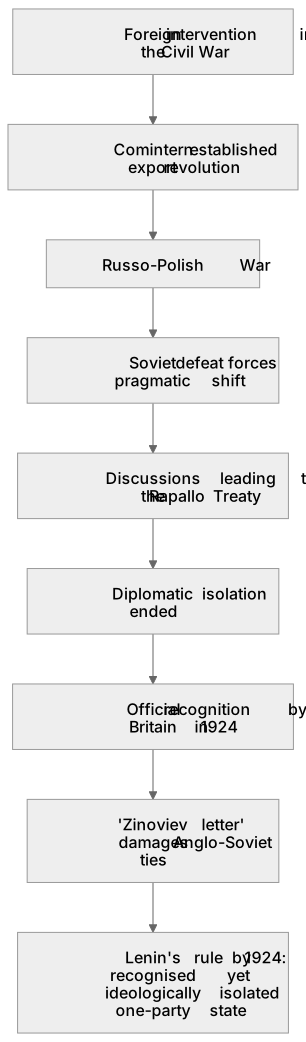
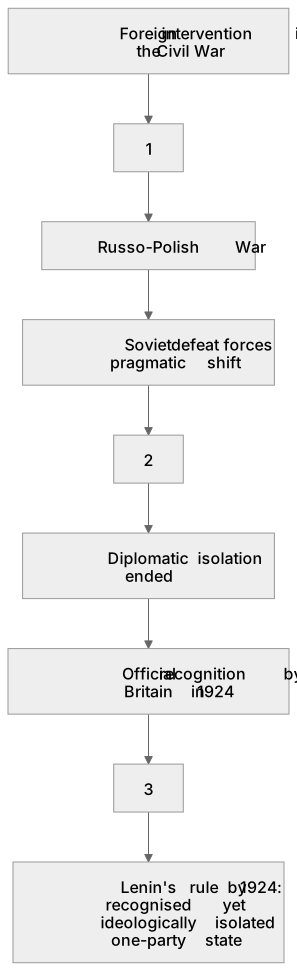
Bolshevik foreign policy balanced global revolution with state survival. Foreign powers intervened in the Civil War to support the Whites, reflecting deep anti-Bolshevik attitudes. Concurrently, Lenin established the Comintern to export revolution. The Russo-Polish War tested this expansionism, but Soviet defeat forced a pragmatic shift. This drove discussions leading to the 1922 Rapallo Treaty with Germany, ending diplomatic isolation. By 1924, Britain granted official recognition, though relations remained fragile, as seen when the forged 'Zinoviev letter' damaged Anglo-Soviet ties. By Lenin's death in 1924, his rule had transformed Russia into a consolidated, internationally recognised, yet ideologically isolated one-party state.
What earns the marks
- Assess the motivations for foreign intervention in the Civil War, distinguishing between wartime strategic aims and post-1918 anti-communist ideology.
- Explain the dual track of Soviet foreign policy: the Comintern's revolutionary aims versus the Narkomindel's pursuit of traditional diplomacy.
- Evaluate the Russo-Polish War as a turning point that ended hopes of immediate European revolution and necessitated peaceful coexistence.
- Analyse the significance of the Rapallo Treaty in breaking the diplomatic isolation of both Soviet Russia and Weimar Germany.
- Examine the impact of the Zinoviev letter on Anglo-Soviet relations and its role in highlighting the contradictions of Soviet foreign policy.
Common mistakes and how to put them right
Claiming foreign intervention was a massive, coordinated effort to destroy Bolshevism.
Put it right: Emphasise that intervention was uncoordinated, lacked clear objectives after WWI ended, and involved limited troop engagements.
Confusing the Comintern with the Soviet government's diplomatic arm.
Put it right: Distinguish between the Comintern, which aimed to overthrow foreign governments, and the Commissariat for Foreign Affairs, which sought trade and official recognition.
Stating the Zinoviev letter was a genuine directive that caused the fall of the British government.
Put it right: Note that it was a forgery that strained relations, rather than the sole cause of the Labour government's electoral defeat.
Exam tips
- Use the concept of 'dual foreign policy' to explain the contradictions between Comintern activities and the pursuit of trade treaties.
- Highlight the Rapallo Treaty as a masterstroke of pragmatic diplomacy, uniting Europe's two outcast nations for mutual economic and military benefit.
- When assessing Lenin's rule by 1924, synthesize domestic consolidation with the achievement of official recognition by major powers like Britain.
Try the lesson
The start of the 2N Revolution and dictatorship: Russia, 1917–1953 – Bolshevik consolidation, 1918–1924: Foreign relations and attitudes of foreign powers: foreign intervention in the Civil War; Comintern; the Russo-Polish War; discussions leading to the Rapallo Treaty; official recognition and the repercussions of the 'Zinoviev letter'; Lenin's rule by 1924 lesson, made from checked teaching notes for this specification point.
Have a go first
What was the primary consequence of the Battle of Warsaw (1920) during the Russo-Polish War for Soviet foreign policy?
Listen
Bolshevik foreign policy balanced global revolution with state survival. Foreign powers intervened in the Civil War to support the Whites, reflecting deep anti-Bolshevik attitudes. Concurrently, Lenin established the Comintern to export revolution. The Russo-Polish War tested this expansionism, but Soviet defeat forced a pragmatic shift. This drove discussions leading to the 1922 Rapallo Treaty with Germany, ending diplomatic isolation. By 1924, Britain granted official recognition, though relations remained fragile, as seen when the forged 'Zinoviev letter' damaged Anglo-Soviet ties. By Lenin's death in 1924, his rule had transformed Russia into a consolidated, internationally recognised, yet ideologically isolated one-party state. A strong answer earns marks for these points. Assess the motivations for foreign intervention in the Civil War, distinguishing between wartime strategic aims and post-1918 anti-communist ideology. Explain the dual track of Soviet foreign policy: the Comintern's revolutionary aims versus the Narkomindel's pursuit of traditional diplomacy. Evaluate the Russo-Polish War as a turning point that ended hopes of immediate European revolution and necessitated peaceful coexistence. Analyse the significance of the Rapallo Treaty in breaking the diplomatic isolation of both Soviet Russia and Weimar Germany. A common slip: Claiming foreign intervention was a massive, coordinated effort to destroy Bolshevism. Instead, Emphasise that intervention was uncoordinated, lacked clear objectives after WWI ended, and involved limited troop engagements. Exam tip: Use the concept of 'dual foreign policy' to explain the contradictions between Comintern activities and the pursuit of trade treaties.
See it
Key words
Say what each word means before you turn the card.
Comintern
Try answering aloud or in your head before turning the card.
Rapallo Treaty
Try answering aloud or in your head before turning the card.
Zinoviev letter
Try answering aloud or in your head before turning the card.
Russo-Polish War
Try answering aloud or in your head before turning the card.
See every definition
- Comintern
- Established by Lenin to export revolution, aiming to overthrow foreign governments.
- Rapallo Treaty
- A 1922 treaty with Germany that ended diplomatic isolation for both Soviet Russia and Weimar Germany.
- Zinoviev letter
- A forgery that damaged Anglo-Soviet ties and strained relations after Britain granted official recognition.
- Russo-Polish War
- A test of expansionism whose Soviet defeat forced a pragmatic shift and ended hopes of immediate European revolution.
Label the diagram
Some boxes have lost their names. Pick the right name for each number.
1Box 1
2Box 2
3Box 3
There is more to this lesson
The full lesson goes on to check your understanding and help you earn the marks. Create a free account to carry on, with your progress saved.
A week of Premium from your first lesson · Then the free plan continues · No card, no charge
Test your understanding of 2N Revolution and dictatorship: Russia, 1917–1953 – Bolshevik consolidation, 1918–1924: Foreign relations and attitudes of foreign powers: foreign intervention in the Civil War; Comintern; the Russo-Polish War; discussions leading to the Rapallo Treaty; official recognition and the repercussions of the 'Zinoviev letter'; Lenin's rule by 1924
Active recall beats re-reading. Take an instant quiz now to test what you’ve learned and lock it into long-term memory.
A week of Premium from your first lesson · Then the free plan continues · No card, no charge