AQA · A-Level · History
Course version: 7042 · Version from Sept 2017
Russia, 1917–1953 – Bolshevik consolidation, 1918–1924: Economic and…
Full specification wording
2N Revolution and dictatorship: Russia, 1917–1953 – Bolshevik consolidation, 1918–1924: Economic and social developments: state capitalism; social change; conditions in cities and countryside during the Civil War; war communism; the Red Terror: revolts of 1920–1921 including the Tambov revolt and Kronstadt rising; the NEP and its political and economic impact
Lenin initially adopted 'state capitalism', keeping existing structures under state control.
Checked against the AQA 7042 specification (opens in a new tab) on .
- Point 3 of 4
- 4 key terms
Study notes
From the checked teaching notes for this specification point.
The idea
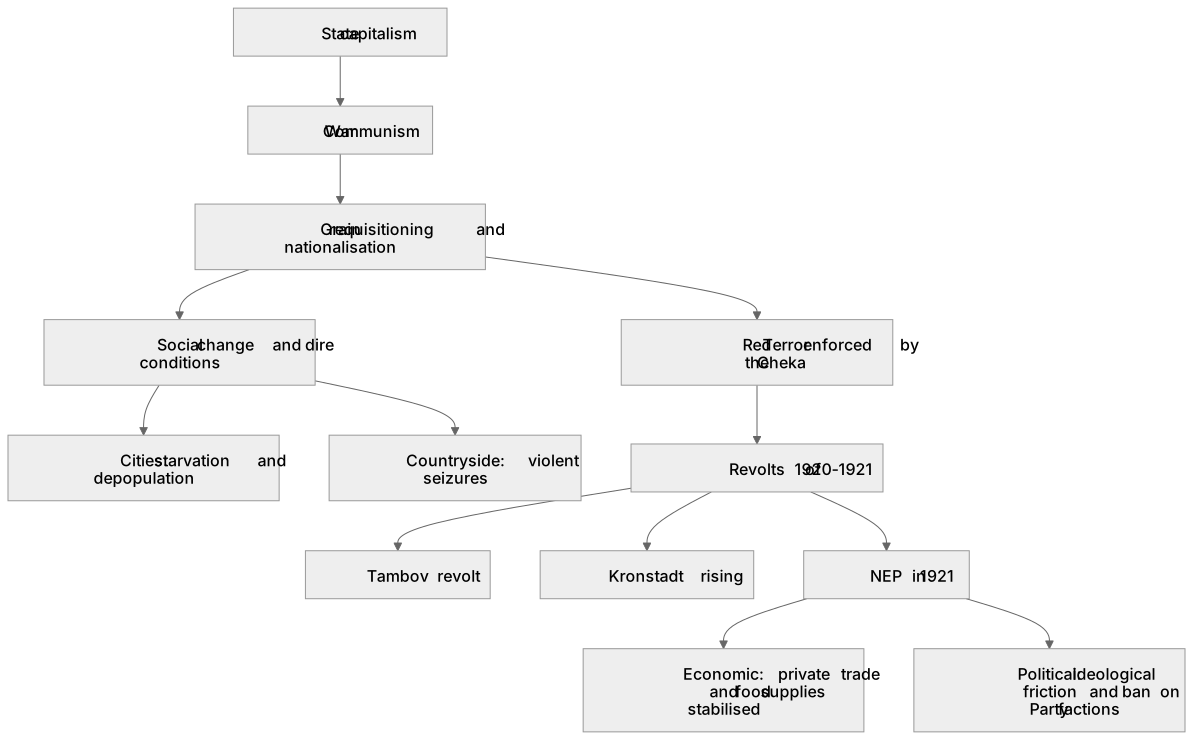
Lenin initially adopted 'state capitalism', keeping existing structures under state control. The Civil War forced a shift to 'War Communism', featuring grain requisitioning and nationalisation. This caused drastic social change and dire conditions: cities faced starvation and depopulation, while the countryside endured violent seizures. The Cheka enforced this via the Red Terror. Such repression sparked the 1920–1921 revolts, notably the Tambov peasant uprising and the Kronstadt sailors' mutiny. Facing collapse, Lenin introduced the New Economic Policy (NEP) in 1921. Economically, the NEP restored private trade and stabilised food supplies. Politically, it caused ideological friction, viewed as a capitalist retreat, prompting Lenin to ban Party factions to ensure strict unity.
What earns the marks
- Explain the transition from state capitalism to War Communism as a pragmatic response to Civil War exigencies and ideological zeal.
- Detail the social impact of War Communism, including urban depopulation, famine, and the destruction of the money economy.
- Analyse the Red Terror as a systematic tool of political suppression and economic enforcement orchestrated by the Cheka.
- Evaluate the Tambov and Kronstadt revolts as the primary catalysts for the abandonment of War Communism.
- Assess the NEP's dual impact: economic recovery through limited capitalism and political tightening via the 1921 Ban on Factions.
Common mistakes and how to put them right
Confusing state capitalism with the NEP.
Put it right: State capitalism was the initial 1917-1918 policy of transitional control, whereas the NEP was a 1921 retreat to limited private trade after War Communism.
Assuming the Red Terror only targeted the Whites.
Put it right: The Red Terror targeted a wide range of perceived enemies, including SRs, Mensheviks, striking workers, and peasants resisting requisitioning.
Stating the NEP was universally welcomed by the Bolsheviks.
Put it right: Acknowledge that the NEP caused significant ideological distress within the Party, leading to the Ban on Factions.
Exam tips
- Link economic policies directly to political survival; show how War Communism won the war but almost lost the peace.
- Use the Kronstadt rising to demonstrate the loss of core Bolshevik support, highlighting why Lenin called it the flash that lit up reality.
- When discussing the NEP, always balance its economic success with its political consequences, such as internal Party divisions.
Try the lesson
The start of the 2N Revolution and dictatorship: Russia, 1917–1953 – Bolshevik consolidation, 1918–1924: Economic and social developments: state capitalism; social change; conditions in cities and countryside during the Civil War; war communism; the Red Terror: revolts of 1920–1921 including the Tambov revolt and Kronstadt rising; the NEP and its political and economic impact lesson, made from checked teaching notes for this specification point.
Have a go first
Which of the following was a central feature of the economic policy known as War Communism implemented by the Bolsheviks during the Russian Civil War?
Listen
Lenin initially adopted 'state capitalism', keeping existing structures under state control. The Civil War forced a shift to 'War Communism', featuring grain requisitioning and nationalisation. This caused drastic social change and dire conditions: cities faced starvation and depopulation, while the countryside endured violent seizures. The Cheka enforced this via the Red Terror. Such repression sparked the 1920–1921 revolts, notably the Tambov peasant uprising and the Kronstadt sailors' mutiny. Facing collapse, Lenin introduced the New Economic Policy (NEP) in 1921. Economically, the NEP restored private trade and stabilised food supplies. Politically, it caused ideological friction, viewed as a capitalist retreat, prompting Lenin to ban Party factions to ensure strict unity. A strong answer earns marks for these points. Explain the transition from state capitalism to War Communism as a pragmatic response to Civil War exigencies and ideological zeal. Detail the social impact of War Communism, including urban depopulation, famine, and the destruction of the money economy. Analyse the Red Terror as a systematic tool of political suppression and economic enforcement orchestrated by the Cheka. Evaluate the Tambov and Kronstadt revolts as the primary catalysts for the abandonment of War Communism. A common slip: Confusing state capitalism with the NEP. Instead, State capitalism was the initial 1917-1918 policy of transitional control, whereas the NEP was a 1921 retreat to limited private trade after War Communism. Exam tip: Link economic policies directly to political survival; show how War Communism won the war but almost lost the peace.
See it
Key words
Say what each word means before you turn the card.
State capitalism
Try answering aloud or in your head before turning the card.
War Communism
Try answering aloud or in your head before turning the card.
Red Terror
Try answering aloud or in your head before turning the card.
NEP
Try answering aloud or in your head before turning the card.
See every definition
- State capitalism
- The initial policy of keeping existing structures under state control, adopted by Lenin before the Civil War forced a shift.
- War Communism
- A shift forced by the Civil War, featuring grain requisitioning and nationalisation, which caused drastic social change and dire conditions.
- Red Terror
- A means of enforcement by the Cheka, used as a systematic tool of political suppression and economic enforcement.
- NEP
- Introduced by Lenin in 1921, it restored private trade and stabilised food supplies, but was viewed as a capitalist retreat causing ideological friction.
Label the diagram
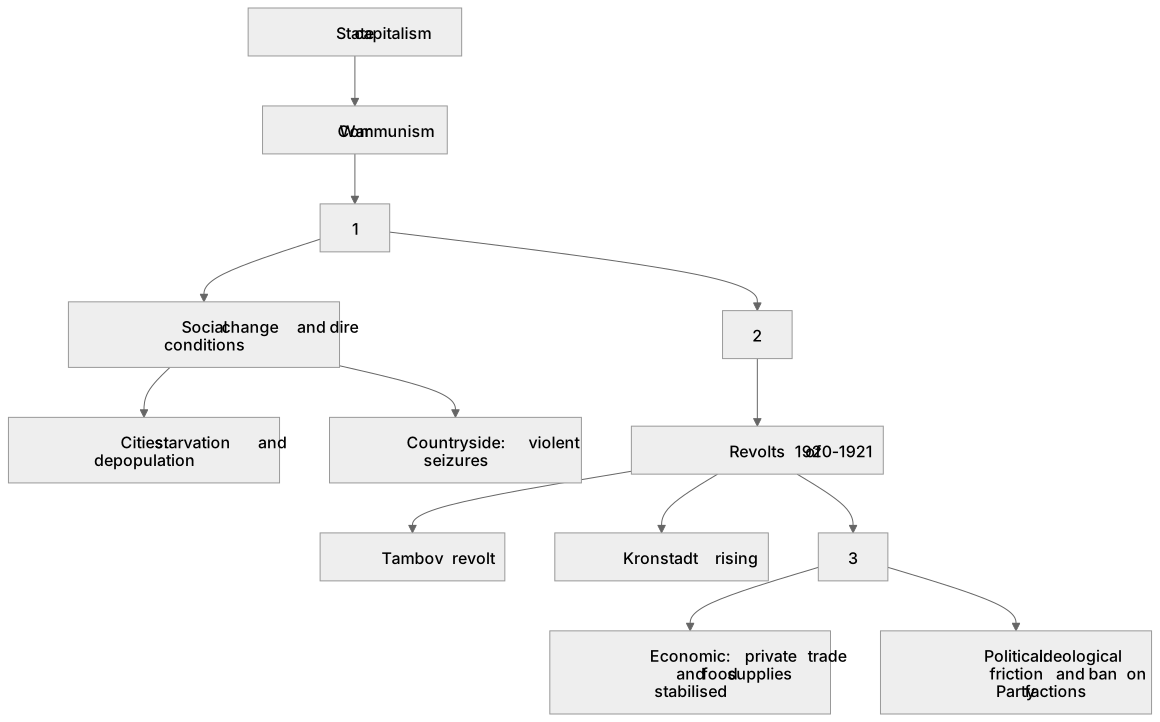
Some boxes have lost their names. Pick the right name for each number.
1Box 1
2Box 2
3Box 3
There is more to this lesson
The full lesson goes on to check your understanding and help you earn the marks. Create a free account to carry on, with your progress saved.
A week of Premium from your first lesson · Then the free plan continues · No card, no charge
Test your understanding of 2N Revolution and dictatorship: Russia, 1917–1953 – Bolshevik consolidation, 1918–1924: Economic and social developments: state capitalism; social change; conditions in cities and countryside during the Civil War; war communism; the Red Terror: revolts of 1920–1921 including the Tambov revolt and Kronstadt rising; the NEP and its political and economic impact
Active recall beats re-reading. Take an instant quiz now to test what you’ve learned and lock it into long-term memory.
A week of Premium from your first lesson · Then the free plan continues · No card, no charge