AQA · A-Level · History
Course version: 7042 · Version from Sept 2017
Russia, 1917–1953 – Bolshevik consolidation, 1918–1924: The Civil War:…
Full specification wording
2N Revolution and dictatorship: Russia, 1917–1953 – Bolshevik consolidation, 1918–1924: The Civil War: causes and course; the role of Trotsky; the murder of the Tsar; the reasons for the Red victory; government and control in wartime
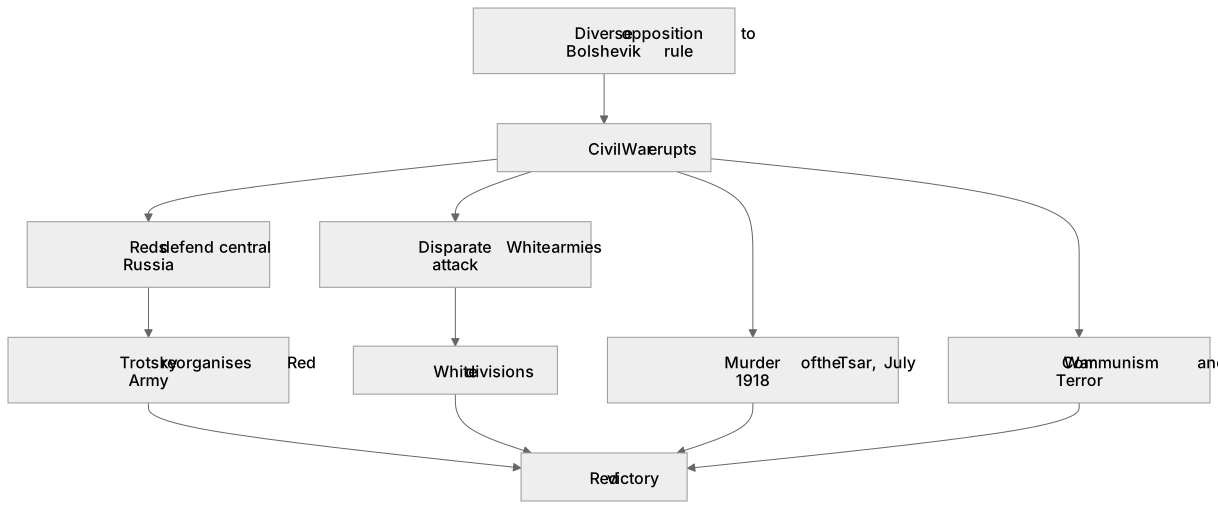
The Russian Civil War erupted due to diverse opposition to Bolshevik rule, including alienated socialists, monarchists, and foreign interventionists.
Checked against the AQA 7042 specification (opens in a new tab) on .
- Point 2 of 4
- 4 key terms
Study notes
From the checked teaching notes for this specification point.
The idea
The Russian Civil War erupted due to diverse opposition to Bolshevik rule, including alienated socialists, monarchists, and foreign interventionists. The course of the war saw the Reds defending central Russia against disparate White armies. Trotsky’s role as Commissar for War was pivotal; he reorganised the Red Army, utilised former Tsarist officers, and maintained morale via his armoured train. In July 1918, the Bolsheviks murdered the Tsar and his family to prevent their rescue by advancing White forces, eliminating a potential rallying figure. Red victory stemmed from geographical advantages, unified command, and Trotsky's leadership, contrasting with White divisions. Wartime government control was enforced through War Communism and the Red Terror, centralising economic and political power.
What earns the marks
- Identify the diverse causes of the Civil War, including political alienation, the Treaty of Brest-Litovsk, and foreign intervention.
- Evaluate the role of Trotsky in securing Red victory, focusing on his military reorganisation, discipline, and strategic leadership.
- Explain the strategic and political motivations behind the murder of the Tsar and his family in Yekaterinburg in July 1918.
- Analyse the reasons for the Red victory, comparing Bolshevik geographical and organisational advantages with the fragmented nature of the White armies.
- Assess the methods of government and control during wartime, specifically the implementation of War Communism and the systematic use of the Red Terror.
Common mistakes and how to put them right
Treating the White armies as a unified force with a single objective.
Put it right: Emphasise that the Whites were a disparate coalition of monarchists, liberals, and socialists with conflicting aims and poor coordination.
Stating the Tsar was murdered solely out of ideological hatred.
Put it right: Explain that the immediate catalyst for the murder was the tactical threat of the advancing Czech Legion and White forces potentially rescuing him.
Attributing Red victory entirely to Trotsky's leadership.
Put it right: Balance Trotsky's role with structural factors such as the Reds' control of the central railway network, industrial hubs, and the core population.
Exam tips
- Contrast the unified ideological message of the Bolsheviks with the Whites' failure to present a compelling alternative to the peasantry.
- Use War Communism as a dual-purpose example: it was both an economic policy to supply the Red Army and a method of extending political control.
- When evaluating Trotsky's role, mention specific tactics such as his use of political commissars alongside former Tsarist military specialists.
Try the lesson
The start of the 2N Revolution and dictatorship: Russia, 1917–1953 – Bolshevik consolidation, 1918–1924: The Civil War: causes and course; the role of Trotsky; the murder of the Tsar; the reasons for the Red victory; government and control in wartime lesson, made from checked teaching notes for this specification point.
Have a go first
What was Leon Trotsky's primary role during the Russian Civil War that significantly contributed to the Red victory?
Listen
The Russian Civil War erupted due to diverse opposition to Bolshevik rule, including alienated socialists, monarchists, and foreign interventionists. The course of the war saw the Reds defending central Russia against disparate White armies. Trotsky’s role as Commissar for War was pivotal; he reorganised the Red Army, utilised former Tsarist officers, and maintained morale via his armoured train. In July 1918, the Bolsheviks murdered the Tsar and his family to prevent their rescue by advancing White forces, eliminating a potential rallying figure. Red victory stemmed from geographical advantages, unified command, and Trotsky's leadership, contrasting with White divisions. Wartime government control was enforced through War Communism and the Red Terror, centralising economic and political power. A strong answer earns marks for these points. Identify the diverse causes of the Civil War, including political alienation, the Treaty of Brest-Litovsk, and foreign intervention. Evaluate the role of Trotsky in securing Red victory, focusing on his military reorganisation, discipline, and strategic leadership. Explain the strategic and political motivations behind the murder of the Tsar and his family in Yekaterinburg in July 1918. Analyse the reasons for the Red victory, comparing Bolshevik geographical and organisational advantages with the fragmented nature of the White armies. A common slip: Treating the White armies as a unified force with a single objective. Instead, Emphasise that the Whites were a disparate coalition of monarchists, liberals, and socialists with conflicting aims and poor coordination. Exam tip: Contrast the unified ideological message of the Bolsheviks with the Whites' failure to present a compelling alternative to the peasantry.
See it
Key words
Say what each word means before you turn the card.
Trotsky
Try answering aloud or in your head before turning the card.
murder of the Tsar
Try answering aloud or in your head before turning the card.
Red victory
Try answering aloud or in your head before turning the card.
War Communism
Try answering aloud or in your head before turning the card.
See every definition
- Trotsky
- Commissar for War whose role was pivotal: he reorganised the Red Army, utilised former Tsarist officers, and maintained morale via his armoured train.
- murder of the Tsar
- In July 1918 the Bolsheviks murdered the Tsar and his family to prevent their rescue by advancing White forces, eliminating a potential rallying figure.
- Red victory
- Stemmed from geographical advantages, unified command, and Trotsky's leadership, contrasting with White divisions.
- War Communism
- Wartime government control enforced through this and the Red Terror, centralising economic and political power.
Label the diagram
Some boxes have lost their names. Pick the right name for each number.
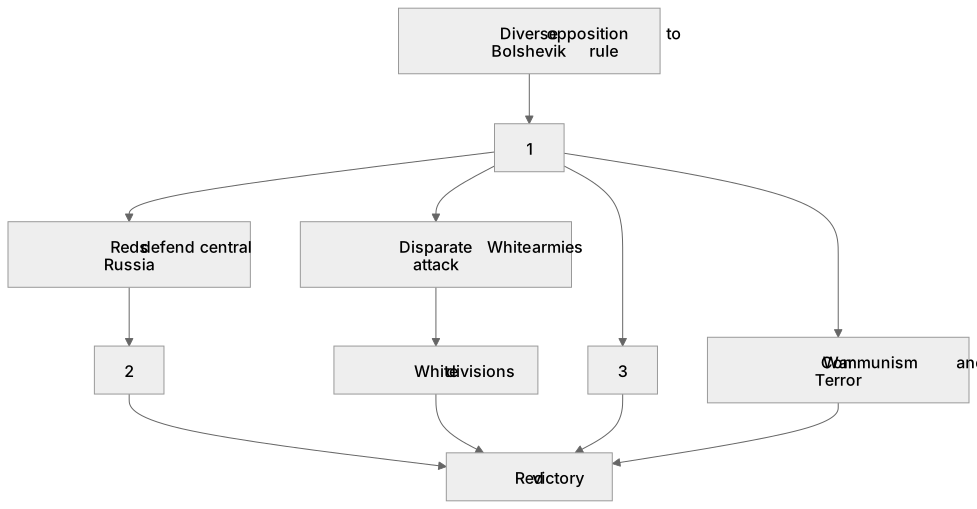
1Box 1
2Box 2
3Box 3
There is more to this lesson
The full lesson goes on to check your understanding and help you earn the marks. Create a free account to carry on, with your progress saved.
A week of Premium from your first lesson · Then the free plan continues · No card, no charge
Test your understanding of 2N Revolution and dictatorship: Russia, 1917–1953 – Bolshevik consolidation, 1918–1924: The Civil War: causes and course; the role of Trotsky; the murder of the Tsar; the reasons for the Red victory; government and control in wartime
Active recall beats re-reading. Take an instant quiz now to test what you’ve learned and lock it into long-term memory.
A week of Premium from your first lesson · Then the free plan continues · No card, no charge