AQA · A-Level · History
Course version: 7042 · Version from Sept 2017
Russia, 1917–1953 – Economy and society, 1929–1941 (A-level only):…
Full specification wording
2N Revolution and dictatorship: Russia, 1917–1953 – Economy and society, 1929–1941 (A-level only): Agricultural and social developments in the countryside: voluntary and forced collectivisation; state farms; mechanisation; the impact of collectivisation on the kulaks and other peasants; the famine of 1932–1934; the success of collectivisation
Stalin’s agricultural policies transformed the Soviet countryside, shifting from voluntary collectivisation in 1928 to forced collectivisation by 1929.
Checked against the AQA 7042 specification (opens in a new tab) on .
- Point 1 of 4
Study notes
From the checked teaching notes for this specification point.
The idea
Stalin’s agricultural policies transformed the Soviet countryside, shifting from voluntary collectivisation in 1928 to forced collectivisation by 1929. Peasants were pushed into collective farms (kolkhozes) or state farms (sovkhozes), supported by Machine Tractor Stations (MTS) for mechanisation. This triggered fierce resistance, leading to the brutal 'dekulakisation' campaign which devastated the kulaks and impoverished other peasants. State grain requisitioning directly caused the catastrophic 1932–1934 famine, killing millions. While collectivisation succeeded ideologically by establishing state control and securing grain for urban industrialisation, it was an economic and human disaster for agriculture.
What earns the marks
- Distinguish between the initial voluntary phase and the rapid shift to forced collectivisation in 1929.
- Explain the structural differences between kolkhozes (collective farms) and sovkhozes (state farms), and the role of MTS in mechanisation.
- Analyse the social impact of dekulakisation on the kulaks, and the resistance and impoverishment of other peasants.
- Evaluate the causes and scale of the 1932–1934 famine, linking it to state requisitioning quotas.
- Assess the 'success' of collectivisation by contrasting ideological and industrial gains with agricultural decline.
Common mistakes and how to put them right
Confusing kolkhozes with sovkhozes.
Put it right: Kolkhozes were collective farms where peasants shared profits, whereas sovkhozes were state-owned farms where peasants received a fixed wage.
Claiming collectivisation was an economic success for agriculture.
Put it right: State that while it secured grain for towns, agricultural production actually plummeted and livestock numbers collapsed.
Ignoring the voluntary phase of collectivisation.
Put it right: Acknowledge that collectivisation began as a voluntary initiative before Stalin escalated it to a forced policy in late 1929.
Exam tips
- When evaluating the success of collectivisation, explicitly separate political success (party control) from economic failure (falling yields).
- Use specific statistics, such as the drop in livestock numbers or grain harvests, to substantiate arguments about the impact on peasants.
- Note that while this topic often follows Stalin's rise to power, these agricultural developments specifically relate to the 1929–1941 period of economy and society.
Try the lesson
The start of the 2N Revolution and dictatorship: Russia, 1917–1953 – Economy and society, 1929–1941 (A-level only): Agricultural and social developments in the countryside: voluntary and forced collectivisation; state farms; mechanisation; the impact of collectivisation on the kulaks and other peasants; the famine of 1932–1934; the success of collectivisation lesson, made from checked teaching notes for this specification point.
Have a go first
What was the primary function of the Machine Tractor Stations (MTS) established during the collectivisation of Soviet agriculture?
Listen
Stalin’s agricultural policies transformed the Soviet countryside, shifting from voluntary collectivisation in 1928 to forced collectivisation by 1929. Peasants were pushed into collective farms (kolkhozes) or state farms (sovkhozes), supported by Machine Tractor Stations (MTS) for mechanisation. This triggered fierce resistance, leading to the brutal 'dekulakisation' campaign which devastated the kulaks and impoverished other peasants. State grain requisitioning directly caused the catastrophic 1932–1934 famine, killing millions. While collectivisation succeeded ideologically by establishing state control and securing grain for urban industrialisation, it was an economic and human disaster for agriculture. A strong answer earns marks for these points. Distinguish between the initial voluntary phase and the rapid shift to forced collectivisation in 1929. Explain the structural differences between kolkhozes (collective farms) and sovkhozes (state farms), and the role of MTS in mechanisation. Analyse the social impact of dekulakisation on the kulaks, and the resistance and impoverishment of other peasants. Evaluate the causes and scale of the 1932–1934 famine, linking it to state requisitioning quotas. A common slip: Confusing kolkhozes with sovkhozes. Instead, kolkhozes were collective farms where peasants shared profits, whereas sovkhozes were state-owned farms where peasants received a fixed wage. Exam tip: When evaluating the success of collectivisation, explicitly separate political success (party control) from economic failure (falling yields).
See it
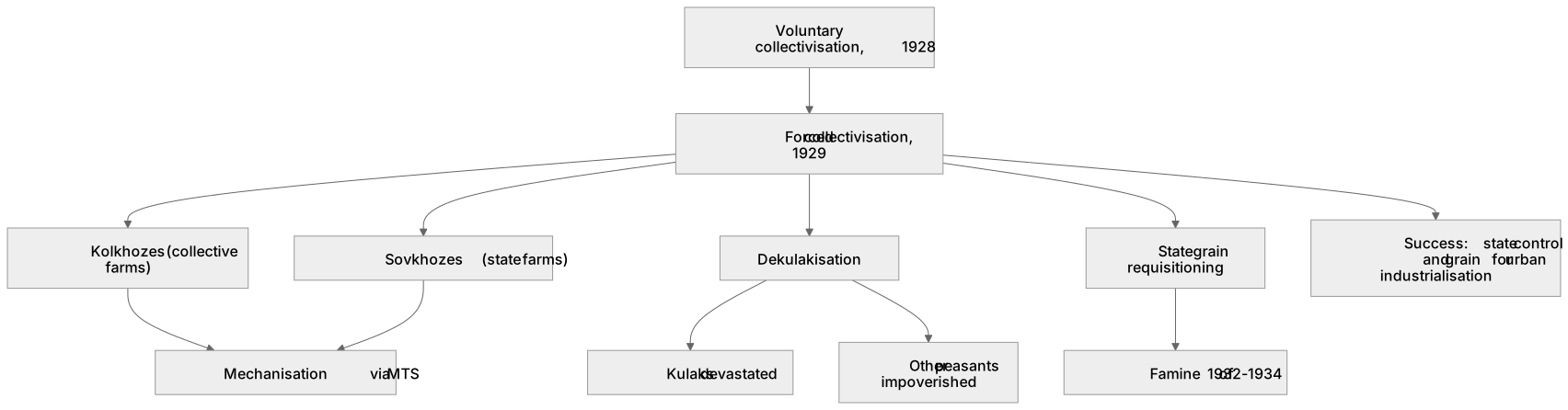
Put the events in order
Put these events in the order they happened, earliest first.
- 1. Voluntary collectivisation begins in the Soviet countryside
- 2. Catastrophic famine caused by state grain requisitioning
- 3. Rapid shift to forced collectivisation
Label the diagram
Some boxes have lost their names. Pick the right name for each number.
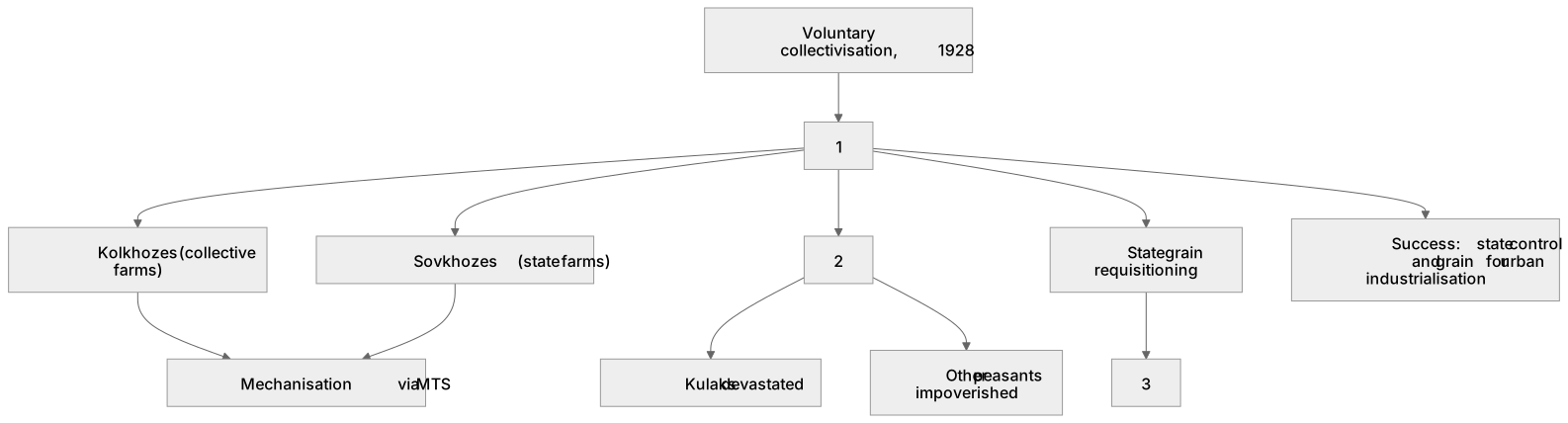
1Box 1
2Box 2
3Box 3
There is more to this lesson
The full lesson goes on to check your understanding and help you earn the marks. Create a free account to carry on, with your progress saved.
A week of Premium from your first lesson · Then the free plan continues · No card, no charge
Test your understanding of 2N Revolution and dictatorship: Russia, 1917–1953 – Economy and society, 1929–1941 (A-level only): Agricultural and social developments in the countryside: voluntary and forced collectivisation; state farms; mechanisation; the impact of collectivisation on the kulaks and other peasants; the famine of 1932–1934; the success of collectivisation
Active recall beats re-reading. Take an instant quiz now to test what you’ve learned and lock it into long-term memory.
A week of Premium from your first lesson · Then the free plan continues · No card, no charge