AQA · A-Level · History
Course version: 7042 · Version from Sept 2017
Russia, 1917–1953 – Economy and society, 1929–1941 (A-level only): The…
Full specification wording
2N Revolution and dictatorship: Russia, 1917–1953 – Economy and society, 1929–1941 (A-level only): The development of the Stalin cult: literature, the arts and other propaganda; Socialist Realism
The Stalin cult developed rapidly, transforming him into an infallible figure presented as Lenin's true heir.
Checked against the AQA 7042 specification (opens in a new tab) on .
- Point 3 of 4
- 4 key terms
Study notes
From the checked teaching notes for this specification point.
The idea
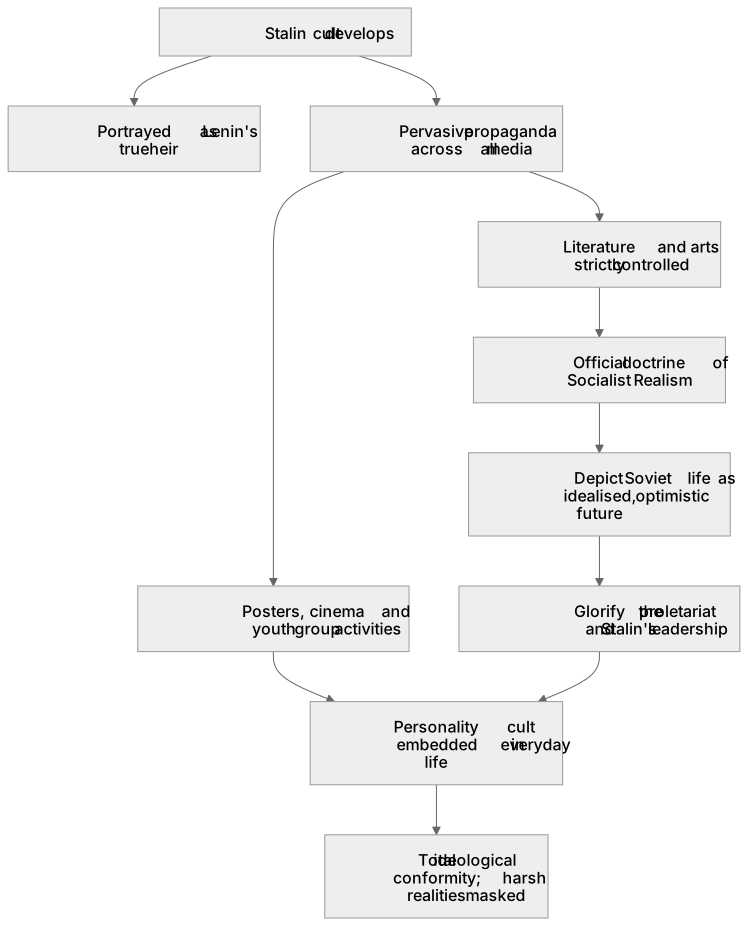
The Stalin cult developed rapidly, transforming him into an infallible figure presented as Lenin's true heir. This was achieved through pervasive propaganda across all media. Literature and the arts were strictly controlled to serve the state, culminating in the official doctrine of Socialist Realism. This required artists to depict Soviet life not as it was, but in an idealised, optimistic future state, glorifying the proletariat and Stalin's leadership. For example, paintings showing Stalin guiding happy peasants became the standard. Other propaganda, including posters, cinema, and youth group activities, reinforced this omnipresent personality cult, ensuring total ideological conformity and masking the harsh realities of the regime.
What earns the marks
- Explain the core features of the Stalin cult, including his portrayal as Lenin's legitimate successor and the omniscient 'father of the nation'.
- Analyse the principles of Socialist Realism, specifically the requirement to depict an idealised, optimistic version of Soviet life that glorified the worker and the state.
- Evaluate the role of literature and the arts in enforcing ideological conformity, noting the censorship and persecution of non-conformist artists.
- Assess the use of other propaganda methods, such as posters, statues, and cinema, in embedding the cult of personality into everyday Soviet life.
Common mistakes and how to put them right
Confusing Socialist Realism with actual realism.
Put it right: Emphasise that Socialist Realism depicted an idealised, utopian version of the future, not the grim reality of contemporary Soviet life.
Assuming the Stalin cult was solely about vanity.
Put it right: Explain that the cult served a vital political function, providing a unifying figurehead and masking the chaos of rapid industrialisation and purges.
Treating all Soviet art as identical throughout the period.
Put it right: Distinguish between the avant-garde experimentation of the 1920s and the rigid enforcement of Socialist Realism from 1932 onwards.
Exam tips
- Use specific examples of propaganda, such as the 'Dizzy with Success' article or famous posters, to substantiate your arguments about the cult's reach.
- Link the development of the Stalin cult to the broader political context, such as the need to justify the hardships of the Five-Year Plans and the Great Terror.
- When evaluating the effectiveness of propaganda, consider the extent to which the Soviet populace genuinely believed the cult versus outwardly conforming out of fear.
Try the lesson
The start of the 2N Revolution and dictatorship: Russia, 1917–1953 – Economy and society, 1929–1941 (A-level only): The development of the Stalin cult: literature, the arts and other propaganda; Socialist Realism lesson, made from checked teaching notes for this specification point.
Have a go first
What was the primary purpose of 'Socialist Realism' in Soviet literature and the arts during the development of the Stalin cult?
Listen
The Stalin cult developed rapidly, transforming him into an infallible figure presented as Lenin's true heir. This was achieved through pervasive propaganda across all media. Literature and the arts were strictly controlled to serve the state, culminating in the official doctrine of Socialist Realism. This required artists to depict Soviet life not as it was, but in an idealised, optimistic future state, glorifying the proletariat and Stalin's leadership. For example, paintings showing Stalin guiding happy peasants became the standard. Other propaganda, including posters, cinema, and youth group activities, reinforced this omnipresent personality cult, ensuring total ideological conformity and masking the harsh realities of the regime. A strong answer earns marks for these points. Explain the core features of the Stalin cult, including his portrayal as Lenin's legitimate successor and the omniscient 'father of the nation'. Analyse the principles of Socialist Realism, specifically the requirement to depict an idealised, optimistic version of Soviet life that glorified the worker and the state. Evaluate the role of literature and the arts in enforcing ideological conformity, noting the censorship and persecution of non-conformist artists. Assess the use of other propaganda methods, such as posters, statues, and cinema, in embedding the cult of personality into everyday Soviet life. A common slip: Confusing Socialist Realism with actual realism. Instead, Emphasise that Socialist Realism depicted an idealised, utopian version of the future, not the grim reality of contemporary Soviet life. Exam tip: Use specific examples of propaganda, such as the 'Dizzy with Success' article or famous posters, to substantiate your arguments about the cult's reach.
See it
Key words
Say what each word means before you turn the card.
Cult of personality
Try answering aloud or in your head before turning the card.
Socialist Realism
Try answering aloud or in your head before turning the card.
Ideological conformity
Try answering aloud or in your head before turning the card.
Propaganda
Try answering aloud or in your head before turning the card.
See every definition
- Cult of personality
- The transformation of Stalin into an infallible figure presented as Lenin's true heir, reinforced by omnipresent propaganda and masking the harsh realities of the regime.
- Socialist Realism
- The official doctrine requiring artists to depict Soviet life not as it was, but in an idealised, optimistic future state, glorifying the proletariat and Stalin's leadership.
- Ideological conformity
- Total conformity ensured by propaganda, including posters, cinema and youth group activities, which reinforced the personality cult.
- Propaganda
- Pervasive material across all media, including literature, the arts, posters and cinema, used to present Stalin as an infallible figure.
Label the diagram
Some boxes have lost their names. Pick the right name for each number.
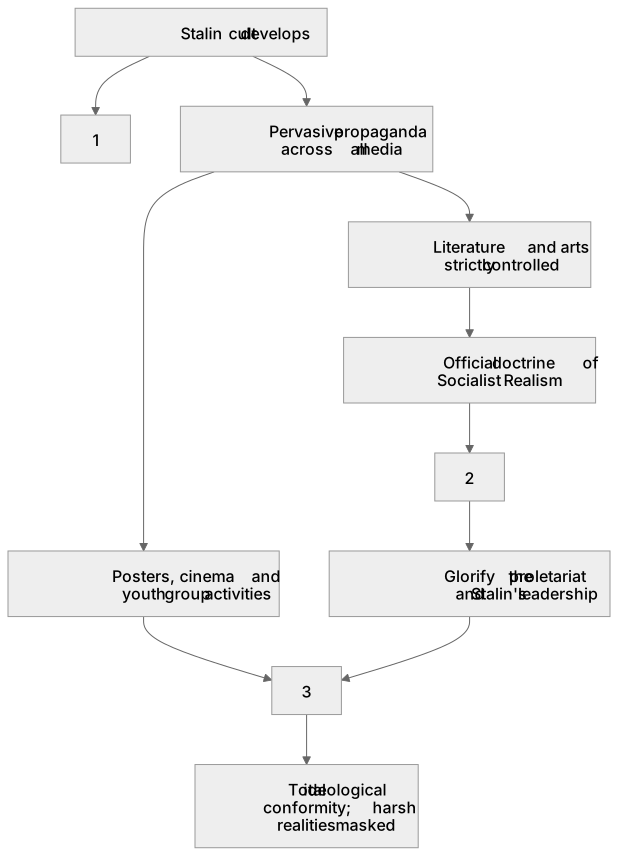
1Box 1
2Box 2
3Box 3
There is more to this lesson
The full lesson goes on to check your understanding and help you earn the marks. Create a free account to carry on, with your progress saved.
A week of Premium from your first lesson · Then the free plan continues · No card, no charge
Test your understanding of 2N Revolution and dictatorship: Russia, 1917–1953 – Economy and society, 1929–1941 (A-level only): The development of the Stalin cult: literature, the arts and other propaganda; Socialist Realism
Active recall beats re-reading. Take an instant quiz now to test what you’ve learned and lock it into long-term memory.
A week of Premium from your first lesson · Then the free plan continues · No card, no charge