AQA · A-Level · History
Course version: 7042 · Version from Sept 2017
Russia, 1917–1953 – Stalin’s rise to power, 1924–1929: Government,…
Full specification wording
2N Revolution and dictatorship: Russia, 1917–1953 – Stalin’s rise to power, 1924–1929: Government, propaganda and the beginning of the Stalinist cult; Stalin's attitude to foreign powers: China; Germany and the Treaty of Berlin; changes in the Comintern
Between 1924 and 1929, Soviet government became increasingly centralised as propaganda laid the foundations of the Stalinist cult.
Checked against the AQA 7042 specification (opens in a new tab) on .
- Point 4 of 4
Study notes
From the checked teaching notes for this specification point.
The idea
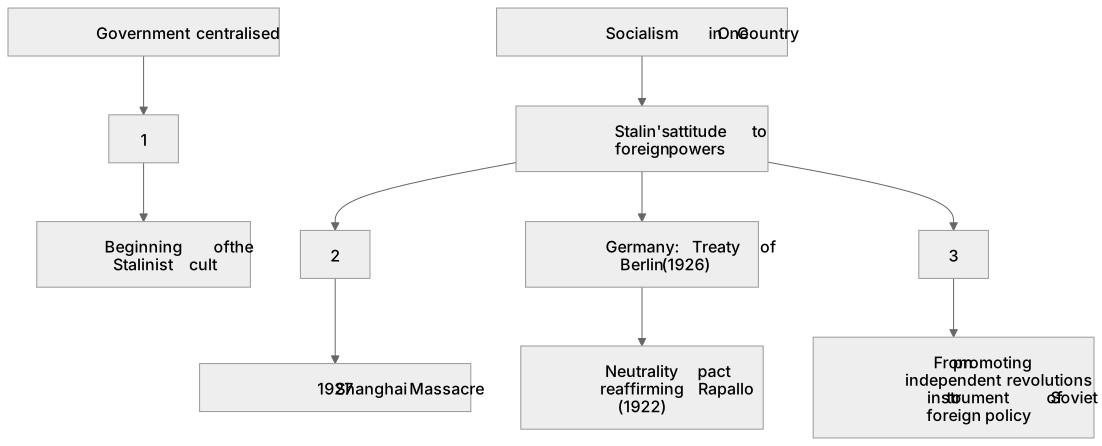
Between 1924 and 1929, Soviet government became increasingly centralised as propaganda laid the foundations of the Stalinist cult. Stalin was portrayed as Lenin's loyal disciple, using imagery to elevate his status above rivals. His attitude to foreign powers reflected 'Socialism in One Country', prioritising Soviet security. In China, Stalin pragmatically backed the nationalist Guomindang over the Chinese Communists, leading to the 1927 Shanghai Massacre. With Germany, he maintained the cooperative Treaty of Berlin (1926), a neutrality pact reaffirming the 1922 Rapallo agreement. Concurrently, changes in the Comintern saw it shift from promoting independent revolutions to serving strictly as an instrument of Soviet foreign policy.
What earns the marks
- Assess how propaganda and the manipulation of Lenin's legacy were used to establish the early Stalinist cult and centralise government control.
- Explain Stalin's pragmatic attitude towards China, specifically his controversial support for Jiang Jieshi (Chiang Kai-shek) and the Guomindang.
- Analyse the significance of the 1926 Treaty of Berlin as a neutrality pact continuing the diplomatic relationship with Germany established at Rapallo.
- Evaluate the changes in the Comintern, noting its transformation into a tool for Soviet state interests and Stalin's factional struggles.
Common mistakes and how to put them right
Assuming the Stalinist cult of personality was fully developed by 1929.
Put it right: Describe this period as the beginning or foundation of the cult, primarily focused on linking Stalin to Lenin, rather than the extreme deification seen in the 1930s.
Claiming Stalin supported the Chinese Communist Party unconditionally.
Put it right: Specify that Stalin ordered the CCP to ally with the nationalist Guomindang, which ultimately led to the CCP's betrayal and massacre in 1927.
Stating the 1926 Treaty of Berlin secured new military ties.
Put it right: Identify the Treaty of Berlin as a neutrality pact that reaffirmed the 1922 Rapallo agreement, rather than a new military alliance.
Exam tips
- Connect Stalin's foreign policy decisions, such as his actions in China, to his domestic ideological battle for 'Socialism in One Country' against Trotsky's 'Permanent Revolution'.
- Use the Treaty of Berlin to demonstrate how the Soviet government prioritised national security and pragmatic diplomacy over ideological purity.
- Discuss how changes in the Comintern reflected Stalin's growing control over the global communist movement and his defeat of the Left Opposition.
Try the lesson
The start of the 2N Revolution and dictatorship: Russia, 1917–1953 – Stalin’s rise to power, 1924–1929: Government, propaganda and the beginning of the Stalinist cult; Stalin's attitude to foreign powers: China; Germany and the Treaty of Berlin; changes in the Comintern lesson, made from checked teaching notes for this specification point.
Have a go first
How did the Treaty of Berlin (1926) affect relations between the Soviet Union and Germany?
Listen
Between 1924 and 1929, Soviet government became increasingly centralised as propaganda laid the foundations of the Stalinist cult. Stalin was portrayed as Lenin's loyal disciple, using imagery to elevate his status above rivals. His attitude to foreign powers reflected 'Socialism in One Country', prioritising Soviet security. In China, Stalin pragmatically backed the nationalist Guomindang over the Chinese Communists, leading to the 1927 Shanghai Massacre. With Germany, he maintained the cooperative Treaty of Berlin (1926), a neutrality pact reaffirming the 1922 Rapallo agreement. Concurrently, changes in the Comintern saw it shift from promoting independent revolutions to serving strictly as an instrument of Soviet foreign policy. A strong answer earns marks for these points. Assess how propaganda and the manipulation of Lenin's legacy were used to establish the early Stalinist cult and centralise government control. Explain Stalin's pragmatic attitude towards China, specifically his controversial support for Jiang Jieshi (Chiang Kai-shek) and the Guomindang. Analyse the significance of the 1926 Treaty of Berlin as a neutrality pact continuing the diplomatic relationship with Germany established at Rapallo. Evaluate the changes in the Comintern, noting its transformation into a tool for Soviet state interests and Stalin's factional struggles. A common slip: Assuming the Stalinist cult of personality was fully developed by 1929. Instead, Describe this period as the beginning or foundation of the cult, primarily focused on linking Stalin to Lenin, rather than the extreme deification seen in the 1930s. Exam tip: Connect Stalin's foreign policy decisions, such as his actions in China, to his domestic ideological battle for 'Socialism in One Country' against Trotsky's 'Permanent Revolution'.
See it
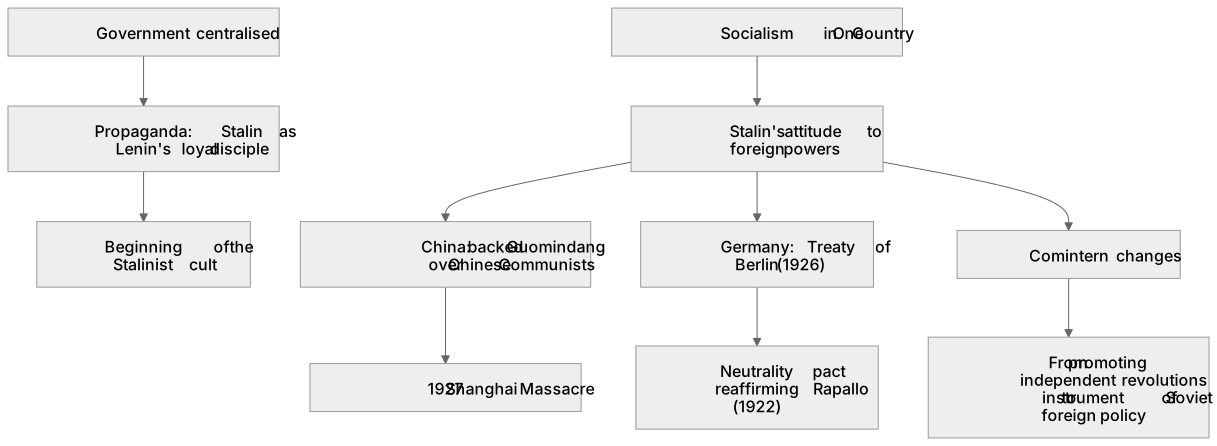
Put the events in order
Put these events in the order they happened, earliest first.
- 1. Rapallo agreement with Germany reaffirmed by later neutrality pact
- 2. Shanghai Massacre following Stalin's backing of the Guomindang
- 3. Treaty of Berlin signed as a neutrality pact with Germany
Label the diagram
Some boxes have lost their names. Pick the right name for each number.
1Box 1
2Box 2
3Box 3
There is more to this lesson
The full lesson goes on to check your understanding and help you earn the marks. Create a free account to carry on, with your progress saved.
A week of Premium from your first lesson · Then the free plan continues · No card, no charge
Test your understanding of 2N Revolution and dictatorship: Russia, 1917–1953 – Stalin’s rise to power, 1924–1929: Government, propaganda and the beginning of the Stalinist cult; Stalin's attitude to foreign powers: China; Germany and the Treaty of Berlin; changes in the Comintern
Active recall beats re-reading. Take an instant quiz now to test what you’ve learned and lock it into long-term memory.
A week of Premium from your first lesson · Then the free plan continues · No card, no charge