AQA · A-Level · History
Course version: 7042 · Version from Sept 2017
Russia, 1917–1953 – Stalin’s rise to power, 1924–1929: Economic…
Full specification wording
2N Revolution and dictatorship: Russia, 1917–1953 – Stalin’s rise to power, 1924–1929: Economic developments: reasons for and impact of the 'Great Turn'; the economic shift; the launch of the first Five Year Plan and the decision to collectivise
The 'Great Turn' of 1928 marked a radical economic shift from Lenin's gradualist New Economic Policy (NEP) to a command economy.
Checked against the AQA 7042 specification (opens in a new tab) on .
- Point 3 of 4
Study notes
From the checked teaching notes for this specification point.
The idea
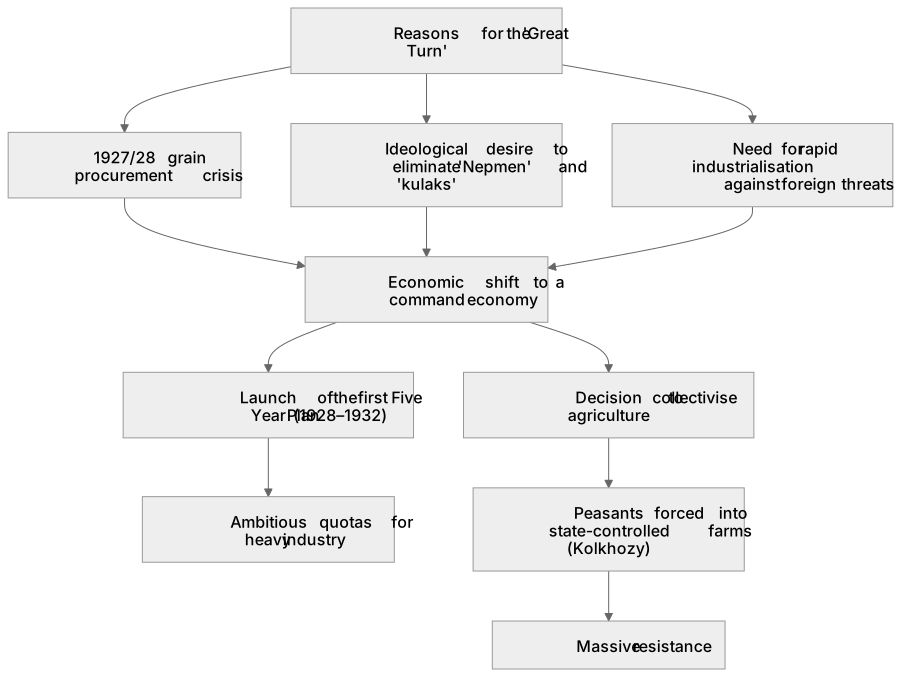
The 'Great Turn' of 1928 marked a radical economic shift from Lenin's gradualist New Economic Policy (NEP) to a command economy. Stalin's reasons included the 1927/28 grain procurement crisis, ideological desires to eliminate capitalist 'Nepmen' and 'kulaks', and the need for rapid industrialisation to defend against foreign threats. The impact was profound, centralising state control over production. This shift was implemented through the launch of the first Five Year Plan (1928–1932), which set ambitious quotas for heavy industries like coal and steel. Simultaneously, the decision to collectivise agriculture aimed to fund industrialisation by forcing peasants into state-controlled farms (Kolkhozy), sparking massive resistance.
What earns the marks
- Identify the ideological and practical reasons for abandoning the NEP, such as the 1927/28 grain procurement crisis and the desire to achieve true socialism.
- Explain the economic shift towards a command economy managed by Gosplan.
- Evaluate the launch of the first Five Year Plan, focusing on its emphasis on heavy industry and the use of unrealistic production targets.
- Analyse the decision to collectivise agriculture as a mechanism to extract grain surpluses to feed urban workers and fund industrial imports.
Common mistakes and how to put them right
Confusing the first Five Year Plan with later plans.
Put it right: Ensure you specifically link the first Five Year Plan (1928-1932) to the initial focus on heavy industry and the 'Great Turn', rather than later focuses on rearmament or consumer goods.
Stating collectivisation was purely an economic decision.
Put it right: Acknowledge the ideological motivation to destroy the 'kulak' class and extend Party control over the countryside.
Claiming the 1923 'scissors crisis' was the immediate trigger for abandoning the NEP.
Put it right: Note that while the 1923 scissors crisis highlighted NEP's flaws, the immediate catalyst for the 'Great Turn' was the 1927/28 grain procurement crisis combined with Stalin's political manoeuvring.
Exam tips
- Link the economic shift of the 'Great Turn' directly to Stalin's political consolidation and his defeat of Bukharin and the Right Opposition.
- Use specific terminology such as 'command economy', 'Gosplan', 'Nepmen', and 'kulaks' to demonstrate precise historical knowledge.
- When evaluating the impact of the first Five Year Plan, contrast the official propaganda successes with the reality of chaotic implementation and human cost.
Try the lesson
The start of the 2N Revolution and dictatorship: Russia, 1917–1953 – Stalin’s rise to power, 1924–1929: Economic developments: reasons for and impact of the 'Great Turn'; the economic shift; the launch of the first Five Year Plan and the decision to collectivise lesson, made from checked teaching notes for this specification point.
Have a go first
What was the primary economic shift associated with Stalin's 'Great Turn' in 1928?
Listen
The 'Great Turn' of 1928 marked a radical economic shift from Lenin's gradualist New Economic Policy (NEP) to a command economy. Stalin's reasons included the 1927/28 grain procurement crisis, ideological desires to eliminate capitalist 'Nepmen' and 'kulaks', and the need for rapid industrialisation to defend against foreign threats. The impact was profound, centralising state control over production. This shift was implemented through the launch of the first Five Year Plan (1928–1932), which set ambitious quotas for heavy industries like coal and steel. Simultaneously, the decision to collectivise agriculture aimed to fund industrialisation by forcing peasants into state-controlled farms (Kolkhozy), sparking massive resistance. A strong answer earns marks for these points. Identify the ideological and practical reasons for abandoning the NEP, such as the 1927/28 grain procurement crisis and the desire to achieve true socialism. Explain the economic shift towards a command economy managed by Gosplan. Evaluate the launch of the first Five Year Plan, focusing on its emphasis on heavy industry and the use of unrealistic production targets. Analyse the decision to collectivise agriculture as a mechanism to extract grain surpluses to feed urban workers and fund industrial imports. A common slip: Confusing the first Five Year Plan with later plans. Instead, Ensure you specifically link the first Five Year Plan (1928-1932) to the initial focus on heavy industry and the 'Great Turn', rather than later focuses on rearmament or consumer goods. Exam tip: Link the economic shift of the 'Great Turn' directly to Stalin's political consolidation and his defeat of Bukharin and the Right Opposition.
See it
Put the events in order
Put these events in the order they happened, earliest first.
- 1. The 'scissors crisis' highlighted flaws in the NEP
- 2. The 'Great Turn' marked a radical economic shift
- 3. The grain procurement crisis prompted the 'Great Turn'
Label the diagram
Some boxes have lost their names. Pick the right name for each number.
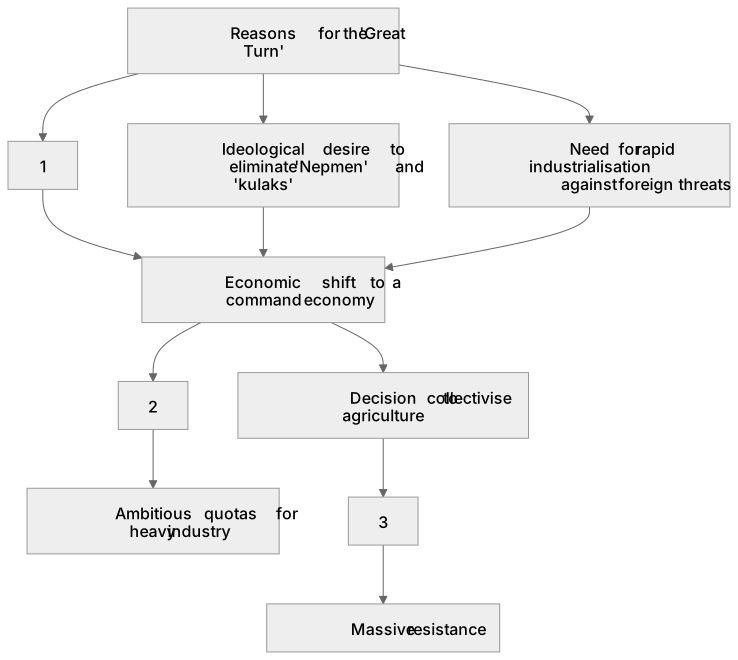
1Box 1
2Box 2
3Box 3
There is more to this lesson
The full lesson goes on to check your understanding and help you earn the marks. Create a free account to carry on, with your progress saved.
A week of Premium from your first lesson · Then the free plan continues · No card, no charge
Test your understanding of 2N Revolution and dictatorship: Russia, 1917–1953 – Stalin’s rise to power, 1924–1929: Economic developments: reasons for and impact of the 'Great Turn'; the economic shift; the launch of the first Five Year Plan and the decision to collectivise
Active recall beats re-reading. Take an instant quiz now to test what you’ve learned and lock it into long-term memory.
A week of Premium from your first lesson · Then the free plan continues · No card, no charge