AQA · A-Level · History
Course version: 7042 · Version from Sept 2017
Russia, 1917–1953 – Stalin’s rise to power, 1924–1929: Ideological debates…
Full specification wording
2N Revolution and dictatorship: Russia, 1917–1953 – Stalin’s rise to power, 1924–1929: Ideological debates and issues in the leadership struggle: NEP and industrialisation; 'permanent revolution' versus 'Socialism in One Country'; how and why Stalin became party leader and the outcome for the other contenders
The leadership struggle was defined by intense ideological debates over economic policy and international strategy.
Checked against the AQA 7042 specification (opens in a new tab) on .
- Point 2 of 4
Study notes
From the checked teaching notes for this specification point.
The idea
The leadership struggle was defined by intense ideological debates over economic policy and international strategy. The Left advocated rapid industrialisation and abandoning the NEP, while the Right supported the NEP's gradualist approach. Simultaneously, Trotsky’s 'Permanent Revolution' demanded international uprisings, contrasting sharply with Stalin’s pragmatic 'Socialism in One Country', which appealed to a war-weary party. Stalin became leader by masterfully exploiting these debates, first allying with the Right to defeat the Left, then adopting the Left's economic policies to crush the Right. Ultimately, Stalin secured absolute control. The other contenders faced grim outcomes: Trotsky was exiled and later assassinated, while Zinoviev, Kamenev, Bukharin, and Rykov were executed during the purges, and Tomsky committed suicide.
What earns the marks
- Analyse the ideological conflict between 'Permanent Revolution' and 'Socialism in One Country', explaining why Stalin's policy was more appealing to the party membership.
- Evaluate the debate over the New Economic Policy (NEP) and industrialisation, distinguishing between the positions of the Left Opposition and the Right Opposition.
- Explain the tactical alliances Stalin formed, such as the Triumvirate and the Duumvirate, to isolate and defeat his rivals sequentially.
- Detail the specific outcomes for the defeated contenders, tracing their fall from power to their eventual exile, suicide, or execution in the 1930s.
Common mistakes and how to put them right
Stating that Stalin always opposed the NEP.
Put it right: Clarify that Stalin supported the NEP while allied with Bukharin and the Right, only turning against it in 1928 to defeat them and launch rapid industrialisation.
Treating the leadership struggle as purely a clash of personalities.
Put it right: Emphasise that genuine ideological debates over the NEP and foreign policy were central to the factional conflicts and Stalin's strategic manoeuvring.
Confusing the timelines of the contenders' downfalls.
Put it right: Ensure accurate sequencing, noting that the Left (Trotsky, Zinoviev, Kamenev) was defeated by 1927, before Stalin turned on the Right (Bukharin, Rykov, Tomsky) in 1928-1929.
Exam tips
- Link Stalin's ideological flexibility to his political success, showing how he adapted his stance on the NEP to outmanoeuvre different factions.
- When discussing 'Socialism in One Country', emphasise its psychological appeal to a party exhausted by war and disappointed by the failure of European revolutions.
- Use the outcomes of the contenders to demonstrate the transition from a collective leadership to a totalitarian dictatorship.
Try the lesson
The start of the 2N Revolution and dictatorship: Russia, 1917–1953 – Stalin’s rise to power, 1924–1929: Ideological debates and issues in the leadership struggle: NEP and industrialisation; 'permanent revolution' versus 'Socialism in One Country'; how and why Stalin became party leader and the outcome for the other contenders lesson, made from checked teaching notes for this specification point.
Have a go first
In the ideological debates of the 1920s, what was the core premise of Stalin's theory of 'Socialism in One Country'?
Listen
The leadership struggle was defined by intense ideological debates over economic policy and international strategy. The Left advocated rapid industrialisation and abandoning the NEP, while the Right supported the NEP's gradualist approach. Simultaneously, Trotsky’s 'Permanent Revolution' demanded international uprisings, contrasting sharply with Stalin’s pragmatic 'Socialism in One Country', which appealed to a war-weary party. Stalin became leader by masterfully exploiting these debates, first allying with the Right to defeat the Left, then adopting the Left's economic policies to crush the Right. Ultimately, Stalin secured absolute control. The other contenders faced grim outcomes: Trotsky was exiled and later assassinated, while Zinoviev, Kamenev, Bukharin, and Rykov were executed during the purges, and Tomsky committed suicide. A strong answer earns marks for these points. Analyse the ideological conflict between 'Permanent Revolution' and 'Socialism in One Country', explaining why Stalin's policy was more appealing to the party membership. Evaluate the debate over the New Economic Policy (NEP) and industrialisation, distinguishing between the positions of the Left Opposition and the Right Opposition. Explain the tactical alliances Stalin formed, such as the Triumvirate and the Duumvirate, to isolate and defeat his rivals sequentially. Detail the specific outcomes for the defeated contenders, tracing their fall from power to their eventual exile, suicide, or execution in the 1930s. A common slip: Stating that Stalin always opposed the NEP. Instead, Clarify that Stalin supported the NEP while allied with Bukharin and the Right, only turning against it in 1928 to defeat them and launch rapid industrialisation. Exam tip: Link Stalin's ideological flexibility to his political success, showing how he adapted his stance on the NEP to outmanoeuvre different factions.
See it
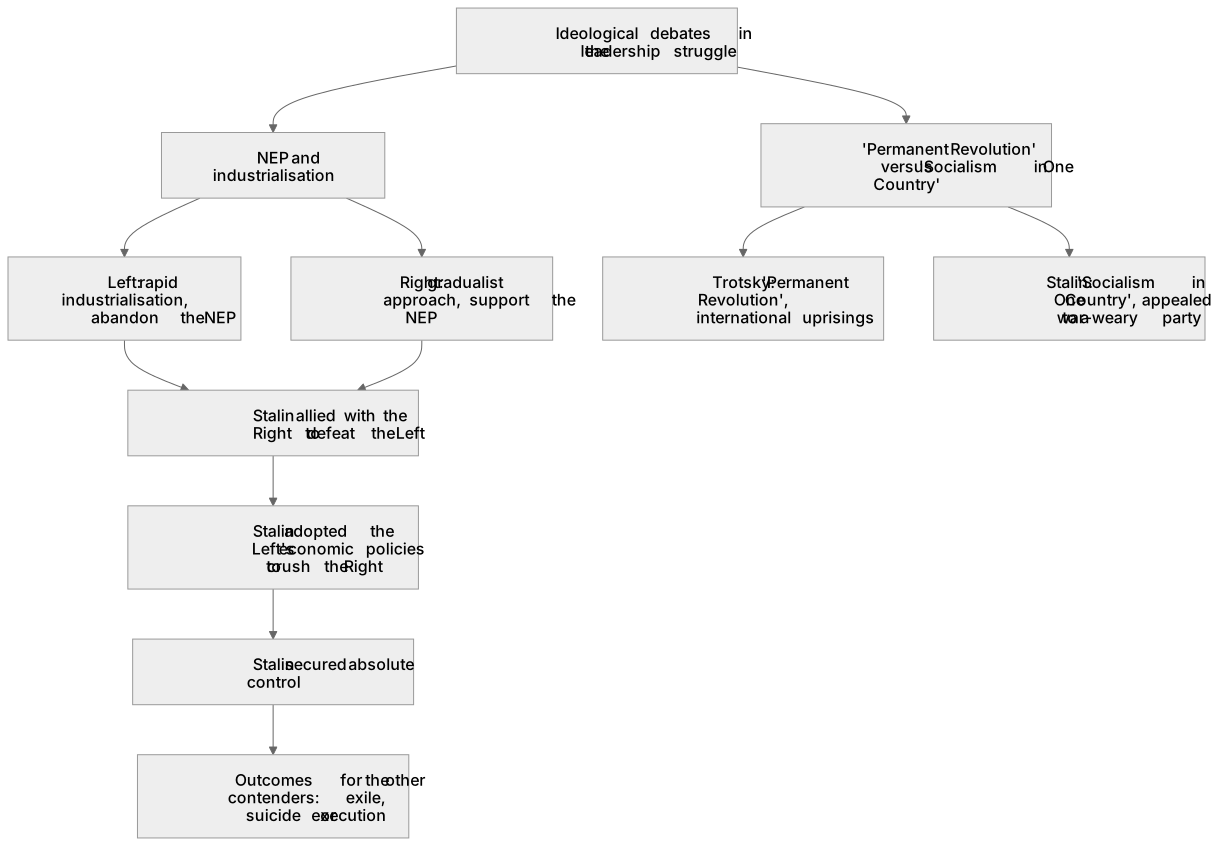
Label the diagram
Some boxes have lost their names. Pick the right name for each number.
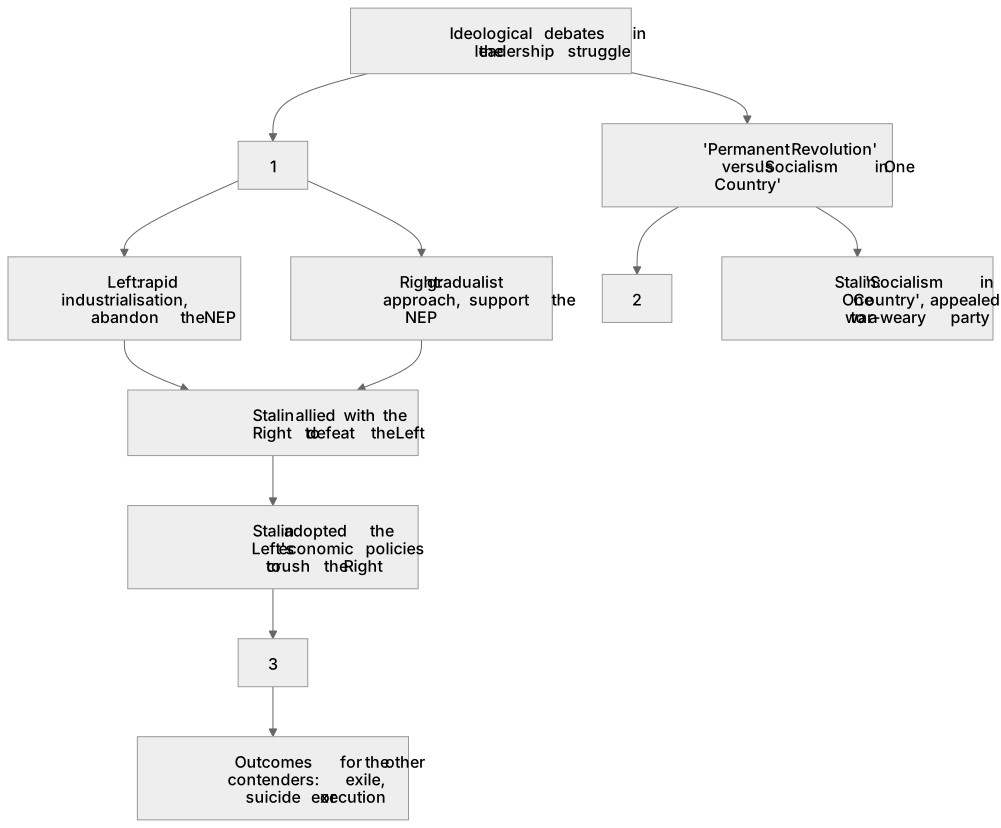
1Box 1
2Box 2
3Box 3
There is more to this lesson
The full lesson goes on to check your understanding and help you earn the marks. Create a free account to carry on, with your progress saved.
A week of Premium from your first lesson · Then the free plan continues · No card, no charge
Test your understanding of 2N Revolution and dictatorship: Russia, 1917–1953 – Stalin’s rise to power, 1924–1929: Ideological debates and issues in the leadership struggle: NEP and industrialisation; 'permanent revolution' versus 'Socialism in One Country'; how and why Stalin became party leader and the outcome for the other contenders
Active recall beats re-reading. Take an instant quiz now to test what you’ve learned and lock it into long-term memory.
A week of Premium from your first lesson · Then the free plan continues · No card, no charge