AQA · A-Level · History
Course version: 7042 · Version from Sept 2017
Russia, 1917–1953 – The Great Patriotic War and Stalin’s Dictatorship,…
Full specification wording
2N Revolution and dictatorship: Russia, 1917–1953 – The Great Patriotic War and Stalin’s Dictatorship, 1941–1953 (A-level only): High Stalinism: dictatorship and totalitarianism; renewed Terror; the NKVD under Beria; Zhdanovism and the cultural purge; Stalin's cult of personality; the Leningrad affair; purges and the Doctors' Plot
High Stalinism (1945–1953) represents the peak of Stalin’s totalitarian dictatorship, characterised by extreme centralization and paranoia following WWII.
Checked against the AQA 7042 specification (opens in a new tab) on .
- Point 3 of 4
Study notes
From the checked teaching notes for this specification point.
The idea
High Stalinism (1945–1953) represents the peak of Stalin’s totalitarian dictatorship, characterised by extreme centralization and paranoia following WWII. The renewed Terror was orchestrated by the NKVD under Lavrentiy Beria, targeting returning POWs and perceived internal enemies. Andrei Zhdanov led 'Zhdanovism', a severe cultural purge enforcing socialist realism and anti-Western sentiment in the arts. Stalin’s cult of personality reached god-like proportions, portraying him as the saviour of the USSR. Political purges resumed, notably the 1949 Leningrad Affair which eliminated rising party stars like Voznesensky. This paranoia culminated in the 1953 Doctors' Plot, an anti-Semitic purge accusing medical professionals of conspiring to assassinate Soviet leaders, halted only by Stalin's death.
What earns the marks
- Explain the characteristics of High Stalinism, focusing on the reassertion of totalitarian control and the dismantling of wartime relaxations.
- Analyse the role of the NKVD under Beria in executing the renewed Terror, including the treatment of returning Soviet prisoners of war and ethnic minorities.
- Evaluate the impact of Zhdanovism on Soviet culture, noting the suppression of Western influence and the persecution of artists like Akhmatova and Shostakovich.
- Assess the political motivations behind the Leningrad Affair and the Doctors' Plot, highlighting Stalin's paranoia and his strategy of playing rivals against each other.
Common mistakes and how to put them right
Confusing the Great Purge of the 1930s with the renewed Terror of High Stalinism.
Put it right: Clearly distinguish the post-war purges (Leningrad Affair, Doctors' Plot) from the 1930s show trials, noting the specific post-war context of anti-Western paranoia.
Assuming the cult of personality was solely a pre-war phenomenon.
Put it right: Emphasise that the cult reached its absolute zenith after 1945, with Stalin credited personally for the victory in the Great Patriotic War.
Viewing the Doctors' Plot purely as a medical dispute.
Put it right: Identify the Doctors' Plot as a politically motivated, largely anti-Semitic fabrication designed to justify a massive new purge of the party leadership.
Exam tips
- When discussing totalitarianism, use specific examples like Zhdanovism to demonstrate how state control extended beyond politics into culture and intellectual life.
- Link the Leningrad Affair to the broader theme of Stalin preventing any individual or faction from gaining enough power to challenge his dictatorship.
- Contrast the wartime relaxation of state control with the immediate post-war clampdown to highlight the defining features of High Stalinism.
Try the lesson
The start of the 2N Revolution and dictatorship: Russia, 1917–1953 – The Great Patriotic War and Stalin’s Dictatorship, 1941–1953 (A-level only): High Stalinism: dictatorship and totalitarianism; renewed Terror; the NKVD under Beria; Zhdanovism and the cultural purge; Stalin's cult of personality; the Leningrad affair; purges and the Doctors' Plot lesson, made from checked teaching notes for this specification point.
Have a go first
What was the primary focus of the cultural policy known as 'Zhdanovism' (Zhdanovshchina) implemented in the Soviet Union after the Second World War?
Listen
High Stalinism (1945–1953) represents the peak of Stalin’s totalitarian dictatorship, characterised by extreme centralization and paranoia following WWII. The renewed Terror was orchestrated by the NKVD under Lavrentiy Beria, targeting returning POWs and perceived internal enemies. Andrei Zhdanov led 'Zhdanovism', a severe cultural purge enforcing socialist realism and anti-Western sentiment in the arts. Stalin’s cult of personality reached god-like proportions, portraying him as the saviour of the USSR. Political purges resumed, notably the 1949 Leningrad Affair which eliminated rising party stars like Voznesensky. This paranoia culminated in the 1953 Doctors' Plot, an anti-Semitic purge accusing medical professionals of conspiring to assassinate Soviet leaders, halted only by Stalin's death. A strong answer earns marks for these points. Explain the characteristics of High Stalinism, focusing on the reassertion of totalitarian control and the dismantling of wartime relaxations. Analyse the role of the NKVD under Beria in executing the renewed Terror, including the treatment of returning Soviet prisoners of war and ethnic minorities. Evaluate the impact of Zhdanovism on Soviet culture, noting the suppression of Western influence and the persecution of artists like Akhmatova and Shostakovich. Assess the political motivations behind the Leningrad Affair and the Doctors' Plot, highlighting Stalin's paranoia and his strategy of playing rivals against each other. A common slip: Confusing the Great Purge of the 1930s with the renewed Terror of High Stalinism. Instead, Clearly distinguish the post-war purges (Leningrad Affair, Doctors' Plot) from the 1930s show trials, noting the specific post-war context of anti-Western paranoia. Exam tip: When discussing totalitarianism, use specific examples like Zhdanovism to demonstrate how state control extended beyond politics into culture and intellectual life.
See it
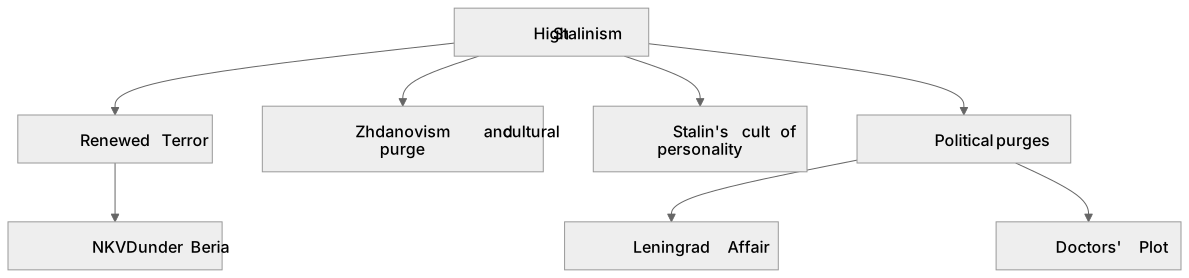
Put the events in order
Put these events in the order they happened, earliest first.
- 1. High Stalinism begins, reasserting totalitarian control after the war
- 2. The Doctors' Plot is halted only by Stalin's death
- 3. The Leningrad Affair eliminates rising party stars
Label the diagram
Some boxes have lost their names. Pick the right name for each number.
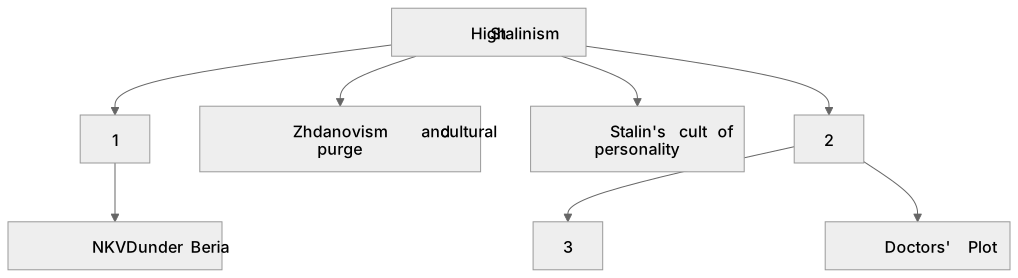
1Box 1
2Box 2
3Box 3
There is more to this lesson
The full lesson goes on to check your understanding and help you earn the marks. Create a free account to carry on, with your progress saved.
A week of Premium from your first lesson · Then the free plan continues · No card, no charge
Test your understanding of 2N Revolution and dictatorship: Russia, 1917–1953 – The Great Patriotic War and Stalin’s Dictatorship, 1941–1953 (A-level only): High Stalinism: dictatorship and totalitarianism; renewed Terror; the NKVD under Beria; Zhdanovism and the cultural purge; Stalin's cult of personality; the Leningrad affair; purges and the Doctors' Plot
Active recall beats re-reading. Take an instant quiz now to test what you’ve learned and lock it into long-term memory.
A week of Premium from your first lesson · Then the free plan continues · No card, no charge