AQA · A-Level · History
Course version: 7042 · Version from Sept 2017
Russia, 1917–1953 – The Great Patriotic War and Stalin’s Dictatorship,…
Full specification wording
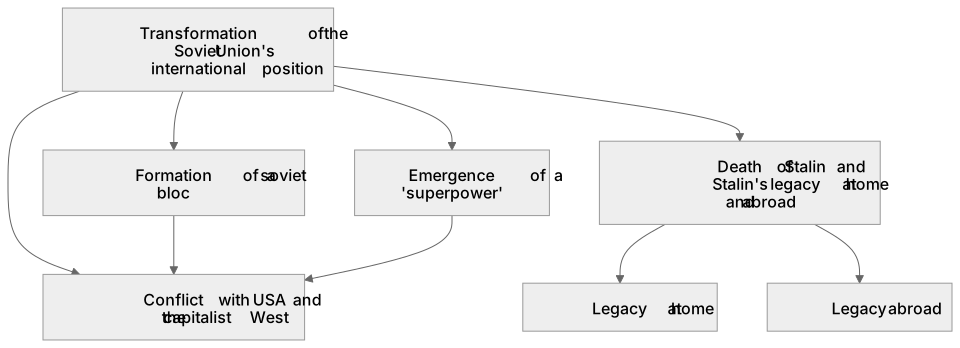
2N Revolution and dictatorship: Russia, 1917–1953 – The Great Patriotic War and Stalin’s Dictatorship, 1941–1953 (A-level only): The transformation of the Soviet Union’s international position: the emergence of a 'superpower'; the formation of a soviet bloc; conflict with USA and the capitalist West; death of Stalin and Stalin's legacy at home and abroad
Following 1945, the Soviet Union's international position transformed dramatically, emerging as a global 'superpower' armed with nuclear weapons by 1949.
Checked against the AQA 7042 specification (opens in a new tab) on .
- Point 4 of 4
- 4 key terms
Study notes
From the checked teaching notes for this specification point.
The idea
Following 1945, the Soviet Union's international position transformed dramatically, emerging as a global 'superpower' armed with nuclear weapons by 1949. Stalin secured Soviet borders through the formation of a Soviet bloc, establishing satellite states across Eastern Europe using 'salami tactics' and military presence. This expansionism triggered intense conflict with the USA and the capitalist West, initiating the Cold War through crises like the Berlin Blockade. Stalin’s death in March 1953 left a complex legacy. At home, he left a heavily industrialised but terrorised society with a stagnant agricultural sector. Abroad, his legacy was a deeply divided world, cementing the USSR's superpower status but ensuring prolonged geopolitical hostility with the West.
What earns the marks
- Analyse the factors contributing to the USSR's emergence as a superpower, including territorial expansion, military strength, and the acquisition of the atomic bomb in 1949.
- Explain the methods used to form the Soviet bloc in Eastern Europe, such as rigged elections, the suppression of non-communist parties, and the role of the Red Army.
- Evaluate the causes and key events of the conflict with the USA and the capitalist West, focusing on ideological differences and early Cold War flashpoints like the Berlin Blockade.
- Assess Stalin's domestic legacy upon his death in 1953, contrasting industrial and military achievements with agricultural failure, poor living standards, and a traumatised population.
- Assess Stalin's international legacy, noting the establishment of a bipolar world order and the entrenchment of the Cold War divide.
Common mistakes and how to put them right
Claiming the Soviet bloc was formed entirely through immediate military conquest in 1945.
Put it right: Explain that the bloc was established gradually between 1945 and 1948 using political manipulation, intimidation, and 'salami tactics'.
Ignoring the domestic economic imbalances in Stalin's legacy.
Put it right: Balance the acknowledgement of superpower status with the reality of a neglected consumer economy and a failing agricultural sector at home.
Treating the conflict with the West as solely the fault of the USA.
Put it right: Recognise the role of Soviet expansionism and Stalin's ideological hostility in escalating tensions with the capitalist West.
Exam tips
- Use the term 'superpower' critically; demonstrate how the USSR's military and industrial might masked severe domestic economic weaknesses.
- When evaluating Stalin's legacy, explicitly divide your analysis into 'at home' (domestic policy, economy, terror) and 'abroad' (Cold War, Soviet bloc) to ensure comprehensive coverage.
- Link the formation of the Soviet bloc directly to the escalating conflict with the USA, showing how geopolitical security for the USSR created insecurity for the West.
Try the lesson
The start of the 2N Revolution and dictatorship: Russia, 1917–1953 – The Great Patriotic War and Stalin’s Dictatorship, 1941–1953 (A-level only): The transformation of the Soviet Union’s international position: the emergence of a 'superpower'; the formation of a soviet bloc; conflict with USA and the capitalist West; death of Stalin and Stalin's legacy at home and abroad lesson, made from checked teaching notes for this specification point.
Have a go first
Following the end of the Second World War, which strategy did the Soviet Union primarily use to establish a 'Soviet bloc' in Eastern Europe?
Listen
Following 1945, the Soviet Union's international position transformed dramatically, emerging as a global 'superpower' armed with nuclear weapons by 1949. Stalin secured Soviet borders through the formation of a Soviet bloc, establishing satellite states across Eastern Europe using 'salami tactics' and military presence. This expansionism triggered intense conflict with the USA and the capitalist West, initiating the Cold War through crises like the Berlin Blockade. Stalin’s death in March 1953 left a complex legacy. At home, he left a heavily industrialised but terrorised society with a stagnant agricultural sector. Abroad, his legacy was a deeply divided world, cementing the USSR's superpower status but ensuring prolonged geopolitical hostility with the West. A strong answer earns marks for these points. Analyse the factors contributing to the USSR's emergence as a superpower, including territorial expansion, military strength, and the acquisition of the atomic bomb in 1949. Explain the methods used to form the Soviet bloc in Eastern Europe, such as rigged elections, the suppression of non-communist parties, and the role of the Red Army. Evaluate the causes and key events of the conflict with the USA and the capitalist West, focusing on ideological differences and early Cold War flashpoints like the Berlin Blockade. Assess Stalin's domestic legacy upon his death in 1953, contrasting industrial and military achievements with agricultural failure, poor living standards, and a traumatised population. A common slip: Claiming the Soviet bloc was formed entirely through immediate military conquest in 1945. Instead, Explain that the bloc was established gradually between 1945 and 1948 using political manipulation, intimidation, and 'salami tactics'. Exam tip: Use the term 'superpower' critically; demonstrate how the USSR's military and industrial might masked severe domestic economic weaknesses.
See it
Put the events in order
Put these events in the order they happened, earliest first.
- 1. Soviet Union's international position transformed after this year
- 2. Stalin's death left a complex legacy
- 3. Soviet Union acquired the atomic bomb
Key words
Say what each word means before you turn the card.
superpower
Try answering aloud or in your head before turning the card.
Soviet bloc
Try answering aloud or in your head before turning the card.
Cold War
Try answering aloud or in your head before turning the card.
Stalin's legacy
Try answering aloud or in your head before turning the card.
See every definition
- superpower
- A global status the Soviet Union emerged as after 1945, armed with nuclear weapons by 1949, though its military and industrial might masked severe domestic economic weaknesses.
- Soviet bloc
- A bloc of satellite states across Eastern Europe, formed gradually between 1945 and 1948 using political manipulation, intimidation and 'salami tactics' alongside military presence.
- Cold War
- Intense conflict with the USA and the capitalist West, initiated through crises like the Berlin Blockade and driven by ideological differences and Soviet expansionism.
- Stalin's legacy
- A complex inheritance at home and abroad: a heavily industrialised but terrorised society with a stagnant agricultural sector, and a deeply divided world.
Label the diagram
Some boxes have lost their names. Pick the right name for each number.
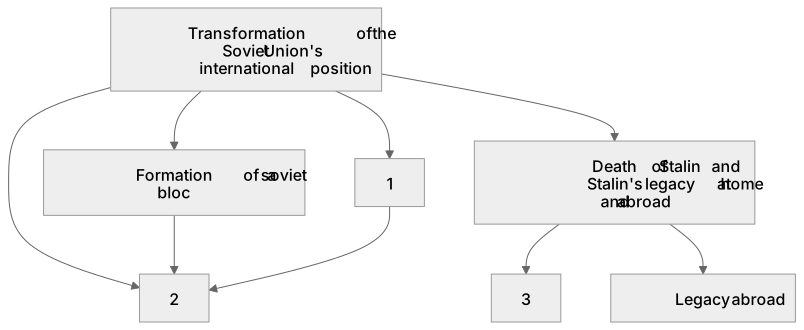
1Box 1
2Box 2
3Box 3
There is more to this lesson
The full lesson goes on to check your understanding and help you earn the marks. Create a free account to carry on, with your progress saved.
A week of Premium from your first lesson · Then the free plan continues · No card, no charge
Test your understanding of 2N Revolution and dictatorship: Russia, 1917–1953 – The Great Patriotic War and Stalin’s Dictatorship, 1941–1953 (A-level only): The transformation of the Soviet Union’s international position: the emergence of a 'superpower'; the formation of a soviet bloc; conflict with USA and the capitalist West; death of Stalin and Stalin's legacy at home and abroad
Active recall beats re-reading. Take an instant quiz now to test what you’ve learned and lock it into long-term memory.
A week of Premium from your first lesson · Then the free plan continues · No card, no charge