AQA · A-Level · History
Course version: 7042 · Version from Sept 2017
Germany, 1918–1945 – The Establishment and early years of Weimar,…
Full specification wording
2O Democracy and Nazism: Germany, 1918–1945 – The Establishment and early years of Weimar, 1918–1924: Political instability and extremism; risings on the left and right, including the Kapp Putsch; the political impact of the invasion of the Ruhr; the Munich Putsch; problems of coalition government and the state of the Republic by 1924
Early Weimar faced severe political instability and extremism from both ends of the spectrum.
Checked against the AQA 7042 specification (opens in a new tab) on .
- Point 4 of 4
Study notes
From the checked teaching notes for this specification point.
The idea
Early Weimar faced severe political instability and extremism from both ends of the spectrum. Left-wing risings, like the Spartacist revolt, were crushed using the Freikorps, highlighting the Republic's reliance on conservative forces. Right-wing threats included the 1920 Kapp Putsch, defeated only by a general strike, exposing the army's refusal to fire on right-wing nationalists. The 1923 invasion of the Ruhr had a profound political impact, fuelling nationalist outrage and triggering Hitler's Munich Putsch. Furthermore, proportional representation created deep problems for coalition governments, causing frequent collapses. Despite these crises, by 1924, Stresemann's decisive actions helped stabilise the Republic, allowing it to survive its turbulent infancy.
What earns the marks
- Analyse the causes and consequences of political extremism, comparing the threats posed by left-wing and right-wing risings.
- Evaluate the significance of the Kapp Putsch in demonstrating the unreliability of the Reichswehr and the vulnerability of the Republic.
- Assess the political impact of the Ruhr invasion, particularly how it catalysed right-wing extremism such as the Munich Putsch.
- Examine the structural problems of coalition governments under the Weimar Constitution and how they contributed to political instability by 1924.
Common mistakes and how to put them right
Arguing that the Munich Putsch was a serious military threat that almost toppled the government.
Put it right: Emphasise that it was poorly planned and easily crushed, though it provided Hitler with a vital propaganda platform.
Stating the army supported the Republic against all threats.
Put it right: Clarify that the Reichswehr ruthlessly suppressed left-wing revolts but refused to act against the right-wing Kapp Putsch.
Blaming coalition failures solely on proportional representation.
Put it right: Acknowledge that deep societal divisions and the reluctance of parties to compromise also caused coalition problems.
Exam tips
- Contrast the government's response to left-wing and right-wing risings to demonstrate the inherent conservative bias within the Weimar justice and military systems.
- Link the political impact of the Ruhr invasion directly to the timing of the Munich Putsch, showing how extremists exploited national crises.
- When evaluating the state of the Republic by 1924, balance the survival of the regime against the underlying structural and political weaknesses that remained.
Try the lesson
The start of the 2O Democracy and Nazism: Germany, 1918–1945 – The Establishment and early years of Weimar, 1918–1924: Political instability and extremism; risings on the left and right, including the Kapp Putsch; the political impact of the invasion of the Ruhr; the Munich Putsch; problems of coalition government and the state of the Republic by 1924 lesson, made from checked teaching notes for this specification point.
Have a go first
What was the primary trigger for the right-wing Kapp Putsch in March 1920?
Listen
Early Weimar faced severe political instability and extremism from both ends of the spectrum. Left-wing risings, like the Spartacist revolt, were crushed using the Freikorps, highlighting the Republic's reliance on conservative forces. Right-wing threats included the 1920 Kapp Putsch, defeated only by a general strike, exposing the army's refusal to fire on right-wing nationalists. The 1923 invasion of the Ruhr had a profound political impact, fuelling nationalist outrage and triggering Hitler's Munich Putsch. Furthermore, proportional representation created deep problems for coalition governments, causing frequent collapses. Despite these crises, by 1924, Stresemann's decisive actions helped stabilise the Republic, allowing it to survive its turbulent infancy. A strong answer earns marks for these points. Analyse the causes and consequences of political extremism, comparing the threats posed by left-wing and right-wing risings. Evaluate the significance of the Kapp Putsch in demonstrating the unreliability of the Reichswehr and the vulnerability of the Republic. Assess the political impact of the Ruhr invasion, particularly how it catalysed right-wing extremism such as the Munich Putsch. Examine the structural problems of coalition governments under the Weimar Constitution and how they contributed to political instability by 1924. A common slip: Arguing that the Munich Putsch was a serious military threat that almost toppled the government. Instead, Emphasise that it was poorly planned and easily crushed, though it provided Hitler with a vital propaganda platform. Exam tip: Contrast the government's response to left-wing and right-wing risings to demonstrate the inherent conservative bias within the Weimar justice and military systems.
See it
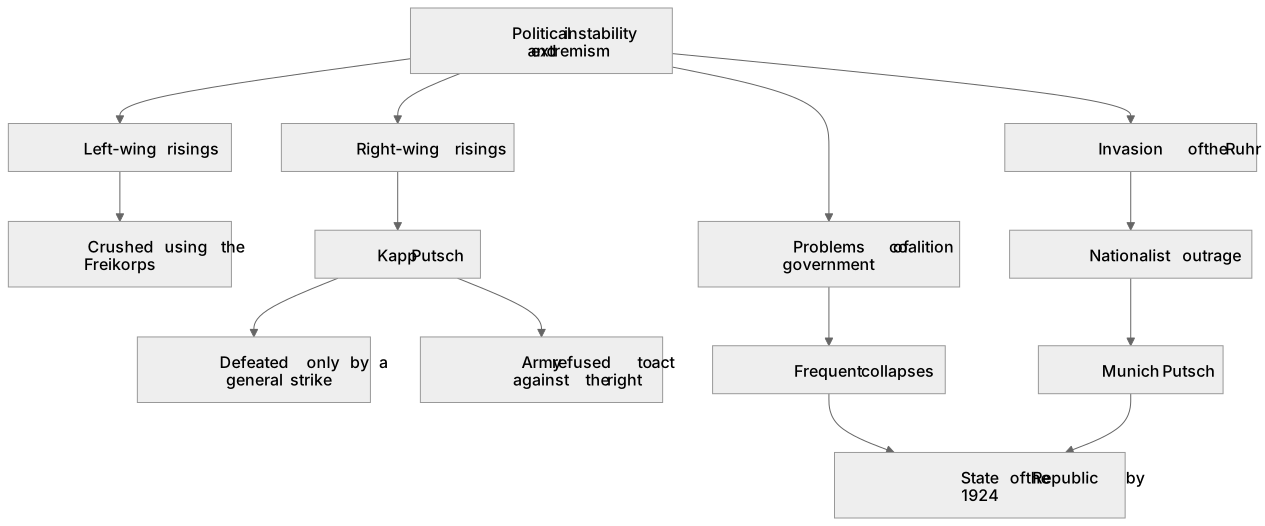
Put the events in order
Put these events in the order they happened, earliest first.
- 1. Kapp Putsch defeated only by a general strike
- 2. Stresemann's decisive actions helped stabilise the Republic
- 3. Invasion of the Ruhr fuelled nationalist outrage
Label the diagram
Some boxes have lost their names. Pick the right name for each number.
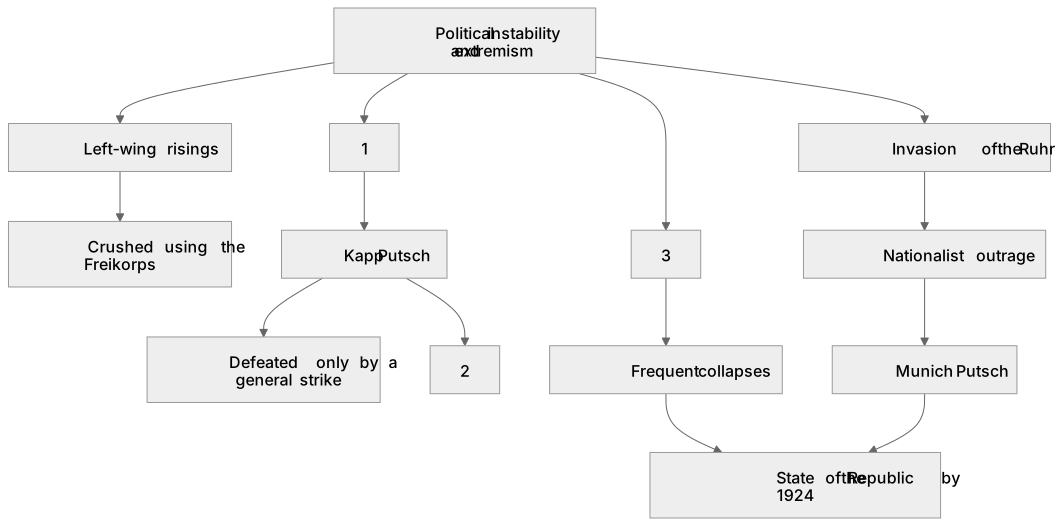
1Box 1
2Box 2
3Box 3
There is more to this lesson
The full lesson goes on to check your understanding and help you earn the marks. Create a free account to carry on, with your progress saved.
A week of Premium from your first lesson · Then the free plan continues · No card, no charge
Test your understanding of 2O Democracy and Nazism: Germany, 1918–1945 – The Establishment and early years of Weimar, 1918–1924: Political instability and extremism; risings on the left and right, including the Kapp Putsch; the political impact of the invasion of the Ruhr; the Munich Putsch; problems of coalition government and the state of the Republic by 1924
Active recall beats re-reading. Take an instant quiz now to test what you’ve learned and lock it into long-term memory.
A week of Premium from your first lesson · Then the free plan continues · No card, no charge