AQA · A-Level · History
Course version: 7042 · Version from Sept 2017
Germany, 1918–1945 – The Establishment and early years of Weimar,…
Full specification wording
2O Democracy and Nazism: Germany, 1918–1945 – The Establishment and early years of Weimar, 1918–1924: Economic and social issues: post-war legacy and the state of the German economy and society; reparations, inflation and hyperinflation; the invasion of the Ruhr and its economic impact; social welfare and the social impact of hyperinflation
The post-war legacy left Germany's economy and society severely strained, burdened by war debt, widows, and wounded veterans requiring extensive social welfare.
Checked against the AQA 7042 specification (opens in a new tab) on .
- Point 3 of 4
Study notes
From the checked teaching notes for this specification point.
The idea
The post-war legacy left Germany's economy and society severely strained, burdened by war debt, widows, and wounded veterans requiring extensive social welfare. The 1921 reparations bill of 132 billion gold marks exacerbated existing inflation, forcing the government to print more money. When Germany defaulted in 1923, French and Belgian troops invaded the industrial Ruhr. The government's response of passive resistance, funded by printing even more currency, triggered catastrophic hyperinflation. The economic impact was devastating, halting production. Socially, hyperinflation destroyed the savings of the middle classes and those on fixed incomes, while those with debts or physical assets, like industrialists, often profited, deepening societal divisions.
What earns the marks
- Evaluate the extent to which the post-war legacy and social welfare commitments strained the Weimar economy before reparations were fully applied.
- Analyse the progression from wartime inflation to the hyperinflation of 1923, linking it to the printing of unbacked currency.
- Assess the economic impact of the Ruhr invasion, specifically the cost of paying striking workers during passive resistance.
- Differentiate the social impact of hyperinflation across different classes, noting the ruin of middle-class savers versus the gains of debtors.
Common mistakes and how to put them right
Claiming reparations were the sole cause of hyperinflation.
Put it right: Explain that wartime borrowing, post-war welfare costs, and the policy of passive resistance in the Ruhr were also primary drivers.
Stating that everyone in Germany became impoverished during hyperinflation.
Put it right: Note that individuals with debts, mortgages, or tangible assets, such as industrialists and farmers, often benefited.
Confusing the 1923 hyperinflation with the 1929 Wall Street Crash.
Put it right: Keep the 1923 crisis distinct, focusing on currency devaluation rather than global depression and mass unemployment.
Exam tips
- When discussing the state of the German economy, explicitly link the burden of social welfare for war veterans to the government's deficit.
- Use specific examples of the social impact of hyperinflation, such as the destruction of Mittelstand savings, to build a strong analytical argument.
- Connect the invasion of the Ruhr directly to the acceleration of hyperinflation through the government's policy of funding passive resistance.
Try the lesson
The start of the 2O Democracy and Nazism: Germany, 1918–1945 – The Establishment and early years of Weimar, 1918–1924: Economic and social issues: post-war legacy and the state of the German economy and society; reparations, inflation and hyperinflation; the invasion of the Ruhr and its economic impact; social welfare and the social impact of hyperinflation lesson, made from checked teaching notes for this specification point.
Have a go first
What was the immediate economic consequence of the French and Belgian invasion of the Ruhr in 1923?
Listen
The post-war legacy left Germany's economy and society severely strained, burdened by war debt, widows, and wounded veterans requiring extensive social welfare. The 1921 reparations bill of 132 billion gold marks exacerbated existing inflation, forcing the government to print more money. When Germany defaulted in 1923, French and Belgian troops invaded the industrial Ruhr. The government's response of passive resistance, funded by printing even more currency, triggered catastrophic hyperinflation. The economic impact was devastating, halting production. Socially, hyperinflation destroyed the savings of the middle classes and those on fixed incomes, while those with debts or physical assets, like industrialists, often profited, deepening societal divisions. A strong answer earns marks for these points. Evaluate the extent to which the post-war legacy and social welfare commitments strained the Weimar economy before reparations were fully applied. Analyse the progression from wartime inflation to the hyperinflation of 1923, linking it to the printing of unbacked currency. Assess the economic impact of the Ruhr invasion, specifically the cost of paying striking workers during passive resistance. Differentiate the social impact of hyperinflation across different classes, noting the ruin of middle-class savers versus the gains of debtors. A common slip: Claiming reparations were the sole cause of hyperinflation. Instead, Explain that wartime borrowing, post-war welfare costs, and the policy of passive resistance in the Ruhr were also primary drivers. Exam tip: When discussing the state of the German economy, explicitly link the burden of social welfare for war veterans to the government's deficit.
See it
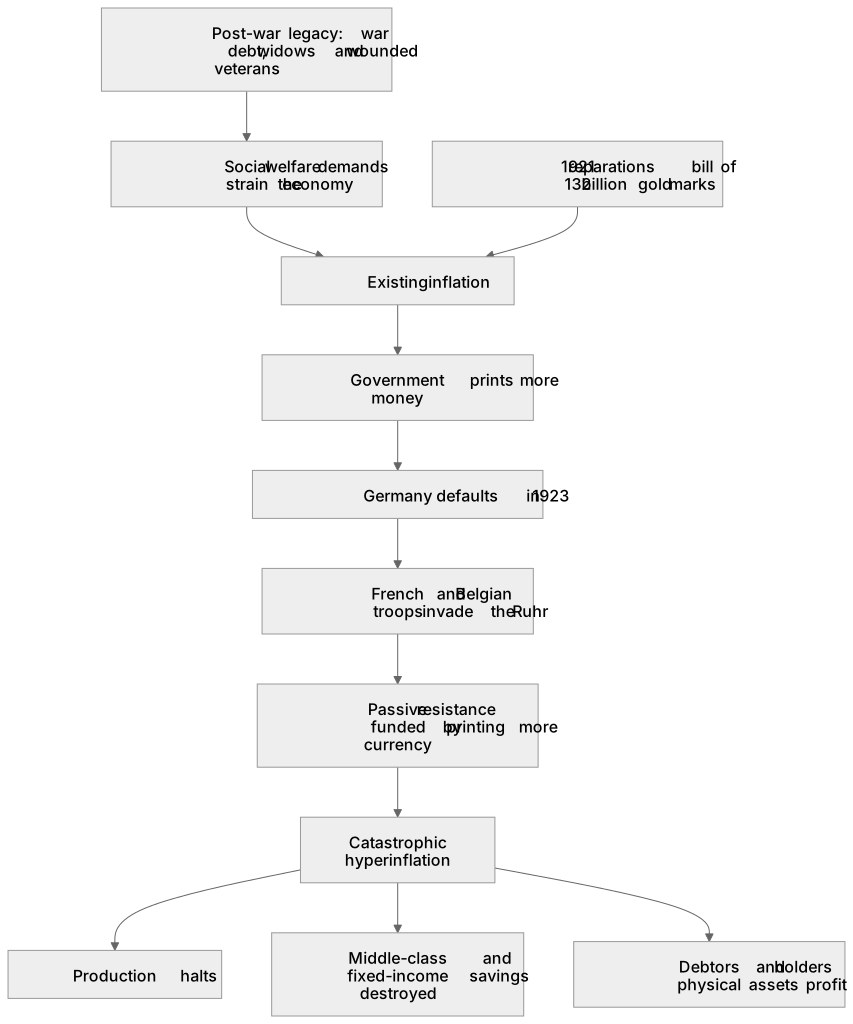
Label the diagram
Some boxes have lost their names. Pick the right name for each number.
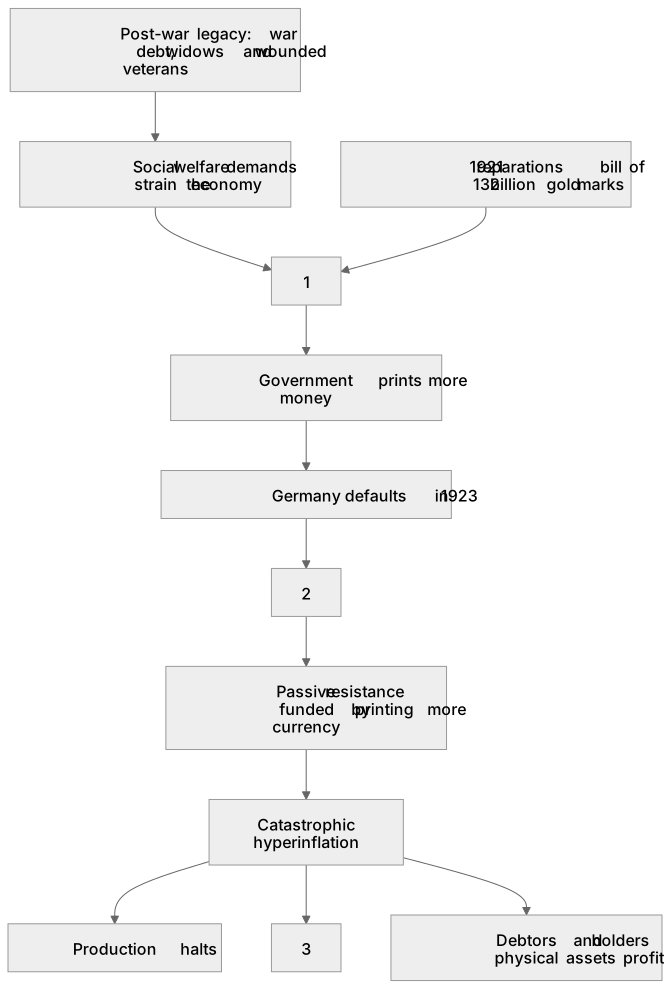
1Box 1
2Box 2
3Box 3
There is more to this lesson
The full lesson goes on to check your understanding and help you earn the marks. Create a free account to carry on, with your progress saved.
A week of Premium from your first lesson · Then the free plan continues · No card, no charge
Test your understanding of 2O Democracy and Nazism: Germany, 1918–1945 – The Establishment and early years of Weimar, 1918–1924: Economic and social issues: post-war legacy and the state of the German economy and society; reparations, inflation and hyperinflation; the invasion of the Ruhr and its economic impact; social welfare and the social impact of hyperinflation
Active recall beats re-reading. Take an instant quiz now to test what you’ve learned and lock it into long-term memory.
A week of Premium from your first lesson · Then the free plan continues · No card, no charge