AQA · A-Level · History
Course version: 7042 · Version from Sept 2017
Germany, 1918–1945 – The Establishment and early years of Weimar,…
Full specification wording
2O Democracy and Nazism: Germany, 1918–1945 – The Establishment and early years of Weimar, 1918–1924: The impact of war and the political crises of October to November 1918; the context for the establishment of the Weimar Constitution; terms, strengths and weaknesses
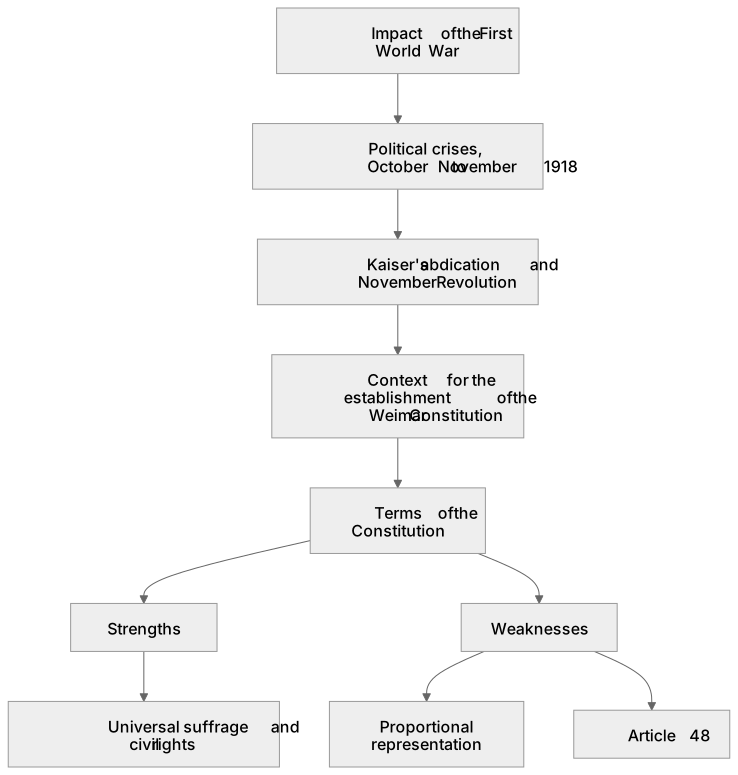
The First World War's devastating impact triggered Germany's October to November 1918 political crises, culminating in the Kaiser's abdication and the November Revolution.
Checked against the AQA 7042 specification (opens in a new tab) on .
- Point 1 of 4
- 4 key terms
Study notes
From the checked teaching notes for this specification point.
The idea
The First World War's devastating impact triggered Germany's October to November 1918 political crises, culminating in the Kaiser's abdication and the November Revolution. This chaotic context, marked by mutinies like Kiel and the threat of a communist takeover, forced the hasty establishment of the Weimar Republic. The resulting Weimar Constitution featured highly democratic terms, including universal suffrage and proportional representation. However, these strengths simultaneously created critical weaknesses. Proportional representation led to fragmented, unstable coalition governments, while Article 48 granted the President emergency decree powers, fatally undermining democratic stability when later exploited.
What earns the marks
- Explain the socio-economic impact of the First World War, such as mass starvation and economic exhaustion, in radicalising the German public.
- Detail the sequence of the October-November 1918 crises, from the naval mutiny at Kiel to the declaration of the Republic by Philipp Scheidemann.
- Analyse the context of the Weimar Constitution's creation, noting the intense pressure from both the Spartacist left and the conservative right.
- Evaluate the Constitution's terms, contrasting the strength of universal suffrage and civil rights with the weakness of proportional representation and Article 48.
Common mistakes and how to put them right
Claiming the Weimar Constitution was entirely flawed from the start.
Put it right: Acknowledge its progressive strengths, such as universal suffrage and the protection of civil liberties, alongside its structural weaknesses.
Confusing the October reforms from above with the November Revolution from below.
Put it right: Distinguish Prince Max of Baden's constitutional reforms in October from the popular uprisings that forced the Kaiser's abdication in November.
Stating Article 48 was designed to destroy democracy.
Put it right: Explain that Article 48 was intended as a protective measure for national emergencies, though it was later misused to bypass the Reichstag.
Exam tips
- Link the trauma of the First World War directly to the radicalisation of the German working class and the naval mutinies.
- When evaluating the Constitution, always balance its highly democratic intentions against the practical instability caused by proportional representation.
- Use specific examples of the November 1918 crises, such as the Kiel mutiny or the Bavarian socialist republic, to illustrate the chaotic context of Weimar's birth.
Try the lesson
The start of the 2O Democracy and Nazism: Germany, 1918–1945 – The Establishment and early years of Weimar, 1918–1924: The impact of war and the political crises of October to November 1918; the context for the establishment of the Weimar Constitution; terms, strengths and weaknesses lesson, made from checked teaching notes for this specification point.
Have a go first
Which event in late October and early November 1918 triggered the wider 'revolution from below' that ultimately led to the abdication of Kaiser Wilhelm II?
Listen
The First World War's devastating impact triggered Germany's October to November 1918 political crises, culminating in the Kaiser's abdication and the November Revolution. This chaotic context, marked by mutinies like Kiel and the threat of a communist takeover, forced the hasty establishment of the Weimar Republic. The resulting Weimar Constitution featured highly democratic terms, including universal suffrage and proportional representation. However, these strengths simultaneously created critical weaknesses. Proportional representation led to fragmented, unstable coalition governments, while Article 48 granted the President emergency decree powers, fatally undermining democratic stability when later exploited. A strong answer earns marks for these points. Explain the socio-economic impact of the First World War, such as mass starvation and economic exhaustion, in radicalising the German public. Detail the sequence of the October-November 1918 crises, from the naval mutiny at Kiel to the declaration of the Republic by Philipp Scheidemann. Analyse the context of the Weimar Constitution's creation, noting the intense pressure from both the Spartacist left and the conservative right. Evaluate the Constitution's terms, contrasting the strength of universal suffrage and civil rights with the weakness of proportional representation and Article 48. A common slip: Claiming the Weimar Constitution was entirely flawed from the start. Instead, Acknowledge its progressive strengths, such as universal suffrage and the protection of civil liberties, alongside its structural weaknesses. Exam tip: Link the trauma of the First World War directly to the radicalisation of the German working class and the naval mutinies.
See it
Key words
Say what each word means before you turn the card.
Democratic experimentation
Try answering aloud or in your head before turning the card.
Constitutional strengths and flaws
Try answering aloud or in your head before turning the card.
The legacy of the First World War
Try answering aloud or in your head before turning the card.
Revolution and state-building
Try answering aloud or in your head before turning the card.
See every definition
- Democratic experimentation
- The Weimar Constitution featured highly democratic terms, including universal suffrage and proportional representation, alongside the protection of civil liberties.
- Constitutional strengths and flaws
- Progressive strengths such as universal suffrage and civil rights coexisted with structural weaknesses, as proportional representation led to fragmented, unstable coalition governments and Article 48 granted the President emergency decree powers.
- The legacy of the First World War
- Its devastating impact, such as mass starvation and economic exhaustion, radicalised the German public and triggered the political crises of October to November 1918.
- Revolution and state-building
- The chaotic context, marked by mutinies like Kiel and the threat of a communist takeover, forced the hasty establishment of the Weimar Republic and its Constitution.
Label the diagram
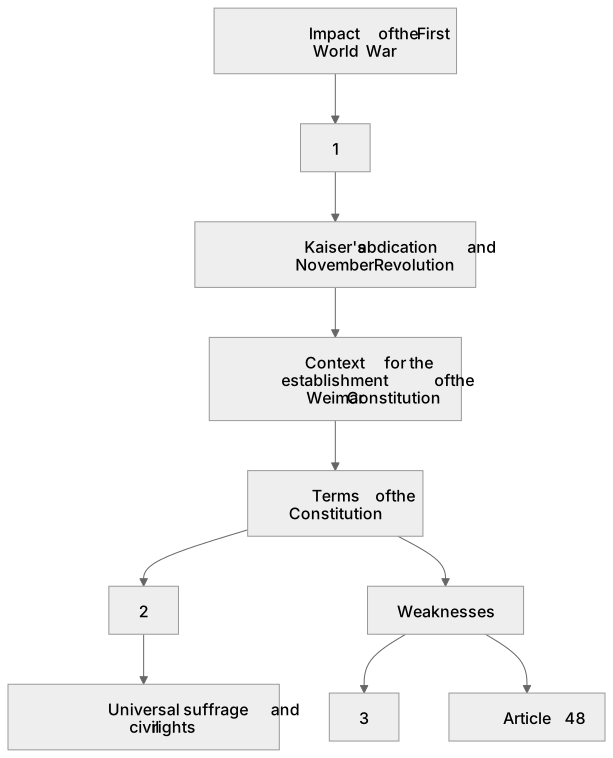
Some boxes have lost their names. Pick the right name for each number.
1Box 1
2Box 2
3Box 3
There is more to this lesson
The full lesson goes on to check your understanding and help you earn the marks. Create a free account to carry on, with your progress saved.
A week of Premium from your first lesson · Then the free plan continues · No card, no charge
Test your understanding of 2O Democracy and Nazism: Germany, 1918–1945 – The Establishment and early years of Weimar, 1918–1924: The impact of war and the political crises of October to November 1918; the context for the establishment of the Weimar Constitution; terms, strengths and weaknesses
Active recall beats re-reading. Take an instant quiz now to test what you’ve learned and lock it into long-term memory.
A week of Premium from your first lesson · Then the free plan continues · No card, no charge