AQA · A-Level · History
Course version: 7042 · Version from Sept 2017
Germany, 1918–1945 – The Establishment and early years of Weimar,…
Full specification wording
2O Democracy and Nazism: Germany, 1918–1945 – The Establishment and early years of Weimar, 1918–1924: The Peace Settlement: expectations and reality; terms and problems; attitudes within Germany and abroad
Germany expected the 1919 Peace Settlement to be a lenient agreement based on Woodrow Wilson's Fourteen Points.
Checked against the AQA 7042 specification (opens in a new tab) on .
- Point 2 of 4
- 4 key terms
Study notes
From the checked teaching notes for this specification point.
The idea
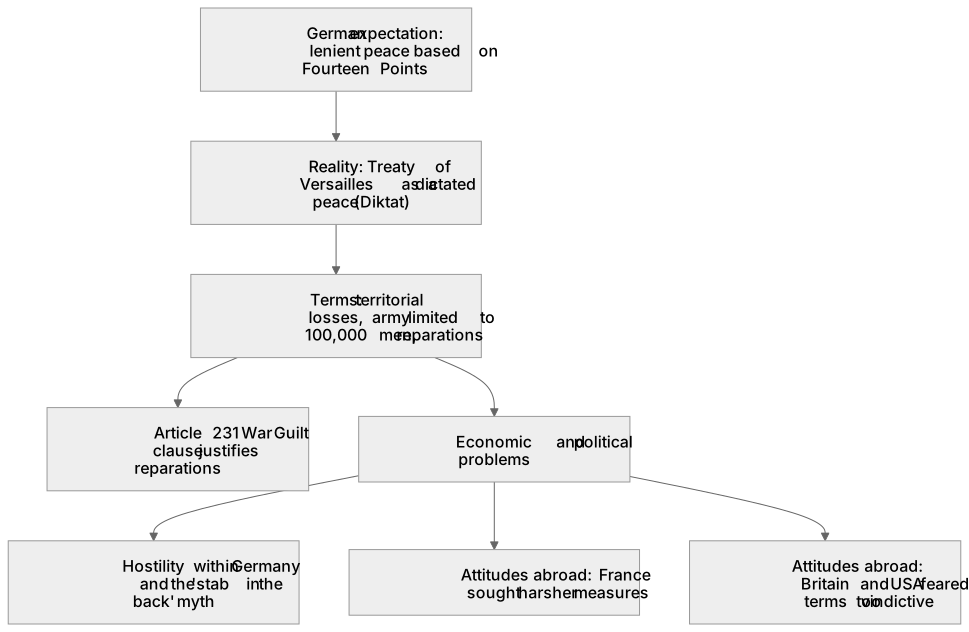
Germany expected the 1919 Peace Settlement to be a lenient agreement based on Woodrow Wilson's Fourteen Points. The reality of the Treaty of Versailles was a dictated peace (Diktat) that shocked the nation. Its terms included severe territorial losses, such as the Polish Corridor, military restrictions limiting the army to 100,000 men, and crippling reparations justified by the Article 231 War Guilt clause. These terms created immense economic and political problems. Within Germany, attitudes were universally hostile, fuelling the 'stab in the back' myth. Abroad, attitudes varied: France sought harsher security measures, while Britain and the USA felt the terms were potentially too vindictive and economically destabilising.
What earns the marks
- Contrast Germany's expectation of a Wilsonian peace with the reality of the punitive Treaty of Versailles.
- Detail specific terms of the settlement, including territorial losses like Alsace-Lorraine, military reductions, and the Article 231 War Guilt clause.
- Explain the political and economic problems caused by the treaty, such as the burden of reparations and the delegitimisation of the new Weimar government.
- Analyse the differing international attitudes towards the treaty, contrasting French demands for security with British and American concerns over European economic recovery.
Common mistakes and how to put them right
Stating that the Treaty of Versailles completely destroyed the German economy immediately in 1919.
Put it right: Clarify that while reparations were a massive burden, the hyperinflation crisis peaked later in 1923 due to a combination of factors including the Ruhr occupation.
Assuming all Allied powers were entirely satisfied with the treaty.
Put it right: Note that France felt it was too lenient, while figures in Britain and the USA feared it was too harsh and would provoke future conflict.
Claiming the Weimar politicians willingly agreed to the treaty.
Put it right: Emphasise that it was a 'Diktat' (dictated peace) and the government felt forced to sign under the threat of Allied invasion.
Exam tips
- Always use specific terms of the Treaty of Versailles, such as the 100,000 men limit or Article 231, rather than vague references to harsh punishments.
- Connect the psychological shock of the treaty's reality to the growth of right-wing nationalism and the Dolchstoßlegende (stab-in-the-back myth).
- Contrast the domestic outrage in Germany with the varied diplomatic attitudes of the Big Three to show a nuanced understanding of the geopolitical context.
Try the lesson
The start of the 2O Democracy and Nazism: Germany, 1918–1945 – The Establishment and early years of Weimar, 1918–1924: The Peace Settlement: expectations and reality; terms and problems; attitudes within Germany and abroad lesson, made from checked teaching notes for this specification point.
Have a go first
Which specific term of the Treaty of Versailles was most widely resented in Germany because it provided the moral justification for the imposition of heavy financial reparations?
Listen
Germany expected the 1919 Peace Settlement to be a lenient agreement based on Woodrow Wilson's Fourteen Points. The reality of the Treaty of Versailles was a dictated peace (Diktat) that shocked the nation. Its terms included severe territorial losses, such as the Polish Corridor, military restrictions limiting the army to 100,000 men, and crippling reparations justified by the Article 231 War Guilt clause. These terms created immense economic and political problems. Within Germany, attitudes were universally hostile, fuelling the 'stab in the back' myth. Abroad, attitudes varied: France sought harsher security measures, while Britain and the USA felt the terms were potentially too vindictive and economically destabilising. A strong answer earns marks for these points. Contrast Germany's expectation of a Wilsonian peace with the reality of the punitive Treaty of Versailles. Detail specific terms of the settlement, including territorial losses like Alsace-Lorraine, military reductions, and the Article 231 War Guilt clause. Explain the political and economic problems caused by the treaty, such as the burden of reparations and the delegitimisation of the new Weimar government. Analyse the differing international attitudes towards the treaty, contrasting French demands for security with British and American concerns over European economic recovery. A common slip: Stating that the Treaty of Versailles completely destroyed the German economy immediately in 1919. Instead, Clarify that while reparations were a massive burden, the hyperinflation crisis peaked later in 1923 due to a combination of factors including the Ruhr occupation. Exam tip: Always use specific terms of the Treaty of Versailles, such as the 100,000 men limit or Article 231, rather than vague references to harsh punishments.
See it
Key words
Say what each word means before you turn the card.
Diktat
Try answering aloud or in your head before turning the card.
Article 231 War Guilt clause
Try answering aloud or in your head before turning the card.
'stab in the back' myth
Try answering aloud or in your head before turning the card.
reparations
Try answering aloud or in your head before turning the card.
See every definition
- Diktat
- A dictated peace that shocked the nation, as Germany was forced to sign the Treaty of Versailles under the threat of Allied invasion.
- Article 231 War Guilt clause
- The clause that justified the crippling reparations imposed on Germany under the terms of the Treaty of Versailles.
- 'stab in the back' myth
- A myth fuelled by universally hostile attitudes within Germany towards the terms of the peace settlement.
- reparations
- Crippling payments justified by the Article 231 War Guilt clause, which created immense economic and political problems.
Label the diagram
Some boxes have lost their names. Pick the right name for each number.
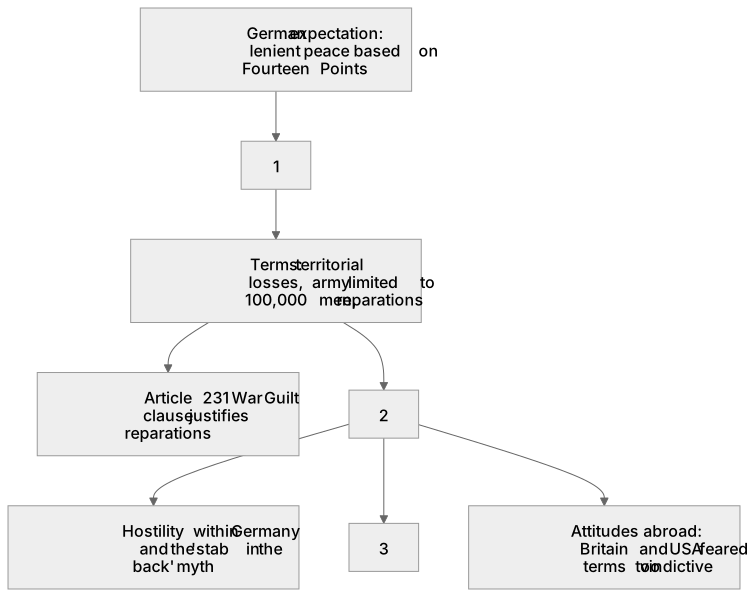
1Box 1
2Box 2
3Box 3
There is more to this lesson
The full lesson goes on to check your understanding and help you earn the marks. Create a free account to carry on, with your progress saved.
A week of Premium from your first lesson · Then the free plan continues · No card, no charge
Test your understanding of 2O Democracy and Nazism: Germany, 1918–1945 – The Establishment and early years of Weimar, 1918–1924: The Peace Settlement: expectations and reality; terms and problems; attitudes within Germany and abroad
Active recall beats re-reading. Take an instant quiz now to test what you’ve learned and lock it into long-term memory.
A week of Premium from your first lesson · Then the free plan continues · No card, no charge