AQA · A-Level · History
Course version: 7042 · Version from Sept 2017
Germany, 1918–1945 – The 'Golden Age' of the Weimar Republic, 1924–1928:…
Full specification wording
2O Democracy and Nazism: Germany, 1918–1945 – The 'Golden Age' of the Weimar Republic, 1924–1928: Economic developments: Stresemann; the Dawes Plan; industry, agriculture and the extent of recovery; the reparations issue and the Young Plan
Gustav Stresemann’s economic leadership stabilised Weimar Germany after the 1923 hyperinflation crisis.
Checked against the AQA 7042 specification (opens in a new tab) on .
- Point 1 of 4
- 3 key terms
Study notes
From the checked teaching notes for this specification point.
The idea
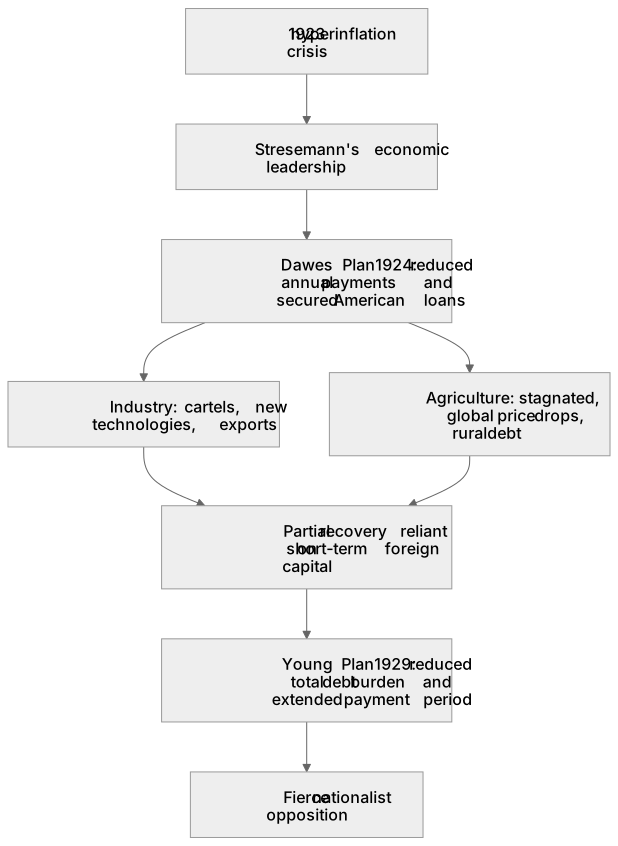
Gustav Stresemann’s economic leadership stabilised Weimar Germany after the 1923 hyperinflation crisis. He negotiated the 1924 Dawes Plan, which restructured the reparations issue by reducing annual payments and securing American loans to stimulate the economy. This fuelled a partial recovery: industry modernised with cartels and new technologies, boosting exports. However, agriculture stagnated due to global price drops and rural debt, leaving farmers impoverished. The extent of recovery was therefore uneven and dangerously reliant on short-term foreign capital. To further resolve reparations, the 1929 Young Plan reduced the total debt burden and extended the payment period, though it faced fierce nationalist opposition.
What earns the marks
- Evaluate Stresemann's role in ending hyperinflation and securing foreign investment to stabilise the German economy.
- Analyse the terms of the Dawes Plan (1924) and its impact on industrial modernisation and infrastructure.
- Contrast the relative prosperity of the industrial sector with the persistent depression and debt in agriculture.
- Assess the limitations of the economic recovery, particularly the structural weakness of relying on short-term US loans.
- Explain the significance of the Young Plan (1929) in reducing the overall reparations burden and the political backlash it provoked from the right wing.
Common mistakes and how to put them right
Assuming the Dawes Plan reduced the total reparations bill.
Put it right: It only restructured annual payments, whereas the Young Plan reduced the total amount.
Claiming the 'Golden Age' brought universal prosperity.
Put it right: This ignores the severe agricultural depression and high rural debt that persisted throughout the 1920s.
Stating Stresemann was Chancellor throughout this period.
Put it right: He was Chancellor briefly in 1923 but drove economic and foreign policy as Foreign Minister until 1929.
Exam tips
- Use the contrast between industrial growth and agricultural stagnation to evaluate the 'extent of recovery' critically.
- Link economic developments to political stability, noting how reliance on US loans created a vulnerability that extremists later exploited.
- When discussing reparations, explicitly distinguish between the mechanisms and outcomes of the Dawes Plan and the Young Plan.
Try the lesson
The start of the 2O Democracy and Nazism: Germany, 1918–1945 – The 'Golden Age' of the Weimar Republic, 1924–1928: Economic developments: Stresemann; the Dawes Plan; industry, agriculture and the extent of recovery; the reparations issue and the Young Plan lesson, made from checked teaching notes for this specification point.
Have a go first
Which of the following was a key provision of the Dawes Plan agreed in 1924 to address Germany's economic crisis?
Listen
Gustav Stresemann’s economic leadership stabilised Weimar Germany after the 1923 hyperinflation crisis. He negotiated the 1924 Dawes Plan, which restructured the reparations issue by reducing annual payments and securing American loans to stimulate the economy. This fuelled a partial recovery: industry modernised with cartels and new technologies, boosting exports. However, agriculture stagnated due to global price drops and rural debt, leaving farmers impoverished. The extent of recovery was therefore uneven and dangerously reliant on short-term foreign capital. To further resolve reparations, the 1929 Young Plan reduced the total debt burden and extended the payment period, though it faced fierce nationalist opposition. A strong answer earns marks for these points. Evaluate Stresemann's role in ending hyperinflation and securing foreign investment to stabilise the German economy. Analyse the terms of the Dawes Plan (1924) and its impact on industrial modernisation and infrastructure. Contrast the relative prosperity of the industrial sector with the persistent depression and debt in agriculture. Assess the limitations of the economic recovery, particularly the structural weakness of relying on short-term US loans. Exam tip: Use the contrast between industrial growth and agricultural stagnation to evaluate the 'extent of recovery' critically.
See it
Key words
Say what each word means before you turn the card.
Economic stability
Try answering aloud or in your head before turning the card.
Structural weakness
Try answering aloud or in your head before turning the card.
Political extremism
Try answering aloud or in your head before turning the card.
See every definition
- Economic stability
- Stresemann's economic leadership stabilised Weimar Germany after the 1923 hyperinflation crisis, though recovery was partial and uneven.
- Structural weakness
- The economic recovery was dangerously reliant on short-term foreign capital, leaving it vulnerable.
- Political extremism
- The Young Plan faced fierce nationalist opposition, provoking a political backlash from the right wing.
Label the diagram
Some boxes have lost their names. Pick the right name for each number.
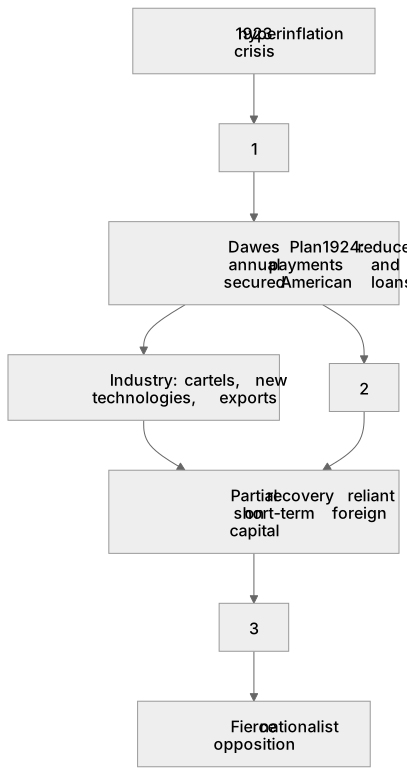
1Box 1
2Box 2
3Box 3
There is more to this lesson
The full lesson goes on to check your understanding and help you earn the marks. Create a free account to carry on, with your progress saved.
A week of Premium from your first lesson · Then the free plan continues · No card, no charge
Test your understanding of 2O Democracy and Nazism: Germany, 1918–1945 – The 'Golden Age' of the Weimar Republic, 1924–1928: Economic developments: Stresemann; the Dawes Plan; industry, agriculture and the extent of recovery; the reparations issue and the Young Plan
Active recall beats re-reading. Take an instant quiz now to test what you’ve learned and lock it into long-term memory.
A week of Premium from your first lesson · Then the free plan continues · No card, no charge