AQA · A-Level · History
Course version: 7042 · Version from Sept 2017
Germany, 1918–1945 – The 'Golden Age' of the Weimar Republic, 1924–1928:…
Full specification wording
2O Democracy and Nazism: Germany, 1918–1945 – The 'Golden Age' of the Weimar Republic, 1924–1928: Social developments: social welfare reforms; the development of Weimar culture; art, architecture, music, theatre, literature and film; living standards and lifestyles
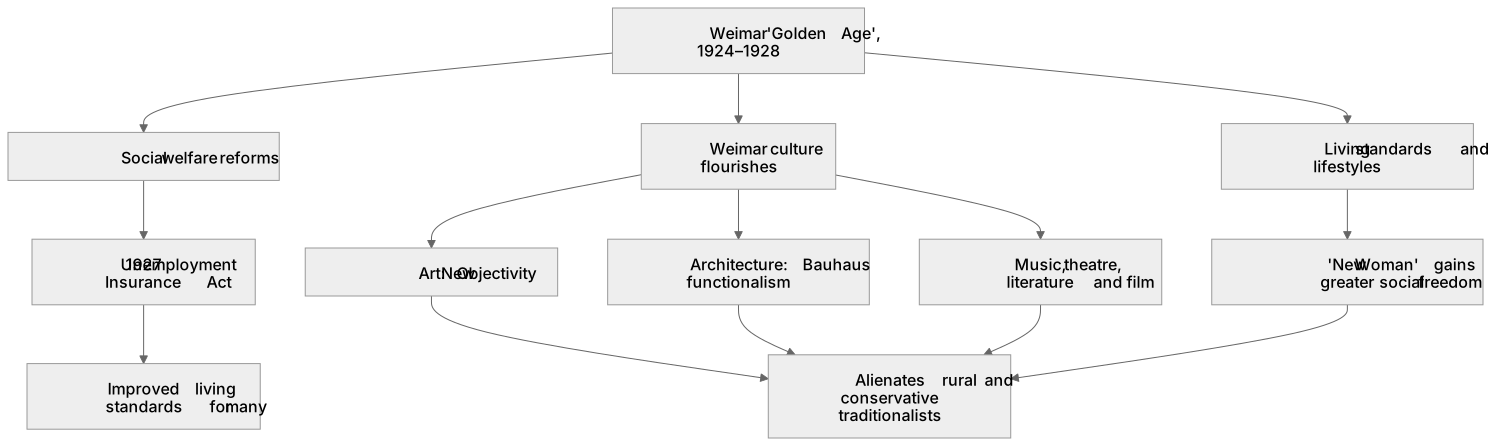
The Weimar 'Golden Age' brought progressive social welfare reforms, like the 1927 Unemployment Insurance Act, improving living standards for many.
Checked against the AQA 7042 specification (opens in a new tab) on .
- Point 2 of 4
- 4 key terms
Study notes
From the checked teaching notes for this specification point.
The idea
The Weimar 'Golden Age' brought progressive social welfare reforms, like the 1927 Unemployment Insurance Act, improving living standards for many. Lifestyles evolved, notably for the 'New Woman' who gained greater social freedom. Weimar culture flourished through avant-garde experimentation. Art embraced 'New Objectivity' (Grosz, Dix), while architecture was transformed by Bauhaus functionalism. Music integrated jazz, and theatre featured Brecht's political works. Literature explored societal disillusionment, and film entered a golden era with expressionist classics like Metropolis. However, these rapid cultural and social shifts deeply alienated rural and conservative traditionalists.
What earns the marks
- Assess the impact of social welfare reforms, such as the 1927 Unemployment Insurance Act, on working-class living standards.
- Analyse the cultural innovations in art (New Objectivity) and architecture (Bauhaus) as reflections of Weimar society.
- Evaluate the developments in music, theatre, literature and film, noting their experimental and often politically critical nature.
- Examine changes in lifestyles, particularly the emergence of the 'New Woman' and shifting urban dynamics.
- Discuss the polarisation caused by these developments, contrasting urban cultural flourishing with conservative rural backlash.
Common mistakes and how to put them right
Overstating the universality of cultural changes.
Put it right: Avant-garde culture was largely confined to Berlin and major cities, not rural areas.
Assuming welfare reforms solved all social issues.
Put it right: The welfare system was financially overstretched and structurally flawed even before the 1929 crash.
Claiming the 'New Woman' represented all German women.
Put it right: Traditional roles remained dominant, especially outside urban centres and among the middle classes.
Exam tips
- Use specific cultural examples, such as Bauhaus architecture or Fritz Lang's films, to support arguments about Weimar innovation.
- Contrast the progressive urban lifestyles with conservative rural attitudes to demonstrate the divided nature of Weimar society.
- Evaluate the financial sustainability of the social welfare reforms when discussing long-term living standards.
Try the lesson
The start of the 2O Democracy and Nazism: Germany, 1918–1945 – The 'Golden Age' of the Weimar Republic, 1924–1928: Social developments: social welfare reforms; the development of Weimar culture; art, architecture, music, theatre, literature and film; living standards and lifestyles lesson, made from checked teaching notes for this specification point.
Have a go first
Which architectural and design movement, founded by Walter Gropius in 1919, became highly influential during the Weimar Republic?
Listen
The Weimar 'Golden Age' brought progressive social welfare reforms, like the 1927 Unemployment Insurance Act, improving living standards for many. Lifestyles evolved, notably for the 'New Woman' who gained greater social freedom. Weimar culture flourished through avant-garde experimentation. Art embraced 'New Objectivity' (Grosz, Dix), while architecture was transformed by Bauhaus functionalism. Music integrated jazz, and theatre featured Brecht's political works. Literature explored societal disillusionment, and film entered a golden era with expressionist classics like Metropolis. However, these rapid cultural and social shifts deeply alienated rural and conservative traditionalists. A strong answer earns marks for these points. Assess the impact of social welfare reforms, such as the 1927 Unemployment Insurance Act, on working-class living standards. Analyse the cultural innovations in art (New Objectivity) and architecture (Bauhaus) as reflections of Weimar society. Evaluate the developments in music, theatre, literature and film, noting their experimental and often politically critical nature. Examine changes in lifestyles, particularly the emergence of the 'New Woman' and shifting urban dynamics. Exam tip: Use specific cultural examples, such as Bauhaus architecture or Fritz Lang's films, to support arguments about Weimar innovation.
See it
Key words
Say what each word means before you turn the card.
Cultural experimentation
Try answering aloud or in your head before turning the card.
Social polarisation
Try answering aloud or in your head before turning the card.
Modernity vs Tradition
Try answering aloud or in your head before turning the card.
Welfare state
Try answering aloud or in your head before turning the card.
See every definition
- Cultural experimentation
- Avant-garde innovation flourished across art, architecture, music, theatre, literature and film, with art embracing 'New Objectivity' and architecture transformed by Bauhaus functionalism.
- Social polarisation
- Rapid cultural and social shifts deeply alienated rural and conservative traditionalists, contrasting urban cultural flourishing with conservative rural backlash.
- Modernity vs Tradition
- Progressive urban lifestyles and avant-garde culture were largely confined to Berlin and major cities, while traditional roles remained dominant outside urban centres.
- Welfare state
- Progressive social welfare reforms, like the 1927 Unemployment Insurance Act, improved living standards for many, though the system was financially overstretched and structurally flawed.
Label the diagram
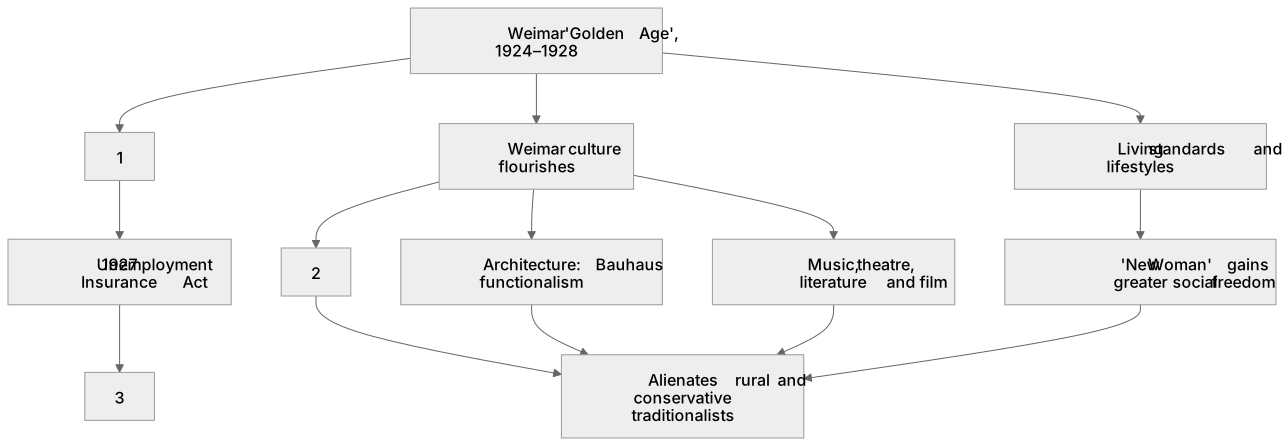
Some boxes have lost their names. Pick the right name for each number.
1Box 1
2Box 2
3Box 3
There is more to this lesson
The full lesson goes on to check your understanding and help you earn the marks. Create a free account to carry on, with your progress saved.
A week of Premium from your first lesson · Then the free plan continues · No card, no charge
Test your understanding of 2O Democracy and Nazism: Germany, 1918–1945 – The 'Golden Age' of the Weimar Republic, 1924–1928: Social developments: social welfare reforms; the development of Weimar culture; art, architecture, music, theatre, literature and film; living standards and lifestyles
Active recall beats re-reading. Take an instant quiz now to test what you’ve learned and lock it into long-term memory.
A week of Premium from your first lesson · Then the free plan continues · No card, no charge