AQA · A-Level · History
Course version: 7042 · Version from Sept 2017
Germany, 1918–1945 – The 'Golden Age' of the Weimar Republic, 1924–1928:…
Full specification wording
2O Democracy and Nazism: Germany, 1918–1945 – The 'Golden Age' of the Weimar Republic, 1924–1928: Germany’s international position; Stresemann's foreign policy aims and achievements including: Locarno; the League of Nations; the Treaty of Berlin; the end of allied occupation and the pursuit of disarmament
Gustav Stresemann’s foreign policy aimed to restore Germany’s international position and revise the Treaty of Versailles through peaceful cooperation (Erfüllungspolitik).
Checked against the AQA 7042 specification (opens in a new tab) on .
- Point 4 of 4
- 4 key terms
Study notes
From the checked teaching notes for this specification point.
The idea
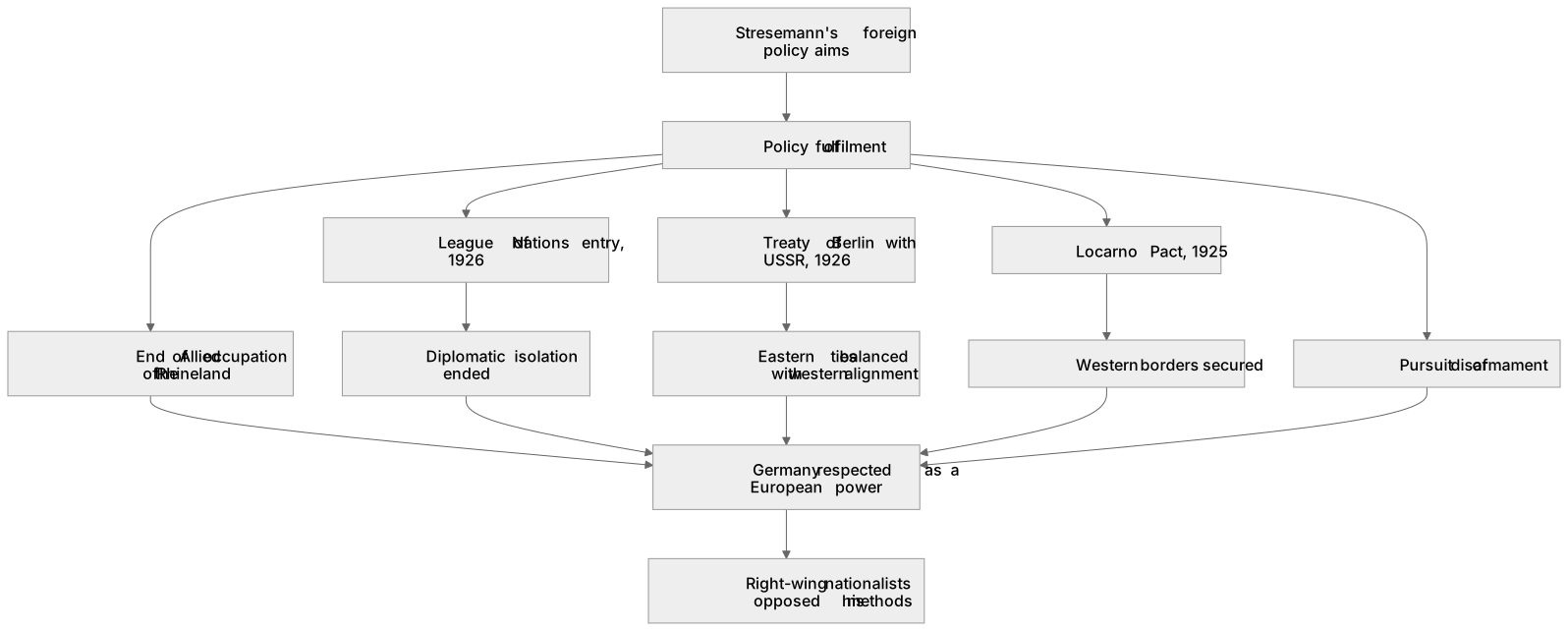
Gustav Stresemann’s foreign policy aimed to restore Germany’s international position and revise the Treaty of Versailles through peaceful cooperation (Erfüllungspolitik). His achievements included the 1925 Locarno Pact, which secured Germany's western borders, and gaining entry to the League of Nations in 1926, ending diplomatic isolation. He balanced western alignment with eastern ties via the 1926 Treaty of Berlin with the USSR. Stresemann also successfully negotiated the early end of Allied occupation in the Rhineland and actively participated in the pursuit of international disarmament. These steps transformed Germany from a defeated outcast into a respected European power, though right-wing nationalists fiercely opposed his methods.
What earns the marks
- Identify Stresemann's core foreign policy aims, specifically the revision of the Treaty of Versailles through the policy of fulfilment.
- Evaluate the significance of the Locarno Pact (1925) in securing Germany's western borders while leaving eastern borders open to peaceful revision.
- Analyse the diplomatic importance of Germany's admission to the League of Nations (1926) and the signing of the Treaty of Berlin (1926) with the Soviet Union.
- Assess Stresemann's success in achieving tangible revisions, such as the early withdrawal of Allied troops from the Rhineland and his role in the pursuit of disarmament.
Common mistakes and how to put them right
Stating that Locarno secured all of Germany's borders.
Put it right: It only guaranteed the western borders (with France and Belgium), deliberately leaving the eastern borders (with Poland and Czechoslovakia) open to future negotiation.
Assuming Stresemann was a pacifist who accepted Versailles.
Put it right: He was a pragmatic nationalist whose ultimate aim was to dismantle the treaty's restrictions and restore German great power status.
Confusing the Treaty of Berlin (1926) with the earlier Treaty of Rapallo (1922).
Put it right: Berlin reaffirmed Rapallo but was specifically timed by Stresemann to reassure the USSR after Germany signed the western-leaning Locarno Pact.
Exam tips
- Link Stresemann's foreign policy achievements directly to domestic politics, noting how right-wing groups attacked his policy of fulfilment despite its diplomatic successes.
- Use the Treaty of Berlin as evidence of Stresemann's diplomatic skill in balancing relations between the Western Allies and the Soviet Union.
- When evaluating Stresemann's success, contrast his long-term aims, such as eastern border revision and rearmament, with his short-term achievements, like Locarno and League of Nations membership.
Try the lesson
The start of the 2O Democracy and Nazism: Germany, 1918–1945 – The 'Golden Age' of the Weimar Republic, 1924–1928: Germany’s international position; Stresemann's foreign policy aims and achievements including: Locarno; the League of Nations; the Treaty of Berlin; the end of allied occupation and the pursuit of disarmament lesson, made from checked teaching notes for this specification point.
Have a go first
As part of Gustav Stresemann's efforts to restore Germany's international position, which international organisation did Germany join in 1926?
Listen
Gustav Stresemann’s foreign policy aimed to restore Germany’s international position and revise the Treaty of Versailles through peaceful cooperation (Erfüllungspolitik). His achievements included the 1925 Locarno Pact, which secured Germany's western borders, and gaining entry to the League of Nations in 1926, ending diplomatic isolation. He balanced western alignment with eastern ties via the 1926 Treaty of Berlin with the USSR. Stresemann also successfully negotiated the early end of Allied occupation in the Rhineland and actively participated in the pursuit of international disarmament. These steps transformed Germany from a defeated outcast into a respected European power, though right-wing nationalists fiercely opposed his methods. A strong answer earns marks for these points. Identify Stresemann's core foreign policy aims, specifically the revision of the Treaty of Versailles through the policy of fulfilment. Evaluate the significance of the Locarno Pact (1925) in securing Germany's western borders while leaving eastern borders open to peaceful revision. Analyse the diplomatic importance of Germany's admission to the League of Nations (1926) and the signing of the Treaty of Berlin (1926) with the Soviet Union. Assess Stresemann's success in achieving tangible revisions, such as the early withdrawal of Allied troops from the Rhineland and his role in the pursuit of disarmament. Exam tip: Link Stresemann's foreign policy achievements directly to domestic politics, noting how right-wing groups attacked his policy of fulfilment despite its diplomatic successes.
See it
Key words
Say what each word means before you turn the card.
Revisionism of the Treaty of Versailles
Try answering aloud or in your head before turning the card.
Pragmatism versus nationalism
Try answering aloud or in your head before turning the card.
Rehabilitation of a defeated power
Try answering aloud or in your head before turning the card.
Diplomacy and international relations
Try answering aloud or in your head before turning the card.
See every definition
- Revisionism of the Treaty of Versailles
- Stresemann's aim to revise the Treaty of Versailles through peaceful cooperation, known as Erfüllungspolitik.
- Pragmatism versus nationalism
- Stresemann was a pragmatic nationalist whose ultimate aim was to dismantle the treaty's restrictions and restore German great power status, though right-wing nationalists fiercely opposed his methods.
- Rehabilitation of a defeated power
- These steps transformed Germany from a defeated outcast into a respected European power.
- Diplomacy and international relations
- Stresemann balanced western alignment with eastern ties via the 1926 Treaty of Berlin with the USSR, and gained entry to the League of Nations in 1926, ending diplomatic isolation.
Label the diagram
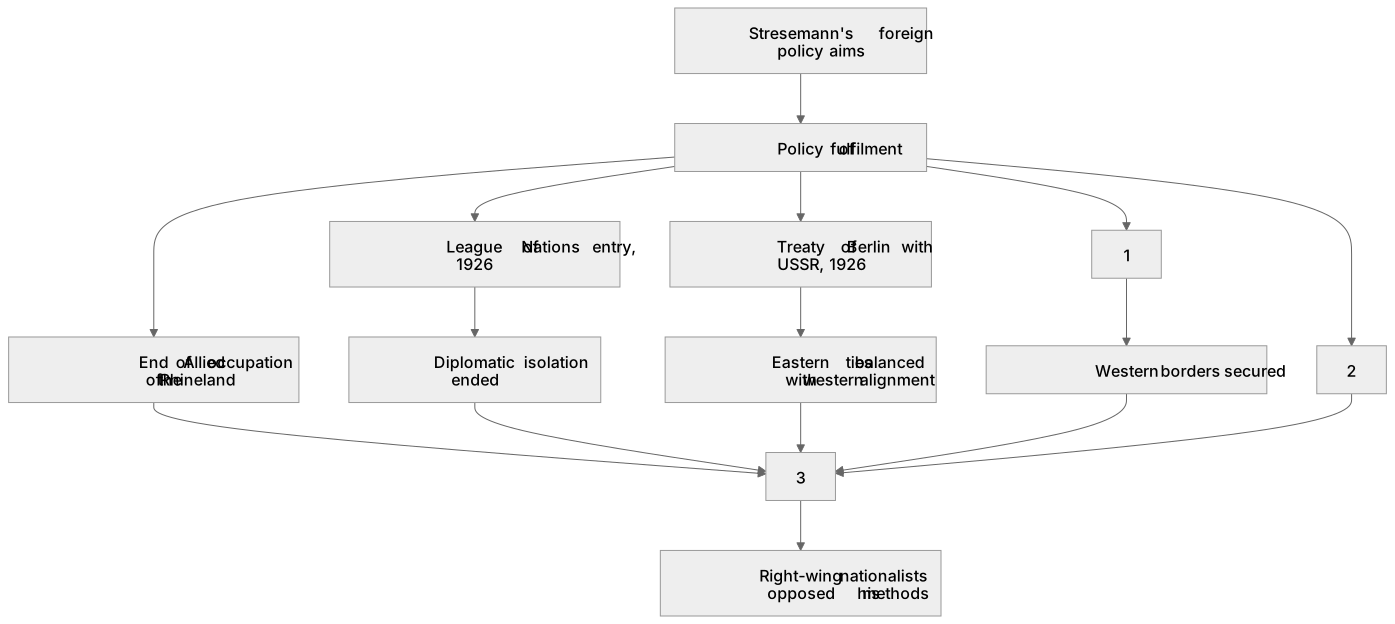
Some boxes have lost their names. Pick the right name for each number.
1Box 1
2Box 2
3Box 3
There is more to this lesson
The full lesson goes on to check your understanding and help you earn the marks. Create a free account to carry on, with your progress saved.
A week of Premium from your first lesson · Then the free plan continues · No card, no charge
Test your understanding of 2O Democracy and Nazism: Germany, 1918–1945 – The 'Golden Age' of the Weimar Republic, 1924–1928: Germany’s international position; Stresemann's foreign policy aims and achievements including: Locarno; the League of Nations; the Treaty of Berlin; the end of allied occupation and the pursuit of disarmament
Active recall beats re-reading. Take an instant quiz now to test what you’ve learned and lock it into long-term memory.
A week of Premium from your first lesson · Then the free plan continues · No card, no charge