AQA · A-Level · History
Course version: 7042 · Version from Sept 2017
Germany, 1918–1945 – The 'Golden Age' of the Weimar Republic, 1924–1928:…
Full specification wording
2O Democracy and Nazism: Germany, 1918–1945 – The 'Golden Age' of the Weimar Republic, 1924–1928: Political developments and the workings of democracy: President Hindenburg; parties ; elections and attitudes to the Republic from the elites and other social groups; the position of the extremists, including the Nazis and Communists; the extent of political stability
The 1924–1928 period is termed Weimar's 'Golden Age', yet political stability remained fragile.
Checked against the AQA 7042 specification (opens in a new tab) on .
- Point 3 of 4
- 4 key terms
Study notes
From the checked teaching notes for this specification point.
The idea
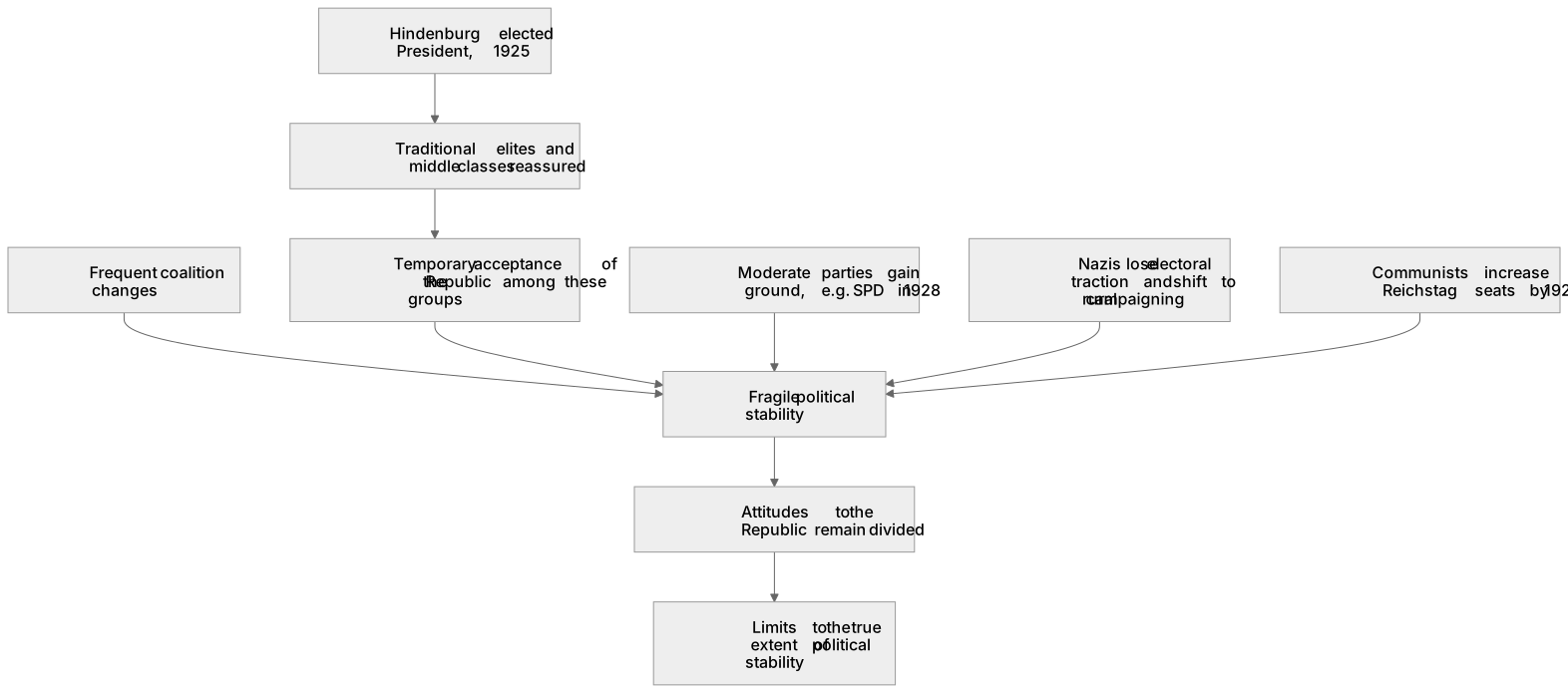
The 1924–1928 period is termed Weimar's 'Golden Age', yet political stability remained fragile. The workings of democracy saw frequent coalition changes, though moderate parties like the SPD gained ground in the 1928 elections. The 1925 election of President Hindenburg, a conservative monarchist, paradoxically reassured traditional elites and middle classes, fostering temporary acceptance of the Republic among these social groups. The position of extremists diverged; while the Nazis lost electoral traction and shifted to rural campaigning, the Communists (KPD) increased their Reichstag seats by 1928. However, underlying attitudes to the Republic remained divided, limiting the true extent of political stability.
What earns the marks
- Evaluate the impact of Hindenburg's 1925 election on the Republic's stability and the shifting attitudes of the traditional elites.
- Analyse the diverging electoral performance of extremist parties in the 1924 and 1928 Reichstag elections, noting the KPD's gains versus the NSDAP's decline.
- Assess the structural weaknesses of Weimar democracy during this period, such as the reliance on fragile, short-lived coalition governments.
- Examine the varying attitudes of different social groups, contrasting the growing working-class support for the SPD and KPD with the lingering anti-republican sentiment among the military and aristocracy.
Common mistakes and how to put them right
Assuming Hindenburg's election immediately undermined the Republic.
Put it right: In reality, it initially brought conservative elites into the republican fold, creating short-term stability.
Claiming both the Nazis and Communists lost electoral support during the Golden Age.
Put it right: While the NSDAP lost seats by 1928, the KPD actually increased its vote share and Reichstag representation.
Equating economic recovery directly with total political stability.
Put it right: Despite economic gains, coalition governments remained highly unstable and deeply divided over domestic policies.
Exam tips
- Use the 1928 election results to demonstrate the peak of Weimar's political stability, noting the SPD's success alongside the KPD's resilient working-class support.
- When discussing the 'Golden Age', always evaluate the extent of stability by contrasting electoral trends with the underlying fragility of coalition governments.
- Distinguish between the attitudes of the traditional elites, who merely tolerated the Republic under Hindenburg, and the industrial working classes, who largely supported the SPD or KPD.
Try the lesson
The start of the 2O Democracy and Nazism: Germany, 1918–1945 – The 'Golden Age' of the Weimar Republic, 1924–1928: Political developments and the workings of democracy: President Hindenburg; parties ; elections and attitudes to the Republic from the elites and other social groups; the position of the extremists, including the Nazis and Communists; the extent of political stability lesson, made from checked teaching notes for this specification point.
Have a go first
Who was elected as the President of the Weimar Republic in 1925 following the death of Friedrich Ebert?
Listen
The 1924–1928 period is termed Weimar's 'Golden Age', yet political stability remained fragile. The workings of democracy saw frequent coalition changes, though moderate parties like the SPD gained ground in the 1928 elections. The 1925 election of President Hindenburg, a conservative monarchist, paradoxically reassured traditional elites and middle classes, fostering temporary acceptance of the Republic among these social groups. The position of extremists diverged; while the Nazis lost electoral traction and shifted to rural campaigning, the Communists (KPD) increased their Reichstag seats by 1928. However, underlying attitudes to the Republic remained divided, limiting the true extent of political stability. A strong answer earns marks for these points. Evaluate the impact of Hindenburg's 1925 election on the Republic's stability and the shifting attitudes of the traditional elites. Analyse the diverging electoral performance of extremist parties in the 1924 and 1928 Reichstag elections, noting the KPD's gains versus the NSDAP's decline. Assess the structural weaknesses of Weimar democracy during this period, such as the reliance on fragile, short-lived coalition governments. Examine the varying attitudes of different social groups, contrasting the growing working-class support for the SPD and KPD with the lingering anti-republican sentiment among the military and aristocracy. Exam tip: Use the 1928 election results to demonstrate the peak of Weimar's political stability, noting the SPD's success alongside the KPD's resilient working-class support.
See it
Key words
Say what each word means before you turn the card.
Political stability and instability
Try answering aloud or in your head before turning the card.
The role of the individual in history
Try answering aloud or in your head before turning the card.
Extremism versus moderation
Try answering aloud or in your head before turning the card.
Social class and political alignment
Try answering aloud or in your head before turning the card.
See every definition
- Political stability and instability
- The extent of political stability remained fragile, with frequent coalition changes limiting the true extent of political stability.
- The role of the individual in history
- The 1925 election of President Hindenburg, a conservative monarchist, paradoxically reassured traditional elites and middle classes, fostering temporary acceptance of the Republic.
- Extremism versus moderation
- Moderate parties like the SPD gained ground in the 1928 elections, while the position of extremists diverged, with the Nazis losing electoral traction and the Communists increasing their Reichstag seats by 1928.
- Social class and political alignment
- Attitudes to the Republic remained divided among social groups, with traditional elites and middle classes reassured by Hindenburg and growing working-class support for the SPD and KPD.
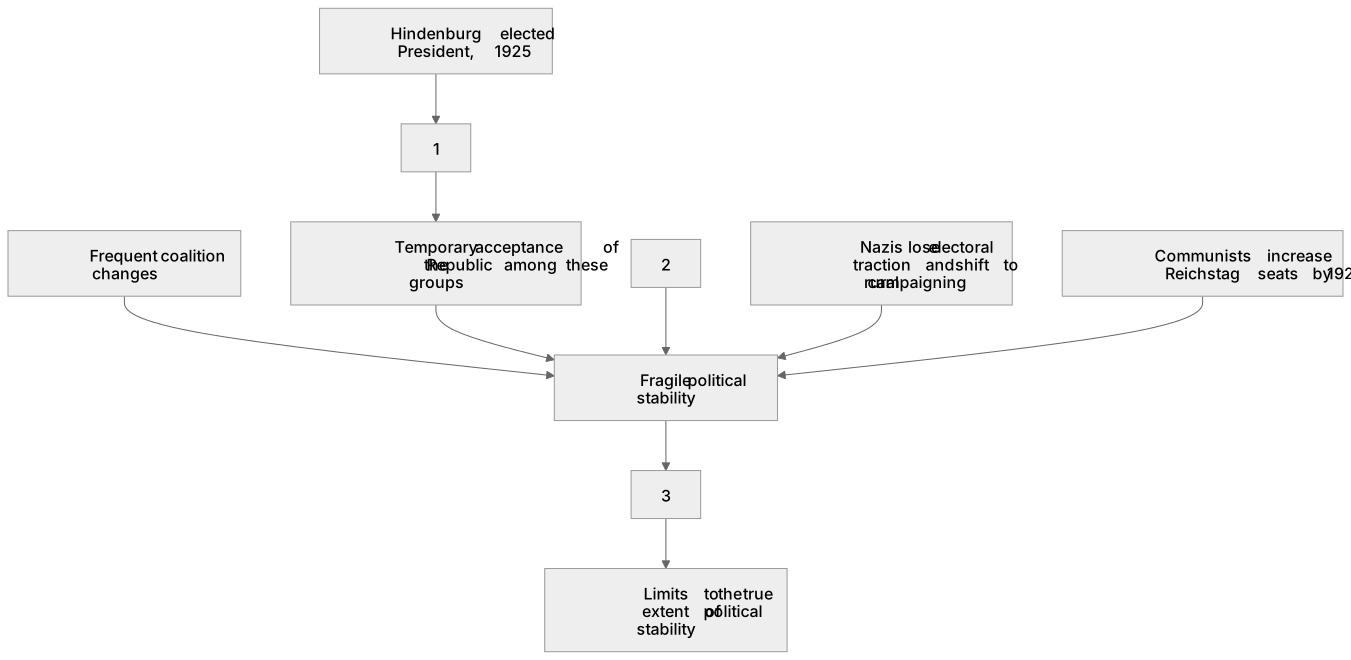
Label the diagram
Some boxes have lost their names. Pick the right name for each number.
1Box 1
2Box 2
3Box 3
There is more to this lesson
The full lesson goes on to check your understanding and help you earn the marks. Create a free account to carry on, with your progress saved.
A week of Premium from your first lesson · Then the free plan continues · No card, no charge
Test your understanding of 2O Democracy and Nazism: Germany, 1918–1945 – The 'Golden Age' of the Weimar Republic, 1924–1928: Political developments and the workings of democracy: President Hindenburg; parties ; elections and attitudes to the Republic from the elites and other social groups; the position of the extremists, including the Nazis and Communists; the extent of political stability
Active recall beats re-reading. Take an instant quiz now to test what you’ve learned and lock it into long-term memory.
A week of Premium from your first lesson · Then the free plan continues · No card, no charge