AQA · A-Level · History
Course version: 7042 · Version from Sept 2017
Germany, 1918–1945 – The impact of War, 1939–1945 (A-level only):…
Full specification wording
2O Democracy and Nazism: Germany, 1918–1945 – The impact of War, 1939–1945 (A-level only): Opposition and resistance in wartime including students, churchmen, the army and civilian critics; assassination attempts and the July Bomb Plot; overview of the Nazi state by 1945
Wartime opposition to Nazism was fragmented but significant, encompassing diverse groups.
Checked against the AQA 7042 specification (opens in a new tab) on .
- Point 4 of 4
- 3 key terms
Study notes
From the checked teaching notes for this specification point.
The idea
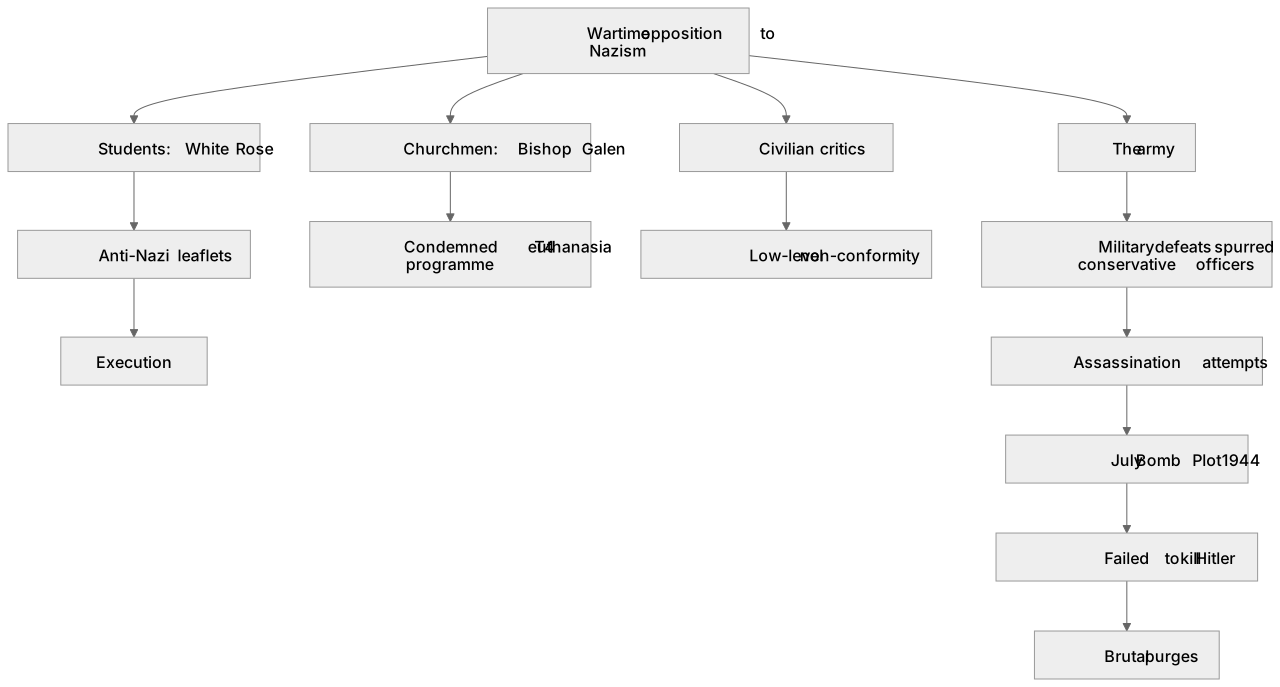
Wartime opposition to Nazism was fragmented but significant, encompassing diverse groups. Student resistance, notably the White Rose, distributed anti-Nazi leaflets before their execution. Churchmen like Bishop Galen publicly condemned the T4 euthanasia programme, while civilian critics engaged in low-level non-conformity. The most serious threat came from the army; military defeats spurred conservative officers to act. This culminated in assassination attempts, most famously Stauffenberg's July Bomb Plot in 1944, which failed to kill Hitler and led to brutal purges. By 1945, the Nazi state was characterised by administrative chaos, total war mobilisation, and the dominance of the SS, ending in total collapse as the Allies advanced.
What earns the marks
- Differentiate between non-conformity, opposition, and active resistance among the German population during the war.
- Evaluate the motivations and impact of student groups like the White Rose and civilian critics such as the Kreisau Circle.
- Analyse the role of churchmen in opposing specific Nazi policies, noting the limitations of institutional church resistance.
- Assess the significance of the July Bomb Plot and other assassination attempts by army officers in threatening the regime.
- Describe the condition of the Nazi state by 1945, focusing on polycratic chaos, SS dominance, and the impact of total war.
Common mistakes and how to put them right
Exaggerating the scale of resistance.
Put it right by acknowledging that opposition was limited, fragmented, and lacked broad popular support.
Confusing the motivations of the July Bomb Plotters.
Put it right by noting that many were conservative nationalists motivated by military disaster rather than democratic ideals.
Assuming the Nazi state was highly efficient by 1945.
Put it right by explaining the administrative chaos, overlapping authorities, and the breakdown of infrastructure.
Exam tips
- Categorise opposition into distinct groups (youth, church, military, civilian) to structure your essays effectively.
- Use the July Bomb Plot to discuss both the reality of the threat to Hitler and the regime's subsequent tightening of control.
- When providing an overview of the state by 1945, link the administrative fragmentation to the concept of a polycratic regime.
Try the lesson
The start of the 2O Democracy and Nazism: Germany, 1918–1945 – The impact of War, 1939–1945 (A-level only): Opposition and resistance in wartime including students, churchmen, the army and civilian critics; assassination attempts and the July Bomb Plot; overview of the Nazi state by 1945 lesson, made from checked teaching notes for this specification point.
Have a go first
Which group was primarily responsible for the planning and execution of the July Bomb Plot against Adolf Hitler in 1944?
Listen
Wartime opposition to Nazism was fragmented but significant, encompassing diverse groups. Student resistance, notably the White Rose, distributed anti-Nazi leaflets before their execution. Churchmen like Bishop Galen publicly condemned the T4 euthanasia programme, while civilian critics engaged in low-level non-conformity. The most serious threat came from the army; military defeats spurred conservative officers to act. This culminated in assassination attempts, most famously Stauffenberg's July Bomb Plot in 1944, which failed to kill Hitler and led to brutal purges. By 1945, the Nazi state was characterised by administrative chaos, total war mobilisation, and the dominance of the SS, ending in total collapse as the Allies advanced. A strong answer earns marks for these points. Differentiate between non-conformity, opposition, and active resistance among the German population during the war. Evaluate the motivations and impact of student groups like the White Rose and civilian critics such as the Kreisau Circle. Analyse the role of churchmen in opposing specific Nazi policies, noting the limitations of institutional church resistance. Assess the significance of the July Bomb Plot and other assassination attempts by army officers in threatening the regime. A common slip: Exaggerating the scale of resistance. Instead, acknowledging that opposition was limited, fragmented, and lacked broad popular support. Exam tip: Categorise opposition into distinct groups (youth, church, military, civilian) to structure your essays effectively.
See it
Key words
Say what each word means before you turn the card.
Military vs political authority
Try answering aloud or in your head before turning the card.
Total war and state collapse
Try answering aloud or in your head before turning the card.
Polycracy and administrative chaos
Try answering aloud or in your head before turning the card.
See every definition
- Military vs political authority
- The most serious threat came from the army, as military defeats spurred conservative officers to act in assassination attempts such as the July Bomb Plot.
- Total war and state collapse
- By 1945 the Nazi state was characterised by total war mobilisation and ended in total collapse as the Allies advanced.
- Polycracy and administrative chaos
- By 1945 the Nazi state was characterised by administrative chaos, overlapping authorities and the dominance of the SS.
Label the diagram
Some boxes have lost their names. Pick the right name for each number.
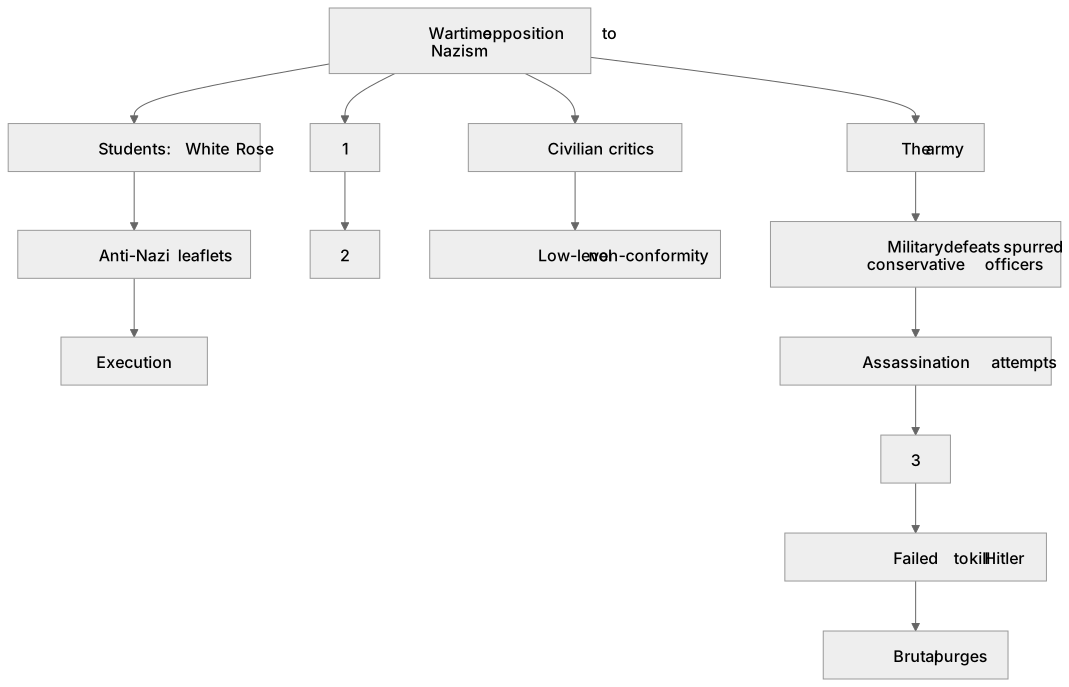
1Box 1
2Box 2
3Box 3
There is more to this lesson
The full lesson goes on to check your understanding and help you earn the marks. Create a free account to carry on, with your progress saved.
A week of Premium from your first lesson · Then the free plan continues · No card, no charge
Test your understanding of 2O Democracy and Nazism: Germany, 1918–1945 – The impact of War, 1939–1945 (A-level only): Opposition and resistance in wartime including students, churchmen, the army and civilian critics; assassination attempts and the July Bomb Plot; overview of the Nazi state by 1945
Active recall beats re-reading. Take an instant quiz now to test what you’ve learned and lock it into long-term memory.
A week of Premium from your first lesson · Then the free plan continues · No card, no charge